
**If your RSUs were withheld at 22% but your marginal federal rate may be 35% or 37%, you may still face a tax bill in April.**
I’d sum it up like this: RSU withholding at vest may look like the tax was handled, but for higher earners, that flat rate may fall short. A $100,000 vest withheld at 22% may leave a federal gap of about $13,000 if that income lands in the 35% bracket. If this happens across multiple vest dates, the shortfall may add up fast.
Here’s the short version:
- RSUs vesting may count as W-2 income right away
- Federal withholding at vest may default to 22%
- Your actual marginal rate may be 35% or 37%
- The difference may show up as tax due in April
- Underpayment penalties may also apply in some cases
- Some people look at W-4 changes, estimated payments, or share sales to cover the gap
- Tracking payroll, equity, and brokerage data together may make the shortfall easier to spot before 12/31
A simple example:
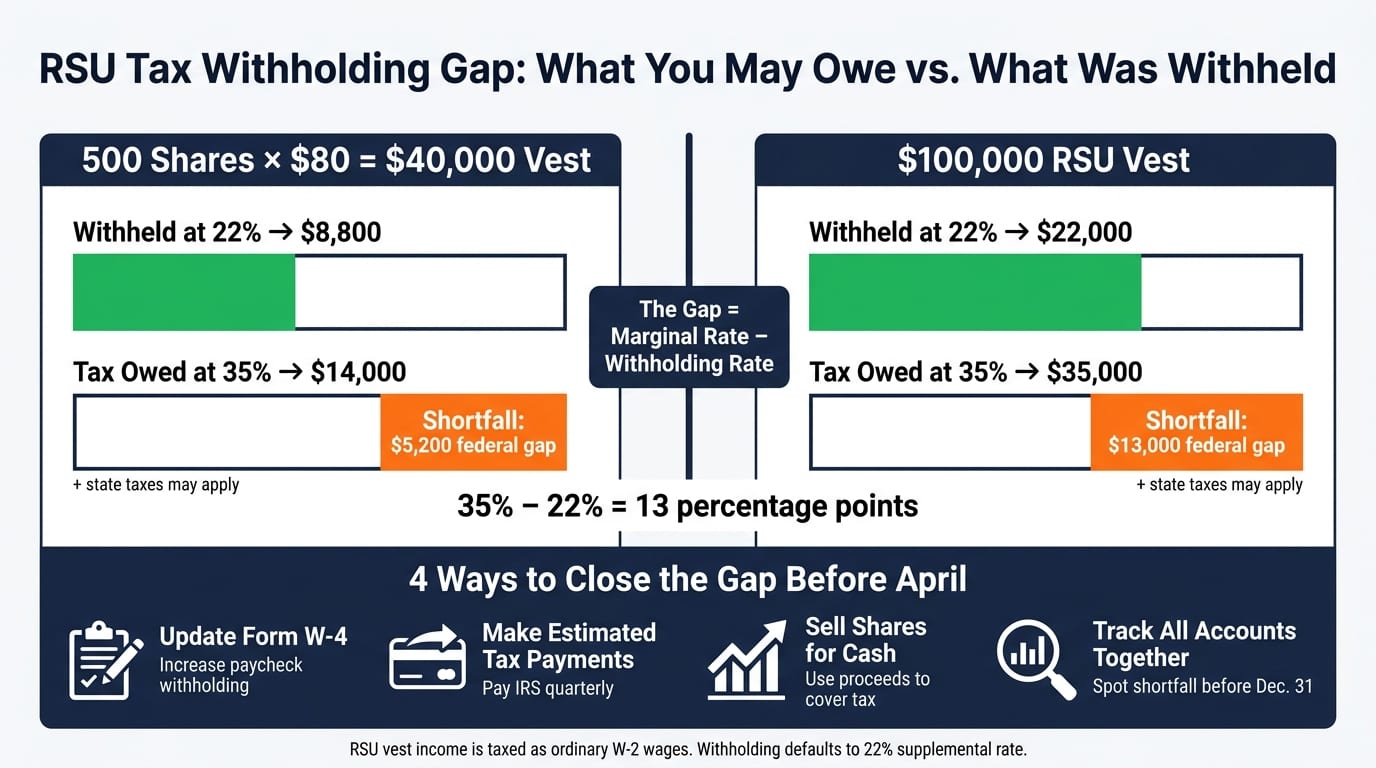
- 500 shares × $80 = $40,000 of taxable vest income
- 22% withholding = $8,800
- 35% federal tax = $14,000
- Possible federal gap = $5,200, before state tax
That’s the core issue: withholding may happen, but it may not match what you may owe.
This article breaks down how the mismatch may happen, how to estimate it, and which year-end moves some people consider before filing season.
How RSU Taxes Actually Work at Vest
What Gets Taxed on Vest Day
When your RSUs vest, the IRS treats the market value of those shares as ordinary W-2 wages.
Here’s the simple version: if 500 shares vest when the stock trades at $80, that adds $40,000 to your taxable wages for the year. The vest event creates taxable income right away. The tax clock starts that day.
That said, the amount withheld at vest may cover only part of what you may end up owing.
What May Already Be Covered vs. What May Still Be Due
Your employer typically adds the vest value to payroll and withholds:
- Federal income tax at the supplemental wage rate
- Social Security, until you reach the annual Social Security wage base
- Medicare
- Any state or local tax
That withholding may cover part of the bill, but your final tax bill may still be based on your total annual income and your marginal tax rates. That’s often where the gap shows up.
For example, if your salary and bonus already place you in the 35% federal bracket, but your RSUs were withheld at 22%, about 13 percentage points may still be due at tax time. On a $40,000 vest, that may mean a $5,200 federal tax gap before state taxes are included.
Why Multiple Vest Events Make the Gap Bigger
If you have more than one vest event during the year, the same mismatch may happen again and again. That may make the annual shortfall easier to spot, and it may add to year-end cash-flow pressure.
The next step may be estimating how large that gap may be before tax time.
How to Estimate Your RSU Withholding Gap
A Simple Example: $100,000 Vest in the 35% Bracket
Here’s a fast way to estimate the gap before year-end.
If $100,000 of RSUs vest, 22% withholding would take out $22,000. If your marginal federal rate may be 35%, the federal tax on that income may be about $35,000. That may leave a $13,000 gap.
That’s the point of the example: the shortfall may be bigger than people expect.
How to Check Whether You May Owe More by April
A quick estimate may take three steps:
- Add projected salary, bonus, and RSU vests through Dec. 31.
- Add year-to-date federal and state withholding, including tax withheld from sell-to-cover sales.
- Compare that total with your estimated tax liability.
This won’t give you a perfect answer, but it may give you a useful read on whether a gap is starting to form.
Why Seeing All Your Accounts Together Matters
Your RSU tax data may be spread across payroll, equity portals, and brokerage accounts.
Vest income may flow through payroll. Sell-to-cover transactions may show up in an equity portal. Later share sales may appear in a brokerage account.
When that data stays scattered, underpayment may stay hidden until you file. Seeing those pieces together may make it easier to spot underwithholding early.
Once you can see the full picture, the next step may be deciding how to close the gap.
How a $200K RSU Vest Turned Into a $20,000 Surprise Tax Bill?
4 Ways to Close the Gap Before Tax Time
If your estimate shows a shortfall, there may be a few moves to use before year-end. In many cases, these steps may narrow the gap before April.
Raise Paycheck Withholding on Form W-4
One option may be to increase your regular paycheck withholding on Form W-4. That may help cover the RSU tax gap before April.
If extra withholding still may not cover the full amount, estimated tax payments may cover the rest.
Make Quarterly Estimated Tax Payments on RSU Income
If paycheck withholding may not fully cover the gap, another path may be to make quarterly estimated tax payments directly to the IRS.
This approach may help keep payments current through the year. It may also reduce the chance of underpayment penalties, which may add to the amount due in April.
Sell Shares to Raise Cash and Reduce Concentration
If you plan to sell vested shares, it may make sense to first confirm that you’re allowed to sell. Then, some people use part of the proceeds to cover the tax gap and reduce concentration in company stock.
That may leave less tax pressure in April while also lowering stock exposure at the same time.
Build an Ongoing RSU Tax System With Mezzi
Those three moves may work best when you can see your year-end numbers before Dec. 31. Mezzi puts that view in one place. Once you know the gap, the next step may be tracking the numbers tied to it.
Track Vests and Concentration in One Place
Mezzi connects to your brokerage, retirement, and taxable accounts through read-only access, so you may monitor RSU-related income and employer stock exposure across your full household portfolio. If vested shares and other employer stock sit in different accounts, concentration may be harder to spot. Mezzi's X-Ray feature shows employer stock overlap across accounts. That may make it easier to act before Dec. 31.
Use AI-Driven Guidance to Decide What to Do Next
Once your accounts are connected, Mezzi may flag possible underwithholding when year-end numbers show a shortfall. If a gap shows up, Mezzi may suggest next steps like updating Form W-4 or making an estimated payment. It reads your accounts but does not move money or place trades. The main idea is to watch the right numbers before Dec. 31.
Key Numbers to Watch Before December 31
Checking these numbers before Dec. 31 may give you time to act. Waiting until April may leave fewer options and may add underpayment penalties.
This article is for informational purposes only and does not constitute tax, legal, or investment advice. Tax rules are complex and individual situations vary. Please consult a qualified tax professional for guidance specific to your circumstances.
FAQs
Why are my RSUs withheld at 22% if I'm in the 35% bracket?
Employers often withhold federal tax on RSUs at the flat 22% supplemental wage rate, even when your actual marginal tax bracket may be 35%.
That may create a gap. The withholding at vest may not fully cover your tax liability, so you may owe the difference when you file your annual tax return.
How can I estimate my RSU tax shortfall before year-end?
Compare your employer’s flat RSU withholding rate - often 22% - with your actual marginal tax bracket, which may be 35%. That side-by-side check may help you estimate whether there’s a likely shortfall.
If you want to cover that gap before year-end, some people increase paycheck withholding, make estimated tax payments, or sell shares and set aside cash. A consolidated view of vest events across accounts may also make it easier to track what’s happened and what may still be coming.
Can RSU underwithholding trigger IRS penalties?
Yes. If your employer withholds only the flat 22% supplemental rate on RSUs, but your actual tax rate may be higher, you may owe more when you file your tax return.
That gap may also lead to an IRS underpayment penalty if it isn't covered during the year through estimated tax payments or higher paycheck withholding.
Disclosures:
- This content is for informational purposes only and does not constitute investment advice or a recommendation to buy or sell any security.
- Tax rules are complex and individual situations vary. Please consult a qualified tax professional for guidance specific to your circumstances.
- Past performance is not indicative of future results. No guarantee of future performance or outcomes is implied.
Related Blog Posts
- Should you sell RSUs when they vest? A tax-aware framework
- How to Close the RSU Withholding Gap Before December
- The RSU Cost-Basis Double-Tax Trap on Form 1099-B
- Cross-Border Equity Comp: RSUs When You Work in the US on a Visa
Employers often withhold federal tax on RSUs at the flat 22% supplemental wage rate, even when your actual marginal tax bracket may be 35%.
That may create a gap. The withholding at vest may not fully cover your tax liability, so you may owe the difference when you file your annual tax return.
Compare your employer’s flat RSU withholding rate - often 22% - with your actual marginal tax bracket, which may be 35%. That side-by-side check may help you estimate whether there’s a likely shortfall.
If you want to cover that gap before year-end, some people increase paycheck withholding, make estimated tax payments, or sell shares and set aside cash. A consolidated view of vest events across accounts may also make it easier to track what’s happened and what may still be coming.
Yes. If your employer withholds only the flat 22% supplemental rate on RSUs, but your actual tax rate may be higher, you may owe more when you file your tax return.
That gap may also lead to an IRS underpayment penalty if it isn't covered during the year through estimated tax payments or higher paycheck withholding.