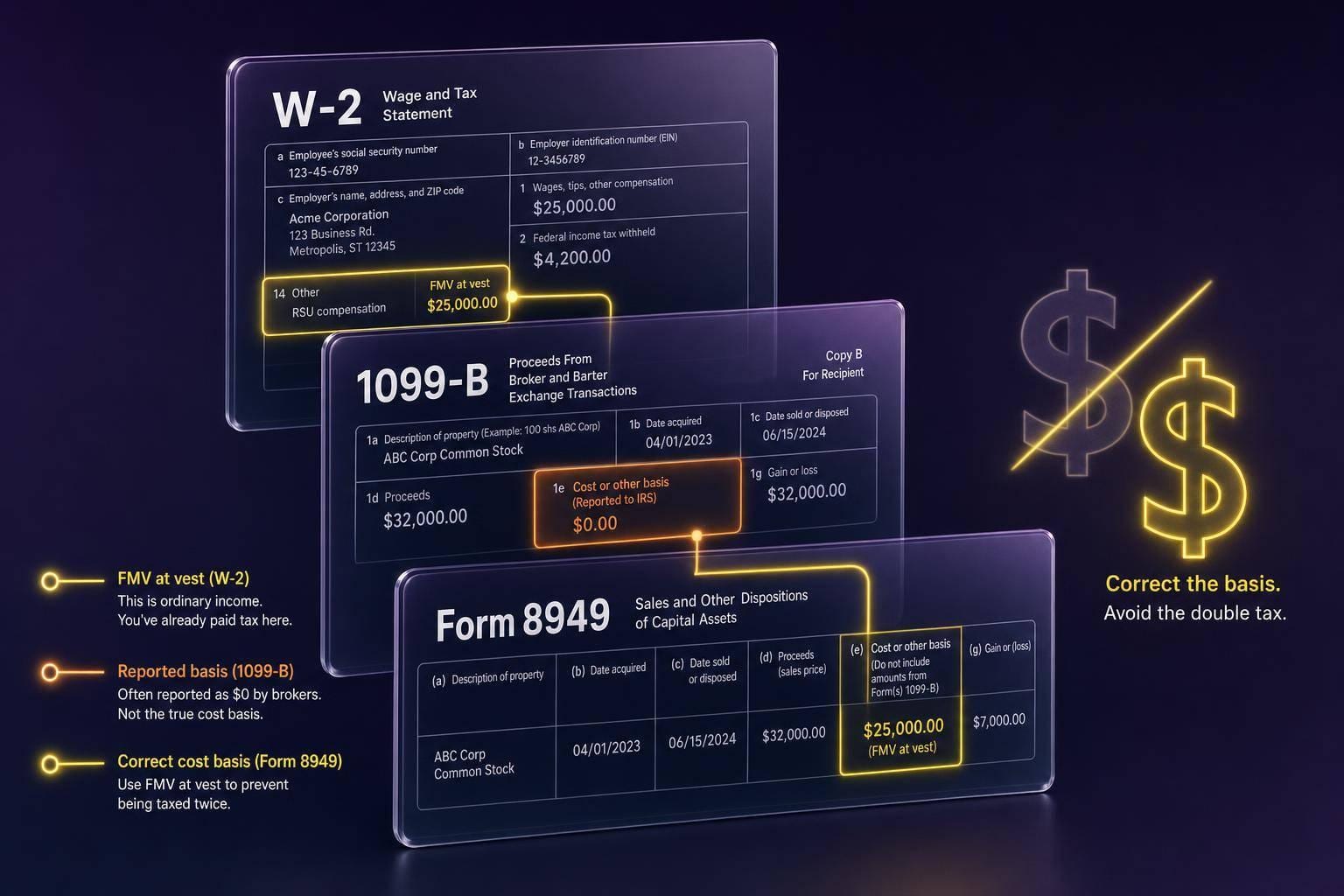
If your 1099-B shows a $0 RSU cost basis, part of your stock income may be taxed twice. For many people, the fix may come down to one step: match each sale to the vest-date fair market value already included in W-2 wages, then report any basis correction on Form 8949.
Here’s the short version:
- RSUs may trigger two tax events: wage income at vesting, then capital gain or loss at sale.
- Your starting basis may be the stock’s value on the vest date.
- Your 1099-B may show $0 or only part of that basis.
- If you file the 1099-B number as printed, your gain may be overstated.
- The mismatch may be fixed on Form 8949, then flow to Schedule D.
- Sell-to-cover shares, partial sales, and multiple vesting lots and past sales may need extra care.
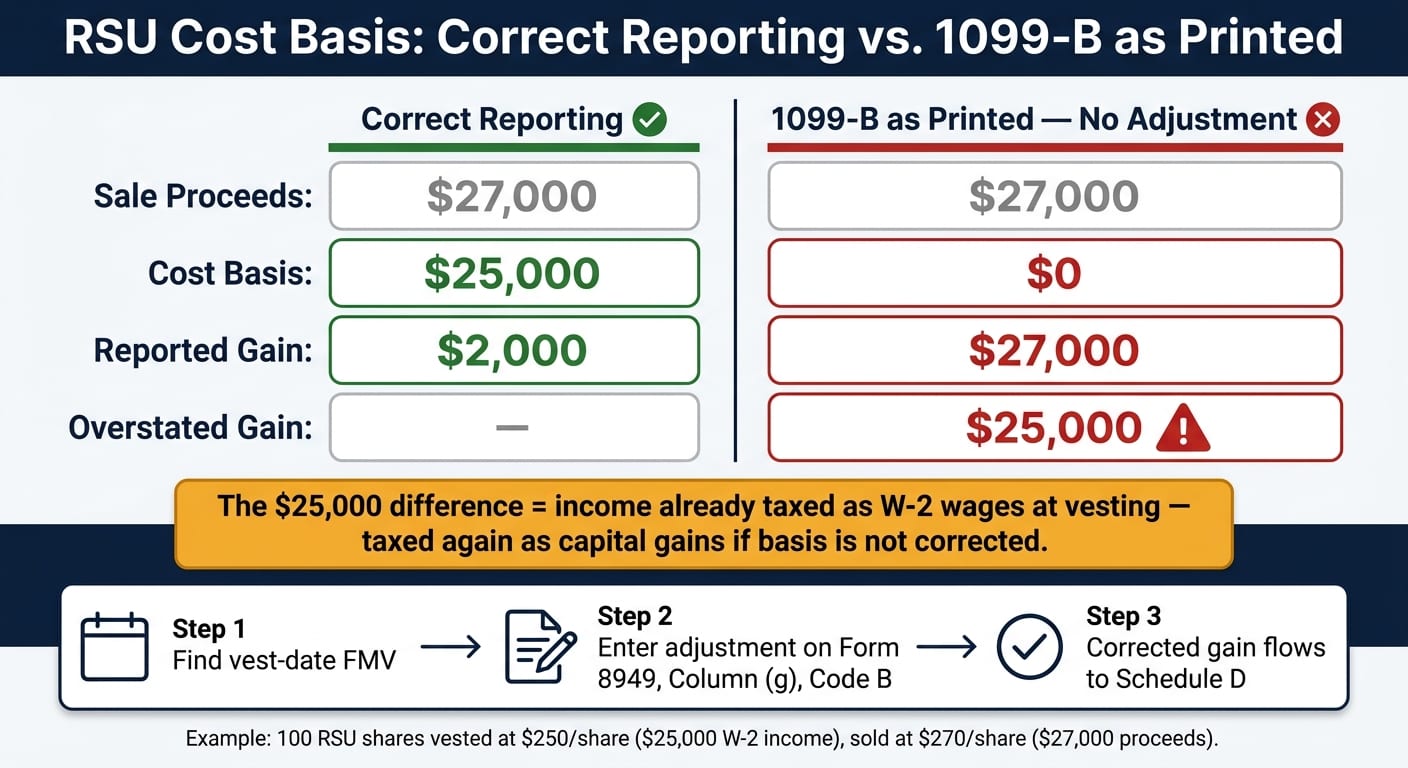
A simple example shows the issue fast: if 100 shares vest at $250 per share, $25,000 may already be taxed through your W-2. If you later sell for $27,000, your taxable gain may be only $2,000. But if the 1099-B shows a $0 basis, the sale may look like a $27,000 gain instead.
What I’d check first:
- the vest date
- the share count
- the vest-date FMV
- the W-2 wage amount
- any brokerage adjusted-basis supplement
This article breaks down where the mismatch may start, what numbers to line up, and how some filers report the correction before filing.
RSU Cost Basis Reporting 2026: Form 8949, Code B & The "Zero Basis" Error
How the RSU double-tax trap shows up in real filings
What gets taxed at vesting versus what gets taxed at sale
RSUs may create two tax events. Vesting may add wages, and the later sale may create a capital gain or loss only on the change in value after vesting.
The filing issue often shows up when the 1099-B basis does not include the vested value that was already taxed as wages. When that happens, too much of the sale may look like a new gain. If the stock barely moved, the taxable gain at sale may be small or even zero. But if the basis is missing, the full proceeds may appear taxable.
Common reporting patterns that trigger the error
In many cases, the mismatch shows up as a 1099-B basis that does not line up with W-2 income. The issue often starts with how brokerages report RSU sales. A brokerage may list the sale record but not the vested value that was already taxed as wages.
These patterns often lead to overreporting:
- Incomplete basis: The 1099-B may show $0, or only part of the vested value, which may make too much of the sale look taxable.
- Sell-to-cover: Shares sold at vesting for withholding may appear as separate 1099-B sales with the same basis issue.
- Multiple tranches: RSUs that vest in stages each have their own vest-date FMV. If lots get mixed up, or the wrong FMV gets tied to the wrong tranche, errors may stack up over time.
How $25,000 gets taxed twice
Suppose 100 RSU shares vest when the stock price is $250 per share. The total vested value - $25,000 - may be reported as ordinary income on your W-2. That would generally make your cost basis $250 per share.
Six months later, suppose you sell all 100 shares at $270 per share, for total proceeds of $27,000. Your actual taxable gain may be $2,000 ($27,000 − $25,000).
But if your 1099-B shows a $0 basis and you file it as printed, the IRS may see a $27,000 capital gain instead. In that case, ordinary income tax may already have applied to $25,000 of that amount, and the same $25,000 may now be treated as taxable again for capital gains purposes. The problem may not be the sale itself. The problem may be reporting the vested shares as though they had a $0 basis.
That adjustment may belong on Form 8949, not on the unedited 1099-B. The next step may be matching each sold lot to its vest date, share count, and FMV before filing.
What to verify before you file your return
Use this checklist to reconcile the 1099-B basis before filing. Before you file, match each RSU sale on Form 1099-B to its vesting date, share count, and vest-date FMV, and confirm that income was already captured on your W-2.
Match each sold lot to its vest date, share count, and vest-date fair market value
Use the same logic from the example: confirm the vested value, then correct the basis. Pull your stock plan statement and any brokerage supplement, then match each sold lot to its vest date, share count, and vest-date FMV. That FMV may be the correct basis for the sale. Then confirm that same value may have already flowed through payroll.
Confirm the vested value was already included in W-2 wages
Verify the vest amount appears in wages. Check the pay stub on or near each vest date for a line item such as "RSU" or "Restricted Stock." That amount may appear in taxable wages.
It also may help to cross-check the year's total RSU FMV against year-to-date taxable wages on your final pay stub. If the numbers do not match, review payroll detail or your year-end stock compensation summary before filing. If the payroll numbers still do not line up, the brokerage supplement may be the next place to confirm the basis.
Check whether the brokerage issued a supplemental adjusted-basis statement
The brokerage supplement may be the document that clears up the mismatch between what the 1099-B reports and what was taxed at vesting. Check it for adjusted basis, then compare it with the reported basis, vest date, and sale price shown on Form 1099-B. Those figures may be used to correct Form 8949.
How to fix an incorrect RSU basis on Form 8949
Once you match the lot to the vest-date FMV, the fix usually moves to Form 8949, which then flows to Schedule D.
Report the sale and adjust basis to vest-date FMV
Report the sale as shown, then adjust column (g) for the difference between the broker basis and the vest-date FMV. Use the acquisition date that applies to the lot, which may often be the vest date. Pull proceeds from column (d) and the broker-reported basis from column (e), then enter the adjustment in column (g), often with code "B."
Here’s how that may look with actual numbers: 1,000 RSU shares vest on March 1, 2025, at an FMV of $25 per share. Your employer reports $25,000 as ordinary wages on your W-2. Later, you sell all 1,000 shares at $28, so the 1099-B shows $28,000 in proceeds and a $0 basis. On Form 8949, you enter a $25,000 adjustment in column (g) with code "B." That gives you a corrected basis of $25,000, and the taxable gain on Schedule D may drop to $3,000 - just the post-vest price move from $25 to $28.
Handle partial sales, multiple tranches, and sell-to-cover shares carefully
A single-lot sale may be simple. Split lots take more care.
If you sell only part of one vesting tranche - say, 400 of 1,000 shares that vested at a $40 FMV - your corrected basis for that sale may be $16,000 (400 ÷ 1,000 × $40,000). The other 600 shares keep a $40-per-share basis for any later sale. Skip that proration, and your gain may be overstated.
If one trade pulls shares from more than one vest date, split the sale into separate Form 8949 lines, one for each tranche. Use the broker’s lot detail to see how many shares came from each vest date, allocate proceeds by share count, and apply each tranche’s own vest-date FMV as the corrected basis.
For sell-to-cover shares, that same vest-date FMV still applies as the per-share basis, even if those shares were sold right away at vesting. If the broker reports a $0 basis on those shares too, the same column (g) adjustment may apply.
Use software and account-level data to cut manual errors
Software may help cut lot-by-lot mistakes. Most tax software lets you import 1099-B data straight from your brokerage, which may reduce typing mistakes on proceeds, dates, and share counts. After the import, you may often override the cost basis field or enter an adjustment amount with the matching code.
Use the supplemental basis statement to confirm the per-lot number before you enter Form 8949. Mezzi may connect read-only to brokerage and payroll data and surface lot-level detail, RSU vest histories, and basis mismatches.
Conclusion: A filing checklist to catch the RSU double-tax trap before you file
Before you file, run this last check against your W-2, 1099-B, and brokerage supplement.
Use this checklist to review the 1099-B before filing.
If any line doesn’t match, you may want to fix the basis on Form 8949 before filing.
If the 1099-B shows a $0 basis and the adjustment is skipped, you may pay ordinary income tax at vesting and capital gains tax on the same dollars at sale. That’s the trap.
Your Form 8949 should reflect only post-vest gain.
FAQs
How do I know if my RSU basis is wrong on Form 1099-B?
Check whether the cost basis on Form 1099-B shows $0 or only the discounted purchase price, instead of the fair market value on the vesting date.
Brokers may leave out income that may already have been taxed as W-2 wages. Because of that, it may make sense to compare the reported basis with your own records.
The basis that may apply here would equal the shares’ total fair market value on the vesting date. If the amount on Form 1099-B does not match that figure, an adjustment on the tax return may be needed to avoid double taxation.
What if I sold only some of my vested RSU shares?
If you sell only some vested RSU shares, you may need to track the cost basis for the exact tax lots you sold. For each share, the cost basis may be the fair market value on its vesting date.
Form 1099-B may show an incomplete cost basis. If that happens, some people adjust it to include the amount that was already taxed as ordinary income on the W-2. Without that adjustment, the same income may be taxed twice.
Do sell-to-cover RSU shares need a basis adjustment too?
Yes. When RSUs vest, their fair market value may be taxed as ordinary income and reported on your W-2.
But Form 1099-B may show a cost basis of $0 or only part of the amount. Since the vest-date value may have already been taxed, you may need to adjust the basis to the full fair market value to avoid being taxed twice on those shares.
Disclosures:
- This content is for informational purposes only and does not constitute investment advice or a recommendation to buy or sell any security.
- Tax situations can be complex and individual circumstances may vary. Consult a qualified tax professional for personalized advice.
- Past performance is not indicative of future results. No guarantee of future performance or outcomes is implied.
Related Blog Posts
- Should you sell RSUs when they vest? A tax-aware framework
- Sell RSUs at Vest or Hold? The Concentration-vs-Tax Tradeoff
- Double-Trigger RSUs at a Pre-IPO Company: The Tax Time Bomb at Liquidity
- Cross-Border Equity Comp: RSUs When You Work in the US on a Visa
Check whether the cost basis on Form 1099-B shows $0 or only the discounted purchase price, instead of the fair market value on the vesting date.
Brokers may leave out income that may already have been taxed as W-2 wages. Because of that, it may make sense to compare the reported basis with your own records.
The basis that may apply here would equal the shares’ total fair market value on the vesting date. If the amount on Form 1099-B does not match that figure, an adjustment on the tax return may be needed to avoid double taxation.
If you sell only some vested RSU shares, you may need to track the cost basis for the exact tax lots you sold. For each share, the cost basis may be the fair market value on its vesting date.
Form 1099-B may show an incomplete cost basis. If that happens, some people adjust it to include the amount that was already taxed as ordinary income on the W-2. Without that adjustment, the same income may be taxed twice.
Yes. When RSUs vest, their fair market value may be taxed as ordinary income and reported on your W-2.
But Form 1099-B may show a cost basis of $0 or only part of the amount. Since the vest-date value may have already been taxed, you may need to adjust the basis to the full fair market value to avoid being taxed twice on those shares.