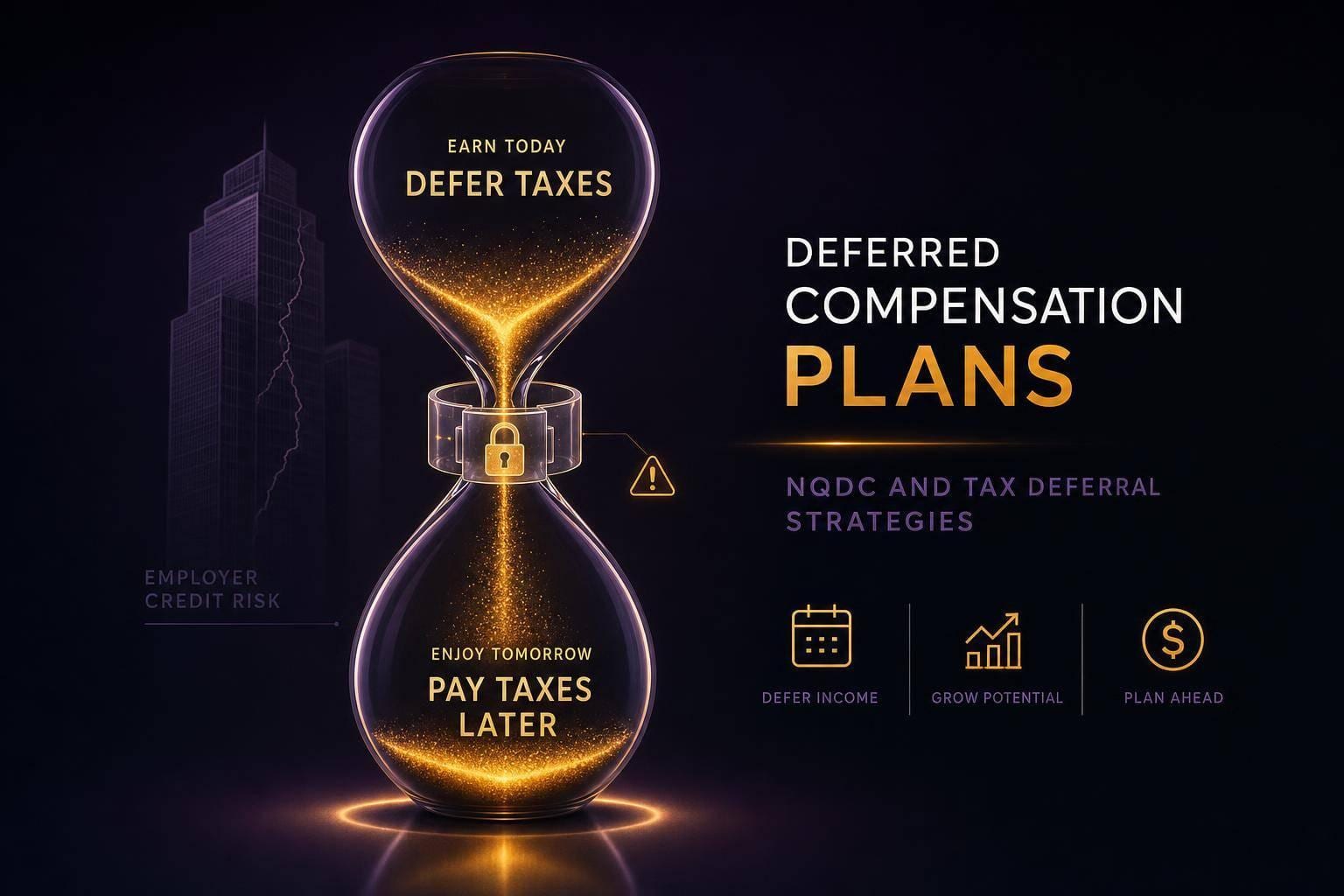
NQDC may let high earners defer more pay than a 401(k), but the tradeoff may be steep: less liquidity, no rollover, and employer credit risk.
If I boil the article down to the core point, it’s this: NQDC may work best when my tax rate later may be lower than it is now, my cash needs may already be covered, and my employer may remain financially sound when payouts arrive. The tax angle may look attractive, but a bad payout schedule, high retirement income, or employer trouble may wipe out much of that upside.
Here’s the short version:
- 401(k) limits stop at $24,500 in 2026 before catch-up, while NQDC has no IRS deferral cap if the plan allows more
- Income tax may be deferred, but FICA taxes are generally due at vesting
- Section 409A rules are strict; mistakes may trigger immediate tax, a 20% extra federal tax, and interest
- NQDC money stays tied to the employer’s general assets, so I may be an unsecured creditor
- Lump-sum payouts may spike taxable income, while 5- or 10-year installments may spread income across lower-tax years for some people
- Roth conversions, RMD timing, brokerage gains, and state moves may all affect whether deferral pays off compared to other retirement tax strategies
- Some people limit NQDC exposure to around 20% to 30% of total compensation to keep single-employer risk in check
Non-Qualified Deferred Compensation (NQDC) - Risks, Rewards & What to Know Before You Elect
Quick Comparison
In other words: NQDC may be less about “more retirement saving” and more about “when do I want this income taxed?” That timing question may matter as much as the deferral itself.
How NQDC Plans Work Under U.S. Tax Rules
Deferral Elections, Plan Credits, and Distribution Schedules
Salary deferrals are generally elected by December 31 of the prior year. Bonuses tied to a performance period of at least 12 months are generally due at least six months before that period ends. In plain English: NQDC may fit best when that election timeline lines up with how you expect your income to look later.
Once pay is deferred, the amount is usually tracked as a bookkeeping balance under the plan. Returns may be measured against benchmarks such as mutual funds or company stock. Common payout setups include a lump sum at separation from service or annual installments that begin on a fixed future date.
Section 409A Rules and What Triggers Tax Problems
Section 409A sets the rules for when pay may be deferred and when the plan may distribute it. In practice, any tax upside may depend on following those rules exactly.
Plans generally may pay only at:
- separation from service
- a fixed date
- death
- disability
- change in control
- a narrow hardship exception tied to severe illness, accident, or casualty loss, rather than routine cash needs
A Section 409A failure may trigger immediate tax on the vested amount, plus a 20% additional federal tax and interest.
If you may access the money without restriction, the IRS generally treats it as received. If the amount remains subject to a real forfeiture risk, tax is generally deferred.
Public-company specified employees generally must wait six months after separation before receiving distributions.
These timing rules shape when a deferral may work and when it may fail.
How NQDC Is Taxed at Contribution, Growth, and Distribution
NQDC may defer income tax now, tax growth inside the plan, and tax the full payout later as ordinary income.
Payroll taxes are generally due when the compensation vests, even if payment comes later. For high earners, this usually matters more for Medicare tax than for Social Security.
With the mechanics laid out, the next question may be how these rules fit into efforts to reduce future tax drag.
Tax Deferral Strategies That Can Make NQDC More Useful
How Much to Defer After Maxing Core Tax-Advantaged Accounts
A simple way to think about NQDC is as the last layer in your savings stack, after a 401(k), HSA, and any IRA contribution you may be able to make.
Once those boxes are checked, the next question is more personal: how much extra income may you comfortably defer? That part matters because NQDC elections are usually locked in for the service year. In plain English, once you choose the amount, you may not have much room to change it. So the size of the deferral may need extra care.
One common framework is to defer enough income to move some current earnings into a lower tax bracket. At the same time, some people cap total NQDC balances at about 20% to 30% of total compensation to limit concentration risk with one employer.
Once the account hierarchy is set, the next step is choosing how much income to defer.
Timing Distributions to Manage Future Tax Brackets
The basic tax idea is simple: defer income from a higher bracket today into a lower bracket later. But that math may only work if future income is actually lower. That's where many executives may get the timing wrong.
A lump-sum payout may create a sharp income spike. That may push income back into a higher bracket or trigger Medicare IRMAA surcharges. Spreading that same payout across five or 10 annual installments may smooth income and may keep more of it in a lower bracket, especially before RMDs begin.
But this approach may not work if retirement income stays high. Pensions, Social Security, RMDs, and other NQDC payouts may keep someone in roughly the same bracket, which may weaken the tax tradeoff.
State residency adds another layer. Under federal law, some installment structures may reduce former-state tax exposure under federal sourcing rules. That may matter more for someone who later moves to a no-tax state like Florida or Texas.
That timing only works when other retirement income does not recreate today's tax bracket.
Coordinating NQDC With Roth Conversions, Brokerage Withdrawals, and Charitable Giving
Coordination matters here. NQDC payouts may be used to fill lower-tax years before RMDs start, and Roth conversions may be placed in that same window. Since NQDC distributions add ordinary income, they may crowd out Roth conversions. So sequencing may shape the outcome.
In some cases, running NQDC installments ahead of RMDs may create a lower-tax window for converting traditional IRA balances to Roth at lower rates.
High-NQDC years may also line up with charitable bunching and a Donor-Advised Fund contribution. In those same years, some people try to avoid realizing extra capital gains in taxable brokerage accounts.
What ties all of this together is one shared view of balances, projected income, and tax exposure across accounts. Without that, gaps may turn a decent distribution schedule into a larger tax bill. That full-picture view may be what separates a useful deferral plan from a costly one.
NQDC vs. 401(k)s and IRAs: Benefits, Limits, and Risks
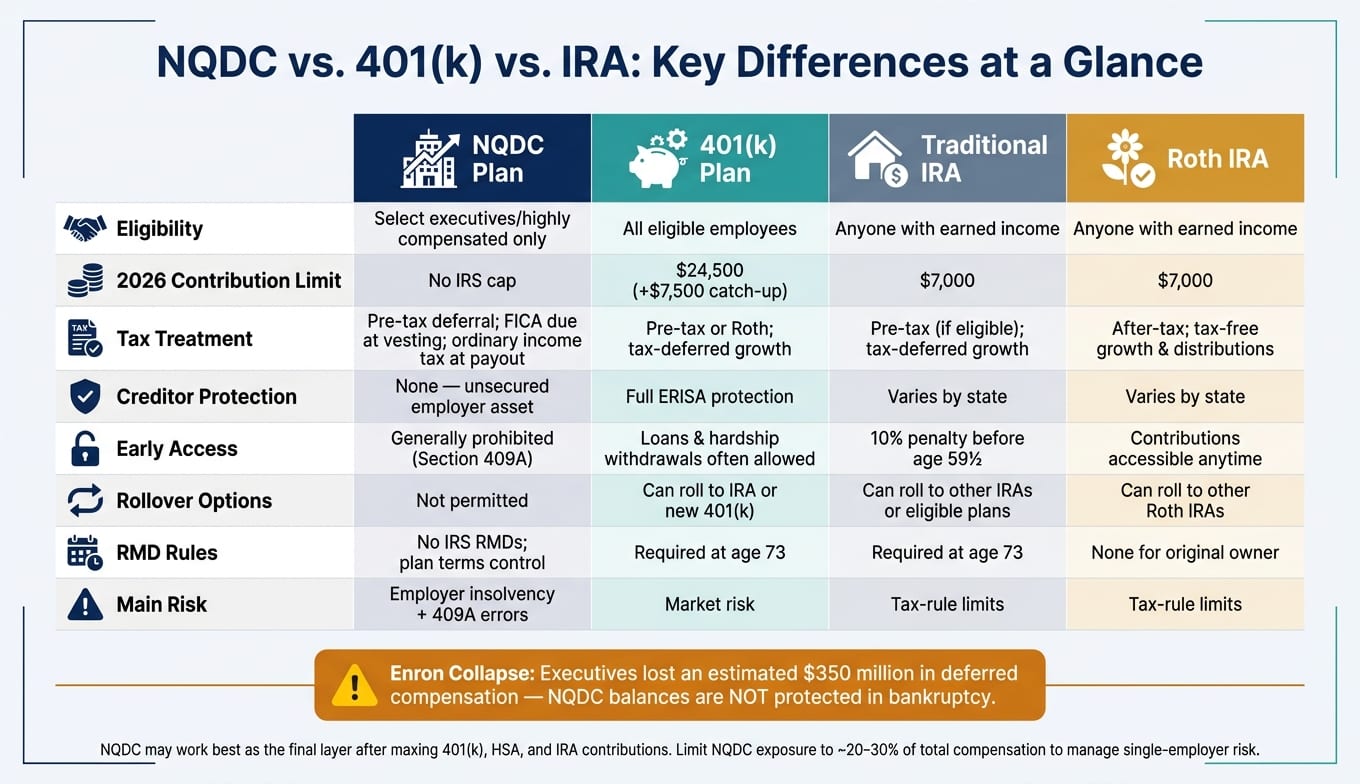
Comparison Table: NQDC, 401(k), Traditional IRA, and Roth IRA
Contribution limits may get the attention, but they’re usually not the main issue here. The bigger differences may show up in creditor protection, access to cash, and payout rules. That’s the tradeoff: tax deferral may look appealing, but it may only make sense if giving up liquidity and protection feels acceptable for your situation.
Pros and Cons Table: When NQDC Helps and When It Can Backfire
Side-by-side, the tradeoff gets easier to see. NQDC may offer tax deferral, but it also may bring more risk and less flexibility.
The employer credit risk may deserve extra attention. Unlike a 401(k), where assets sit in a separate trust under ERISA, NQDC balances stay on the company’s books. If the employer files for bankruptcy, participants may stand in line with other unsecured creditors - not at the front.
Past cases show what that may look like. When Enron collapsed, executives lost an estimated $350 million in deferred compensation.
Where NQDC Fits in a Broader Savings Plan
NQDC may make more sense only after core retirement saving and emergency cash reserves are already covered. In that view, it may fit after core retirement accounts and cash reserves are in place.
Even then, concentration risk may build fast. If salary, bonuses, unvested equity, and deferred compensation all depend on the same employer, exposure to one company may stack up before you know it. The better path may depend on the employer’s stability, your need for liquidity, and how future ordinary income, RMD timing, and cash-flow needs may interact with the deferred balance. If the company’s credit appears weaker, some investors may revisit future deferrals.
Conclusion: How to Evaluate NQDC With a Full-Picture View
After you weigh deferral rules, tax timing, and plan risk, the choice may come down to a few core questions. NQDC may be a useful tax-deferral tool, but only if the tradeoffs make sense. It may fit when your future combined tax rate is lower than today’s, your other cash needs are covered, and the employer remains solvent when the distribution is taxed.
Those questions look simple on paper. The hard part is that the answer may depend on your full income picture.
Three factors may shape whether NQDC works well:
- distribution timing
- your other income in those years
- employer solvency
And none of them stand alone. NQDC may make more sense when you look at it next to your 401(k), IRAs, taxable brokerage assets, and any planned Roth conversions or charitable giving.
That’s where complete account data may matter. Mezzi aggregates accounts in read-only mode, without moving money, so you may get a full household view. From there, its AI-driven analysis may highlight distribution timing, Roth conversion windows, and concentration risk. NQDC may be worth judging as part of a broader tax-deferral plan, not as a stand-alone election.
FAQs
Who should consider an NQDC plan?
An NQDC plan may make the most sense for high-income earners who have already maxed out qualified retirement accounts like 401(k)s and IRAs and want to set aside more for future goals.
It may be a fit for executives or highly compensated employees who expect to be in a lower tax bracket later, or who plan to move to a lower-tax state. It may also suit people who are comfortable giving up some liquidity and accepting employer credit risk.
How do I choose between a lump sum and installments?
It may depend on your need for cash now, taxes, and your employer’s credit risk.
A lump sum gives you full access to the money right away. But the full amount may be taxed at once, which may push you into a higher tax bracket.
Installments may keep the balance growing tax-deferred and may spread taxes over time. In some cases, they may also come with state tax treatment that’s more favorable if payments are spread over 10 or more years.
The tradeoff is pretty simple: you may remain an unsecured creditor of your employer for longer, and that payout choice is usually irrevocable.
What happens to my NQDC if my employer goes bankrupt?
Your NQDC is an unsecured promise from your employer to pay you later.
In plain English, the money may stay part of the company’s general assets until payout. If the company goes bankrupt, you may be treated as a general unsecured creditor.
That puts you behind secured creditors and tax authorities in the line for repayment. As a result, you may recover little - or none - of your balance.
And yes, even assets held in a rabbi trust may still be reached by creditors. So while a rabbi trust may set money aside, it may not fully shield those assets if the employer runs into serious financial trouble.Disclosures:
- This content is for informational purposes only and does not constitute investment advice or a recommendation to buy or sell any security.
- Past performance is not indicative of future results. No guarantee of future performance or outcomes is implied.
Related Blog Posts
- Net Unrealized Appreciation: The 401k Tax Strategy Most People Miss
- Roth or Traditional 401(k)? How High Earners Should Decide
- Deferred compensation: how to track and plan around NQDC plans
- Concentrated Position Management: Collars, Prepaid Forwards, Exchange Funds
An NQDC plan may make the most sense for high-income earners who have already maxed out qualified retirement accounts like 401(k)s and IRAs and want to set aside more for future goals.
It may be a fit for executives or highly compensated employees who expect to be in a lower tax bracket later, or who plan to move to a lower-tax state. It may also suit people who are comfortable giving up some liquidity and accepting employer credit risk.
It may depend on your need for cash now, taxes, and your employer’s credit risk.
A lump sum gives you full access to the money right away. But the full amount may be taxed at once, which may push you into a higher tax bracket.
Installments may keep the balance growing tax-deferred and may spread taxes over time. In some cases, they may also come with state tax treatment that’s more favorable if payments are spread over 10 or more years.
The tradeoff is pretty simple: you may remain an unsecured creditor of your employer for longer, and that payout choice is usually irrevocable.
Your NQDC is an unsecured promise from your employer to pay you later.
In plain English, the money may stay part of the company’s general assets until payout. If the company goes bankrupt, you may be treated as a general unsecured creditor.
That puts you behind secured creditors and tax authorities in the line for repayment. As a result, you may recover little - or none - of your balance.
And yes, even assets held in a rabbi trust may still be reached by creditors. So while a rabbi trust may set money aside, it may not fully shield those assets if the employer runs into serious financial trouble.Disclosures:
- This content is for informational purposes only and does not constitute investment advice or a recommendation to buy or sell any security.
- Past performance is not indicative of future results. No guarantee of future performance or outcomes is implied.