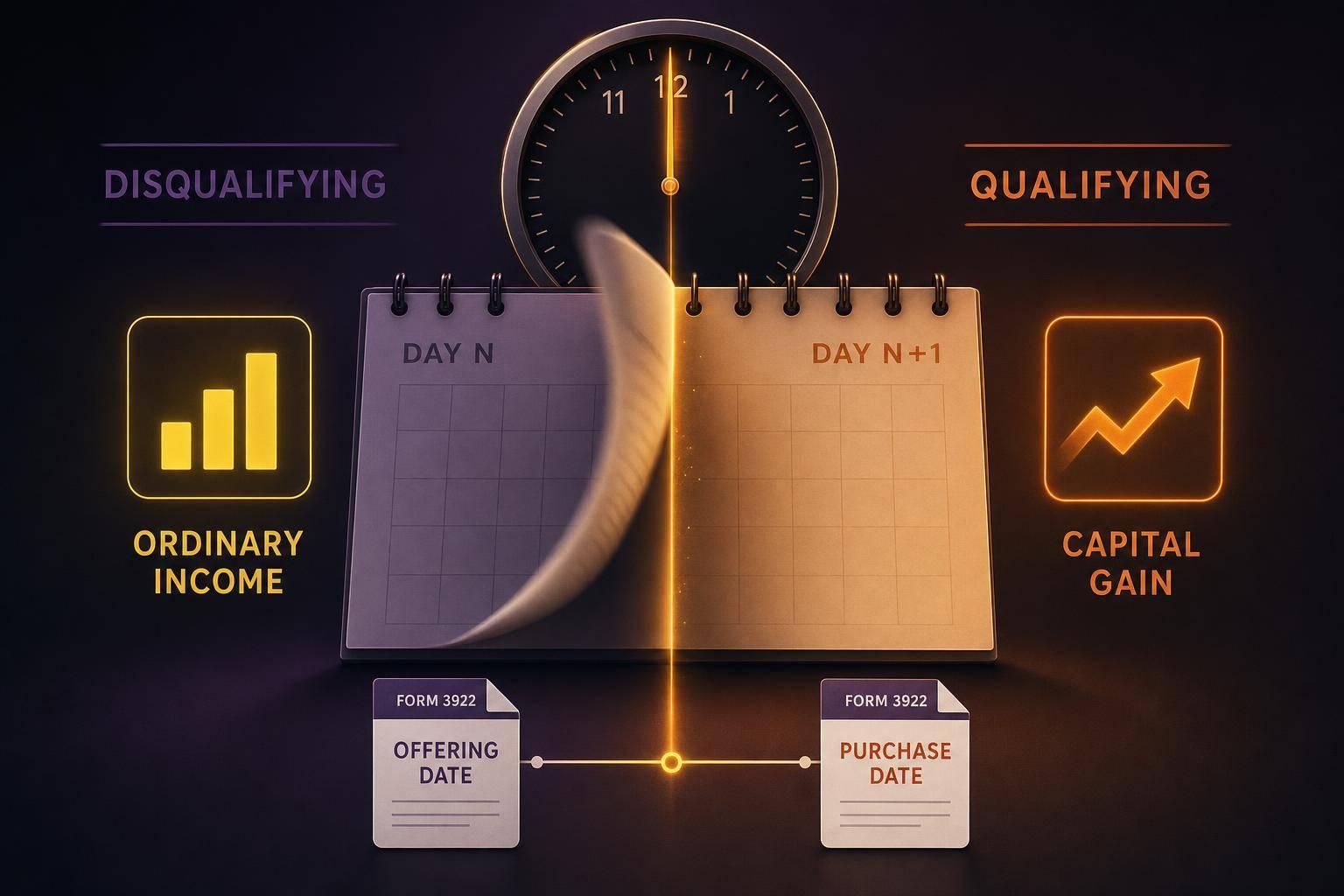
One day may change the tax label on your ESPP sale. For a Section 423 ESPP, a sale may count as qualifying only if it happens more than 2 years after the offering date and more than 1 year after the purchase date. Miss either test, and the sale may be disqualifying.
Here’s the short version: I’d look at three dates first - offering date, purchase date, and sale date. Then I’d use those dates to estimate how much of the sale may be taxed as ordinary income and how much may be treated as capital gain or loss. In many cases, the same total profit may be split very differently for tax purposes depending on timing.
What this article covers, in plain English:
- The two holding-period clocks
Clock 1: more than 2 years from the offering date
- Clock 2: more than 1 year from the purchase date
- How to find those dates on Form 3922
Box 1 = offering date
- Box 2 = purchase date
- Boxes 3, 4, and 5 = prices used in the tax math
- How the tax split may change
Qualifying sale: ordinary income may be the lesser of actual gain or the offering-date discount
- Disqualifying sale: ordinary income may be the lesser of actual gain or the purchase-date spread
- Why waiting may change the result
Selling after just one clock may still leave the sale disqualifying
- Selling after both clocks may move more of the gain into long-term capital gain treatment for some people
- Why lookback plans matter
A lookback may make the purchase-date spread much larger
- That may make early sales more heavily taxed as ordinary income
A simple example from the article shows the point. If the offering date is 01/01/2024 and the purchase date is 06/30/2024, the earliest qualifying sale date may be 01/02/2026 - not 01/01/2026 - because the rule uses more than 2 years, not just 2 years.
Quick Comparison
If I were trying to classify an ESPP sale fast, I’d start with this rule: find both cutoff dates, take the later one, then move one day past it. That may give you the first date a sale may qualify under the federal holding-period rules.
The dates and rules that classify an ESPP sale
Before you do any holding-period math, you need three dates: your offering date, your purchase date, and your sale date. Each one has its own job in how the IRS may classify the sale.
Offering date, purchase date, and sale date
Your plan documents may use different labels for these dates. This table maps the common terms so you can line them up.
The offering date starts the 2-year clock. The purchase date starts the 1-year clock. The sale date, also called the disposition date, decides whether those tests may have been met.
Where to find these dates on Form 3922
Form 3922 lists the dates the IRS may use to test the sale.
These are the dates you use in the holding-period math below.
The IRS rule in plain English
A sale may be treated as qualifying only if it clears both holding periods: more than 2 years from the offering date and more than 1 year from the purchase date. If either deadline isn’t met, the sale may be treated as disqualifying.
Those dates may also affect how much of your profit is treated as ordinary income and how much is treated as capital gain.
Next, those same dates control how the discount and any extra gain may be taxed.
Qualifying vs. disqualifying dispositions: side-by-side tax treatment
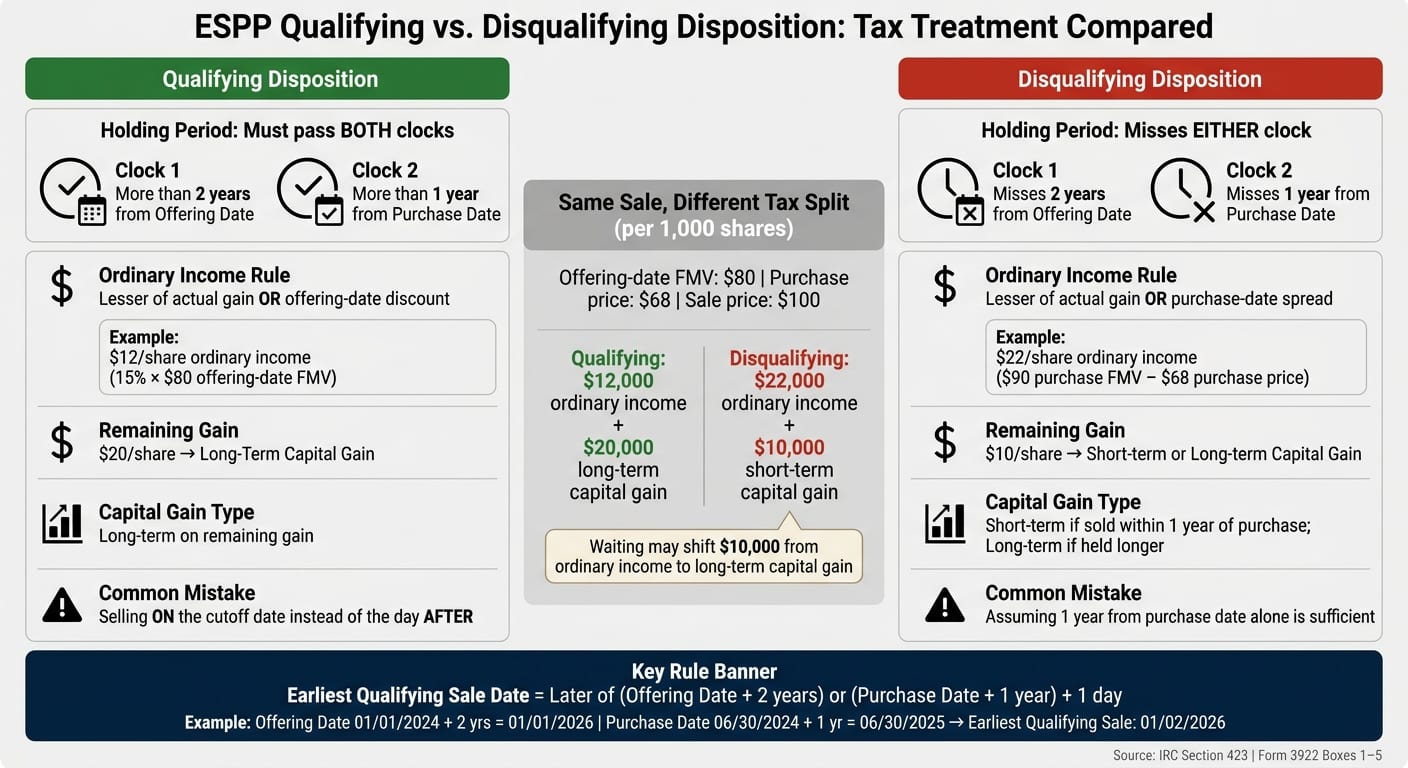
Once you have the Form 3922 dates, the type of disposition may shape how much of your ESPP profit is taxed as ordinary income and how much may fall under capital-gain rules.
How ordinary income is calculated in a qualifying disposition
In a qualifying disposition, the IRS uses a lesser-of rule. Ordinary income is the smaller of:
- the actual gain on the sale
- the discount tied to the offering-date price
Here’s how that may look in practice. Your company offers a 15% discount, the stock is $80 on the offering date, and you pay $68 per share. Later, you sell for $100.
The offering-date discount is 15% × $80 = $12 per share. Your actual gain is $100 − $68 = $32 per share. Since the lower amount is $12, only $12 per share may be treated as ordinary income. The remaining $20 per share may be treated as long-term capital gain.
That setup may lead to lower tax for some people, since more of the profit may fall into long-term capital-gain treatment instead of ordinary income.
How ordinary income is calculated in a disqualifying disposition
A disqualifying disposition starts from a different place: the purchase-date spread. Ordinary income equals the lesser of the purchase-date spread or your actual gain.
Using the same example, assume the stock is $90 on the purchase date. The purchase-date spread is $90 − $68 = $22 per share. That amount may be treated as ordinary income. If you then sell at $100, the extra $10 per share ($100 − $90) may be capital gain. It may be short-term if sold within 1 year of purchase, or long-term if held for more than 1 year after purchase.
Why the same sale profit can be taxed differently
The split matters because ordinary income is taxed at your marginal federal income-tax rate, while long-term capital gains are generally taxed at 0%, 15%, or 20% federally, depending on income.
In the example above, a qualifying disposition produces $12,000 of ordinary income and $20,000 of long-term capital gain on 1,000 shares. A disqualifying disposition on the same trade produces $22,000 of ordinary income and only $10,000 of short-term capital gain.
For a high earner, that shift may increase federal tax liability, since more of the value may be taxed at ordinary-income rates instead of capital-gain rates.
Next, turn these formulas into actual sale dates.
Holding-period math for common ESPP sale scenarios
How to calculate the earliest qualifying sale date
To find the earliest qualifying sale date, calculate both cutoffs and use the later one:
- Add 2 years to the offering date → Date A
- Add 1 year to the purchase date → Date B
The later of Date A and Date B is the last cutoff date. The earliest qualifying sale date is the next day.
Offering date 01/01/2024 + 2 years = 01/01/2026; purchase date 06/30/2024 + 1 year = 06/30/2025; earliest qualifying sale = 01/02/2026.
Three hypothetical sale timelines compared
Once you have the cutoff date, the next step is looking at how the tax split may change if a sale happens before or after it.
Using the same lot - offering-date FMV of $40.00, purchase-date FMV of $50.00, purchase price of $34.00 (15% discount with lookback), and a sale price of $55.00 - here’s how three sale dates may change the tax treatment:
The total gain per share is $21.00 in every scenario ($55.00 − $34.00). What may change is how much of that $21.00 may be taxed as ordinary income versus capital gain. Waiting until 01/02/2026 may shift $10.00 per share from ordinary income to long-term capital gain.
There’s one detail that trips people up. Scenario 2 (07/01/2025) is still a disqualifying disposition even though the shares were held for more than a year from purchase. The capital gain on post-purchase price movement may become long-term, but the full purchase-date spread remains ordinary income. Meeting only one clock does not change that ordinary-income amount.
How a lookback feature raises the tax stakes
A lookback may widen the spread that may be treated as ordinary income if the shares are sold too soon.
Here’s the basic idea: a lookback uses the lower of the offering-date or purchase-date FMV, then applies the plan discount. If the stock moves up between the offering date and the purchase date, the purchase price is based on the lower FMV. That may create a bigger gap between what you paid and what the stock was worth on purchase day.
That wider gap is what may be taxed as ordinary income in a disqualifying sale. Take a plan where the offering-date FMV is $30.00, the purchase-date FMV rises to $50.00, and the 15% discount applies to the lower price: purchase price = 85% × $30.00 = $25.50. The purchase-date spread is $50.00 − $25.50 = $24.50 per share of potential ordinary income in a disqualifying sale. Without a lookback, the discount would apply to the purchase-date FMV, making the purchase price $42.50 and the spread only $7.50 per share - a much smaller ordinary-income amount.
The more the stock rises before purchase, the larger the ordinary-income amount may be if the shares are sold early. That same feature may work in your favor on a qualifying disposition, where ordinary income is capped at the smaller offering-date discount, but it may be costly if the sale happens before both clocks are met.
Decision framework: sell now or wait for qualifying treatment
Once you know the cutoff date, the tradeoff may come down to tax savings vs. risk.
Waiting may reduce the amount taxed as ordinary income. But waiting also may leave you exposed to a single stock for longer and may delay access to cash. That’s the core decision: compare the possible tax benefit of waiting with the risk you take by holding.
A simple way to think about it: estimate how much tax you may save by waiting, then compare that with the possible downside if the stock drops before the qualifying date. If the stock may fall by more than the tax savings from waiting, an earlier sale may make more sense for some people. Concentration matters too, especially when both your paycheck and your ESPP shares are tied to the same employer.
A checklist to run before selling ESPP shares
Before picking a sale date, it may help to review these inputs:
- Dates and basis: offering date, purchase date, purchase price, and FMV on both dates
- Expected sale price: use a realistic range, not just the current quote
- Whether your plan includes a lookback: this may increase the purchase-date spread and the ordinary-income amount in a disqualifying disposition
- Your employer-stock concentration: estimate employer stock as a percentage of your total investable assets
- Cash needs: if you may need liquidity soon, that may outweigh the tax benefit of waiting
If your ESPP lots are spread across multiple accounts or purchase periods, it may be easy to lose track of dates and cost basis. Mezzi is designed to organize ESPP lots across accounts, track key dates and cost basis, and model the tax impact of selling now versus waiting.
Key takeaways
Qualifying treatment requires both clocks: more than 2 years from the offering date and more than 1 year from the purchase date. Miss either one, and more of the spread may be taxed at ordinary-income rates.
The information in this article is general educational content about U.S. tax rules and is not individualized tax advice. Tax treatment varies based on your ESPP plan design, personal tax situation, and current IRS rules. Consult a qualified tax professional before making decisions about your ESPP shares.
FAQs
What if I sell on the cutoff date?
To get favorable long-term capital gains tax treatment on your ESPP shares, you may need to hold them more than one year after the purchase date and more than two years from the grant date.
That “more than” detail matters. Selling on the exact cutoff date generally may not meet the requirement. Under IRS rules, the shares typically need to be held beyond those time marks, so a sale on that day may be treated as a disqualifying disposition.
How do I handle multiple ESPP purchase lots?
Track each ESPP purchase lot on its own. For every offering or purchase, note the offering dates, purchase date, share count, purchase price, fair market value, total discount, and any W-2 ordinary income already reported.
When you sell, match the sale to the exact lots sold. Then apply the holding-period test to each lot. A sale may be qualifying if it happens more than two years after the offering date and more than one year after the purchase date. If not, it may be disqualifying.
Cost basis needs a careful check here. If W-2 ordinary income has already been reported for a lot, reconciling basis may reduce the chance of the same income being taxed twice.
Can a qualifying sale still produce a capital loss?
Yes. Meeting the holding-period rules for a qualifying disposition does not guarantee a profit.
If the stock price drops below your cost basis before you sell, the sale may still result in a capital loss. Qualifying status affects how a gain may be taxed if you have one, not whether you have a gain.
Disclosures:
- This content is for informational purposes only and does not constitute investment advice or a recommendation to buy or sell any security.
- Tax treatment varies based on your ESPP plan design, personal tax situation, and current IRS rules. Consult a qualified tax professional before making decisions about your ESPP shares.
- Past performance is not indicative of future results. No guarantee of future performance or outcomes is implied.
Related Blog Posts
- Capital Gains Tax Calculator for Your Investment Portfolio
- How to avoid a concentrated position in your own employer's stock
- 83(b) Election: Should You File One? Tax Timing Explained
- NSOs vs ISOs: The Ordinary-Income-at-Exercise Difference That Surprises People
To get favorable long-term capital gains tax treatment on your ESPP shares, you may need to hold them more than one year after the purchase date and more than two years from the grant date.
That “more than” detail matters. Selling on the exact cutoff date generally may not meet the requirement. Under IRS rules, the shares typically need to be held beyond those time marks, so a sale on that day may be treated as a disqualifying disposition.
Track each ESPP purchase lot on its own. For every offering or purchase, note the offering dates, purchase date, share count, purchase price, fair market value, total discount, and any W-2 ordinary income already reported.
When you sell, match the sale to the exact lots sold. Then apply the holding-period test to each lot. A sale may be qualifying if it happens more than two years after the offering date and more than one year after the purchase date. If not, it may be disqualifying.
Cost basis needs a careful check here. If W-2 ordinary income has already been reported for a lot, reconciling basis may reduce the chance of the same income being taxed twice.
Yes. Meeting the holding-period rules for a qualifying disposition does not guarantee a profit.
If the stock price drops below your cost basis before you sell, the sale may still result in a capital loss. Qualifying status affects how a gain may be taxed if you have one, not whether you have a gain.