
Here’s the short version: with NSOs, tax may start at exercise, not sale. With ISOs, regular federal tax usually may wait until sale, but AMT may still show up in the exercise year if shares are held through December 31.
That split may change the day-one math more than many people expect:
- NSOs: the spread between fair market value and strike price may be treated as W-2 wages
- NSOs: that amount may also face federal withholding, state withholding, Social Security, and Medicare
- ISOs: usually no regular income tax withholding at exercise
- ISOs: the same spread may become an AMT item
- At sale: both option types may shift into capital gain or loss treatment, but the rules may differ
A simple example shows the gap. If 1,000 options have a $5.00 strike price and a $25.00 value at exercise, the $20,000 spread may create ordinary income right away for an NSO. For an ISO, that same $20,000 usually may create no regular tax at exercise, though AMT may still apply.
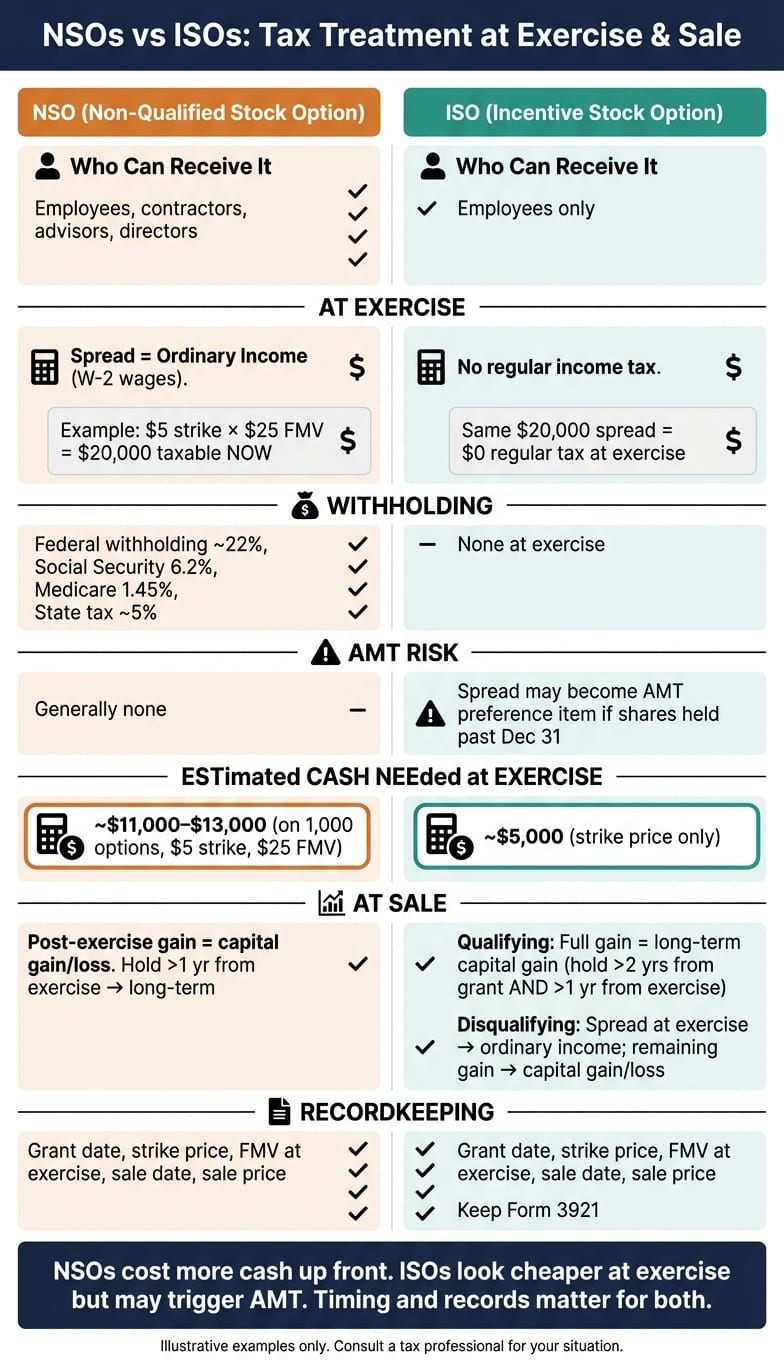
ISOs vs. NSOs Explained: Understanding Your Stock Options
Quick Comparison
Bottom line: if you exercise and hold, NSOs may require more cash up front, while ISOs may look cheaper on day one but still carry a tax risk later. I’d read this piece as a guide to when tax may hit, what may be taxed, and which records may matter when you sell.
NSOs
When you exercise an NSO, the IRS treats the spread - FMV minus strike price - as compensation. The tax event may happen at exercise, not at sale.
What counts as ordinary income at exercise
Ordinary income may equal:
FMV at exercise − strike price.
Here’s a simple example. If your strike price is $10.00 and the stock’s FMV on the day you exercise is $35.00, the spread is $25.00 per share. If you exercise 1,000 shares, that may mean $25,000 of ordinary income - even if you don’t sell any shares that day.
That $25,000 may be reported on your Form W-2 as wages. Put plainly, exercise may be treated as a payroll event, not an investment event.
Why NSOs can cost more cash than you expect
This is where the math may catch people off guard. Using 2,000 shares, a $10.00 strike price, and a $35.00 FMV, the ordinary income may be $50,000:
If you exercise and hold, you may need cash for both the strike price and the tax. Some companies may offer sell-to-cover or share withholding to fund the tax bill. But if you want to keep all the shares, that cash may need to come from somewhere else.
ISOs usually avoid regular tax at exercise, but they may still create AMT exposure.
ISOs
Unlike NSOs, a qualifying ISO exercise usually may not create ordinary income for regular tax. Your upfront cash outlay may be just the strike price plus fees. Because of that, the sale date and holding period may matter more.
Why regular tax is usually not due at exercise
For regular tax, the tax event may be deferred until you sell. If you hold the shares for more than one year after exercise and more than two years after grant, the gain generally may be treated as long-term capital gain. If you sell earlier, part of the spread may be treated as ordinary income. But that’s only part of the story. The exercise-year tax picture may still change because of AMT.
The AMT risk most people miss
The ISO spread may be added to AMTI in the exercise year if you still hold the shares at year-end. That’s the part many people overlook: regular tax may not show up at exercise, but AMT still may.
Form 3921 includes the grant date, exercise date, strike price, FMV, and share count used for AMT and basis tracking. For a large ISO exercise, some people run an AMT estimate first to see what the cash impact may look like.
Next comes the side-by-side cash comparison at exercise.
At exercise: Tax, withholding, and cash compared side by side
Exercise day is where NSOs and ISOs split apart. The same spread may create wages for an NSO, while a qualifying ISO may create no regular-tax income at exercise.
Example 1: Same economics, different tax result
Take 1,000 options with a $5.00 strike price and a $25.00 fair market value at exercise. The spread is $20 per share, or $20,000 total, in both cases. Same economics. Different tax treatment.
For the NSO, that $20,000 may be treated as ordinary income the moment you exercise. It may show up on your W-2 as wages and may be subject to federal income tax, state income tax, Social Security, and Medicare. For an ISO, no regular tax may be due at exercise. AMT may apply if you still hold the shares at year-end. The ISO creates no W-2 income at exercise, though it may create AMT exposure if you still hold the shares at year-end.
*Assumes the Social Security wage base has not already been reached.
What happens next may depend on when you sell.
Where NSOs feel real: withholding and payroll tax
With NSOs, the tax hit may be immediate and may run through payroll. The $20,000 spread may be treated as supplemental wages, so your employer may withhold federal income tax - often at the 22% flat supplemental rate on amounts up to $1,000,000 - plus Social Security at 6.2% and Medicare at 1.45%. On $20,000, that works out to roughly $4,400 in federal withholding and about $1,530 in payroll taxes if the Social Security wage base hasn't already been reached, before state taxes are factored in.
That payroll withholding changes the cash picture. If you exercise NSOs and don’t sell shares right away, you may need outside cash to cover the strike price, withholding, and any state tax. ISOs may look lighter up front by comparison, but that lower day-one cash need may mask an AMT bill that doesn’t show up until filing.
After exercise, sale timing may determine whether the spread is taxed as ordinary income or capital gain.
At sale and ongoing tracking
How sale timing affects whether gains are ordinary income or capital gains
When you sell, NSOs and ISOs split again. After exercise, the timing of the sale may change how much gets taxed as ordinary income and how much may fall under capital gains treatment.
For NSOs, your cost basis per share may generally be the fair market value (FMV) on the exercise date. If you later sell the shares for more or less than that amount, the difference may be a capital gain or capital loss. Hold the shares for more than one year after exercise, and that gain or loss may be long-term. Sell within one year, and it may be short-term.
ISOs follow a different set of rules. Here, the result may depend on two holding-period tests. A qualifying disposition needs both of these:
- More than two years from the grant date
- More than one year from the exercise date
If either test is missed, the sale may become a disqualifying disposition. In that case, the spread at exercise may turn into ordinary income, capped at the lesser of the spread or the actual gain realized. Any extra change in value after exercise may be treated as capital gain or loss.
A side-by-side example makes the split easier to see. Using this 2,000-share example - a $10 strike price, grant on Aug. 13, 2024, exercise on Aug. 13, 2026 at a $30 FMV, and sale on Aug. 13, 2027 at $35 - the tax treatment may look very different:
What to track so basis and taxes stay clean
Once the sale rules are clear, the next step may be recordkeeping. Good basis tracking may make tax reporting a lot less messy.
For each option grant, the minimum records may include:
- Grant date
- Option type
- Strike price
- Number of shares exercised
- FMV on the exercise date
- Withholding amounts
- Sale date
- Sale price
For ISOs, keep Form 3921 too. That form includes the grant date, exercise date, exercise price, and FMV at exercise.
Here’s where people often get tripped up: exercise data may live on one platform, while sale data may sit on another. Basis adjustments tied to NSO exercises or ISO disqualifying dispositions may not move cleanly between systems. If that happens, a broker may show an understated cost basis on Form 1099-B unless the numbers are reconciled.
Mezzi offers read-only connections that keep grant, exercise, basis, withholding, and sale data in one view. That setup may make it easier to avoid basis and reporting errors across tax years.
Key takeaways
- NSOs may create ordinary income at exercise, usually reported on your W-2 and subject to payroll taxes; any change in value from exercise to sale may be capital gain or loss.
- ISOs may create no regular tax at exercise, though the exercise spread may count as an AMT preference item if you hold the shares past year-end.
- ISO sale results may depend on holding periods: qualifying dispositions may get long-term capital gain treatment on the full gain, while disqualifying dispositions may turn the exercise spread into ordinary income.
- Cash and withholding needs may differ a lot: NSOs may require cash for withholding at exercise, while ISOs may seem lighter up front but may still lead to an AMT bill at filing.
- Keep the grant date, option type, FMV at exercise, withholding, sale date, and sale price so basis and reporting errors may be less likely.
FAQs
How do I know if my options are NSOs or ISOs?
Check your grant agreement or equity award letter. It should say whether your options are ISOs or NSOs. You may also find the grant type in your company’s equity portal.
Still not sure? You may want to ask HR or your stock administration team.
One simple clue: ISOs are only granted to employees. NSOs may also be granted to contractors, advisors, and board members.
When does an ISO exercise trigger AMT?
Exercising incentive stock options (ISOs) may trigger AMT if the gap between the exercise price and the stock’s fair market value at exercise gets included in your AMT calculation, and your tentative minimum tax ends up higher than your regular income tax.
That gap may count for AMT even if you haven’t sold the shares yet. So you may owe tax on paper gains - value that exists on paper, but hasn’t turned into cash.
If the shares are sold in the same calendar year as the exercise, that AMT adjustment may not apply.
How much cash might I need to exercise NSOs?
Exercising NSOs may require cash for two separate costs: the strike price and the tax bill that may show up right away.
Here’s the tricky part. The spread between the fair market value and your strike price generally gets treated as ordinary income. That income may be subject to federal, state, and payroll taxes.
So even before you sell any shares, you may owe a meaningful amount. In many cases, employers withhold taxes at exercise, which may create a large upfront cash need.
To deal with that, some people use a cashless exercise or sell-to-cover approach. Those methods are designed to cover some or all of the cost without using personal funds.
Disclosures:
- This content is for informational purposes only and does not constitute investment advice or a recommendation to buy or sell any security.
- Past performance is not indicative of future results. No guarantee of future performance or outcomes is implied.
Related Blog Posts
- Incentive Stock Options: How ISOs Work
- ISO vs NSO: What’s the Difference?
- Different Types of Equity Compensation: RSUs, ISOs, NSOs, ESPP
- Incentive Stock Options and AMT: Exercise Strategy to Minimize Tax
Check your grant agreement or equity award letter. It should say whether your options are ISOs or NSOs. You may also find the grant type in your company’s equity portal.
Still not sure? You may want to ask HR or your stock administration team.
One simple clue: ISOs are only granted to employees. NSOs may also be granted to contractors, advisors, and board members.
Exercising incentive stock options (ISOs) may trigger AMT if the gap between the exercise price and the stock’s fair market value at exercise gets included in your AMT calculation, and your tentative minimum tax ends up higher than your regular income tax.
That gap may count for AMT even if you haven’t sold the shares yet. So you may owe tax on paper gains - value that exists on paper, but hasn’t turned into cash.
If the shares are sold in the same calendar year as the exercise, that AMT adjustment may not apply.
Exercising NSOs may require cash for two separate costs: the strike price and the tax bill that may show up right away.
Here’s the tricky part. The spread between the fair market value and your strike price generally gets treated as ordinary income. That income may be subject to federal, state, and payroll taxes.
So even before you sell any shares, you may owe a meaningful amount. In many cases, employers withhold taxes at exercise, which may create a large upfront cash need.
To deal with that, some people use a cashless exercise or sell-to-cover approach. Those methods are designed to cover some or all of the cost without using personal funds.