
If you're an employee at a startup or fast-growing company, you may have encountered Incentive Stock Options (ISOs) as part of your compensation. These allow you to buy company shares at a fixed price (the "strike price") and may offer tax advantages if handled correctly. Here's what you need to know:
- Key Benefit: ISOs may qualify for lower long-term capital gains tax rates (up to 23.8%) if specific holding periods are met, instead of being taxed as ordinary income (up to 37%).
- Eligibility: Only employees qualify; contractors and consultants do not.
- Rules to Watch:
Must hold shares for at least 2 years from grant and 1 year from exercise for tax benefits.
- Annual exercisable limit capped at $100,000; excess converts to Non-Qualified Stock Options (NSOs).
- Leaving your job? You typically have 90 days to exercise vested ISOs.
- Challenges: Exercising ISOs may trigger the Alternative Minimum Tax (AMT), potentially leading to a tax bill before selling shares.
Why It Matters: ISOs can help you build wealth, but they come with strict rules and tax implications. Timing your exercises and sales strategically may reduce taxes and maximize benefits. Tools like Mezzi can assist in planning around AMT exposure and optimizing your decisions.
Read on to understand how ISOs work, their tax treatment, and strategies to make the most of them.
Incentive Stock Options Taxation Explained: 5 Real-World Scenarios to Understand ISO and AMT Rules
What Are Incentive Stock Options?
Incentive Stock Options (ISOs) - sometimes called statutory or qualified stock options - are a type of equity compensation that allows employees to purchase company stock at a set price, known as the strike price, after a designated vesting period. This strike price is locked in at the time the options are granted, meaning employees can benefit if the stock's value increases over time.
The primary goal of ISOs is to align employees' financial interests with the company's success. If the stock price climbs above the strike price, employees can profit from the growth. In essence, ISOs aim to turn employees into stakeholders in the company’s future.
"ISOs are a Congressionally-approved tool for turning employees into owners, with specific tax benefits as the main 'incentive.'" – US Law Explained
One of the standout features of ISOs is their tax advantages. If you meet specific holding requirements, any profits from selling the stock are taxed as long-term capital gains - capped at 23.8% - rather than as ordinary income.
However, ISOs come with strict eligibility criteria. They are exclusively available to current employees, and the annual exercisable amount is capped at $100,000. Any options exceeding this limit automatically convert to Non-Qualified Stock Options (NSOs). Below, we’ll explore some of the key features that define how ISOs work.
Key Features of ISOs
ISOs are governed by Section 422 of the Internal Revenue Code, which sets specific rules for their operation. Here are the most important aspects:
- Grant Date: This is the date when your company awards the options. At this point, your strike price is locked in and must equal or exceed the company's fair market value (FMV). For private companies, FMV is often determined through a formal 409A valuation.
- Transfer Restrictions: ISOs cannot be sold, assigned, or gifted. They are tied directly to the employee and can only be transferred through inheritance or a will.
- Expiration: ISOs typically expire 10 years from the grant date. If not exercised within this timeframe, they are forfeited.
- 10% Shareholder Rule: If you own more than 10% of the company’s voting power, your strike price must be at least 110% of the FMV, and the options expire within five years instead of the standard ten. This rule ensures that ISOs primarily benefit regular employees rather than major shareholders.
How ISOs Differ From Non-Qualified Stock Options
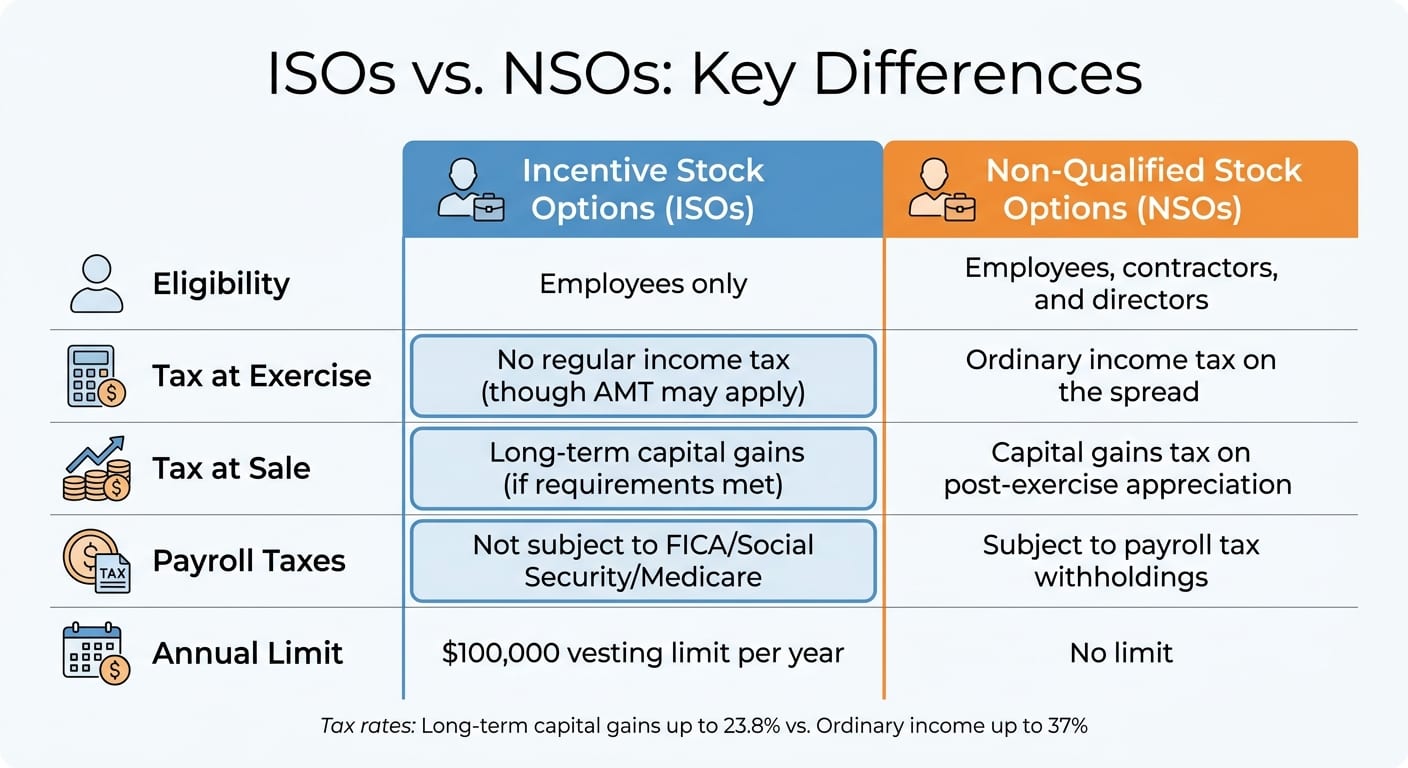
Although ISOs and NSOs both allow employees to purchase company stock, their mechanics and tax implications differ significantly. The table below highlights some of these differences:
For NSOs, exercising the options triggers ordinary income tax on the difference between the strike price and the FMV at the time of exercise. This amount is reported on your W-2 and subject to payroll taxes. ISOs, on the other hand, avoid this immediate tax liability, though the Alternative Minimum Tax (AMT) may apply depending on your income and the size of the spread.
NSOs are more flexible in terms of who can receive them, making them a common choice for contractors, advisors, and board members. However, ISOs often offer better tax outcomes for employees who meet the required holding periods. These distinctions highlight the strategic role ISOs can play in wealth planning for employees.
Who Qualifies for ISOs
ISOs are reserved for eligible employees under strict IRS guidelines. Knowing these rules can help you determine if you qualify and understand the limitations involved.
Employee-Only Rules and Shareholder Limits
ISOs are strictly for employees on the company payroll. If you're a contractor, consultant, or a non-employee board member, you don't qualify and would instead receive non-qualified stock options (NSOs).
"ISOs can only be granted to employees. W-2 employees only. Not advisors, not contractors, not board members who aren't on payroll." – Cake Team
The IRS sets a $100,000 annual vesting limit based on the fair market value (FMV) at the time of the grant. Any options exceeding this threshold automatically convert to NSOs. For example, if you have 15,000 options vesting at $8.00 each (totaling $120,000), only the first $100,000 qualifies as ISOs.
Employees who own more than 10% of the company’s voting stock face additional restrictions. Their options must have a strike price of at least 110% of FMV at the time of the grant and expire within five years instead of the standard ten.
Remaining employed is another key condition for maintaining ISO status. If you leave the company, you typically have 90 days to exercise your vested options before they lose their tax benefits and convert to NSOs. This exercise window extends to one year if the departure is due to a disability.
These rules are paired with legal requirements to ensure ISOs are issued and managed correctly.
Transfer Restrictions and Legal Requirements
ISOs come with strict transfer rules. They cannot be transferred during your lifetime, except through a will or inheritance.
To grant ISOs, a company must have a written equity incentive plan approved by shareholders within 12 months of its adoption. This plan must outline the total number of shares available and specify which employee groups are eligible. Additionally, all ISOs must be granted within 10 years of the plan's approval and exercised within 10 years of the grant date (or five years for employees holding more than 10% of the company’s voting stock).
These rules ensure ISOs remain focused on their purpose: providing tax benefits to employees while fostering a sense of ownership, without extending those benefits to non-employees or major shareholders.
How ISO Vesting and Exercise Work
Understanding your vesting schedule and exercise deadlines can help you make the most of your Incentive Stock Options (ISOs). Vesting determines when you gain the right to purchase shares, while exercise rules outline how long you have to act on those options.
Standard Vesting Schedules
ISOs typically follow a four-year vesting schedule with a one-year cliff. During the first year, none of your options are vested, meaning you can’t exercise them. However, on your first anniversary, 25% of your total grant vests all at once. After that, the remaining 75% usually vests in equal monthly or quarterly increments over the next three years.
Here’s an example: Imagine you’re granted 12,000 ISOs. For the first year, none are vested. On your one-year anniversary, 3,000 options (25% of the total) become exercisable. Afterward, approximately 250 options vest each month for the next 36 months, so you’re fully vested by the end of year four.
However, a one-year cliff can sometimes result in options exceeding the $100,000 ISO limit. For instance, if 60,000 ISOs with a $10 strike price vest at once, only 10,000 qualify as ISOs, while 5,000 convert to Non-Qualified Stock Options (NSOs).
"The 1-year cliff common in startup equity grants often causes more than $100K worth of options to vest at once, triggering this limit." – ESO Fund
Once your options are vested, the next step is navigating the exercise process.
Exercise Process and Deadlines
To exercise your options, you’ll need to pay the strike price per share. You can do this in several ways: paying cash, opting for a cashless exercise, or holding the shares to potentially qualify for long-term capital gains tax treatment.
One of the most critical deadlines is the 90-day post-termination window. If you leave your company, you generally have 90 days to exercise vested ISOs. Missing this window means your options either expire or convert to NSOs, which don’t offer the same tax benefits.
"ISOs must be exercised within three months of the employee's last day to retain their ISO tax status. After that window, options either convert to NSOs or expire." – Cake Team
Some companies may offer extended exercise periods, but the tax advantages tied to ISOs are still limited to the initial 90-day window.
Additionally, all ISOs come with a final expiration date: 10 years from the grant date (or five years if you own more than 10% of the company). Even if you remain employed, you can’t hold onto your options indefinitely.
Tax Treatment of ISOs
Understanding how taxes affect Incentive Stock Options (ISOs) can play a key role in making the most of their wealth-building potential. ISOs don’t trigger taxes at the time of grant or vesting. Instead, tax obligations arise when you exercise the options and later sell the shares.
Qualifying vs. Disqualifying Sales
The tax treatment of ISOs depends on whether the sale of shares qualifies as a "qualifying disposition" or a "disqualifying disposition."
- Qualifying disposition: To qualify, you must hold the shares for at least two years from the grant date and one year from the exercise date. If these conditions are met, the profit (sale price minus the strike price) is taxed at long-term capital gains rates, which can go up to 20% federally.
- Disqualifying disposition: Selling the shares before meeting one or both holding requirements results in the spread at exercise (the difference between the fair market value and the strike price) being taxed as ordinary income, with rates as high as 37% federally. Any additional gain from the exercise date to the sale date is taxed as a capital gain.
"Tax planning around dispositions is one of the highest-leverage things you can do with ISOs." – Equity Simplified
Meeting the qualifying disposition requirements may boost your net gains by as much as 27% compared to a disqualifying sale. However, holding the shares long enough to qualify could expose you to the Alternative Minimum Tax (AMT).
Alternative Minimum Tax (AMT) Impact
Exercising ISOs and holding the shares past the calendar year can trigger AMT liability. The AMT is a separate tax system designed to ensure high earners pay a baseline level of taxes. When you exercise ISOs, the spread between the fair market value and the strike price becomes a "preference item" for AMT purposes.
For 2026, the AMT exemption is $90,100 for single filers and $140,200 for married couples filing jointly. AMT rates are 26% on the first $244,500 of AMT income and 28% on amounts above that.
Example Scenario
Suppose an employee was granted 100 ISOs on March 12, 2020, with a $10 strike price. They exercised these options on January 10, 2021, when the fair market value was $12, and sold the shares on January 25, 2022, for $15. Because the sale occurred less than two years after the grant date, it was a disqualifying disposition. As a result:
- $200 (a $2 spread per share for 100 shares) was taxed as ordinary income.
- $300 (an additional $3 per share gain) was taxed as capital gains.
To reduce AMT exposure, you might consider exercising when the fair market value is close to the strike price. This minimizes the spread and could eliminate AMT liability. Another approach is exercising early in the year. If the stock price drops significantly by December, selling within the same calendar year as a disqualifying disposition may help avoid the AMT adjustment.
"The AMT issue on ISOs is more of a timing issue than a permanent extra tax. You're essentially prepaying taxes that you would've owed later, but it still creates a cash flow problem in the year you exercise." – Bjorn Amundson, CFP
If you do pay AMT, you can claim an AMT credit (using IRS Form 8801) to offset future tax liabilities. It’s also important to track your AMT cost basis - calculated as the strike price plus the AMT adjustment - to avoid overpaying taxes when you eventually sell the shares.
How to Maximize ISO Value
To make the most of your Incentive Stock Options (ISOs), you'll need to balance tax considerations, timing, and cash flow. The timing of your exercise plays a big role in determining whether gains are taxed at long-term capital gains rates or as ordinary income, while also influencing your exposure to the Alternative Minimum Tax (AMT).
When to Exercise ISOs for Tax Savings
Exercising your ISOs when the fair market value (FMV) is close to the strike price may reduce the tax-triggering spread. This approach minimizes the "bargain element" that contributes to AMT exposure. By doing so, you may lower your tax liability and start the clock on the capital gains holding period.
Exercising early in the year can also offer more flexibility. For instance, if you exercise in January or February, you'll have time to meet the one-year holding requirement and potentially sell shares to cover any AMT liability before the next tax deadline. This strategy gives you almost a full year to monitor the stock's performance. If the stock value drops significantly by year-end, you might even consider an intentional disqualifying disposition to avoid paying AMT on income you never realized as cash.
Another strategy is to exercise up to your AMT threshold. This means using your available AMT headroom - the amount you can exercise without triggering additional AMT liability. Staying within this range helps manage your tax exposure effectively.
Keep in mind that exercising ISOs valued over $100,000 annually (based on their grant-date FMV) will automatically convert the excess into Non-Qualified Stock Options (NSOs). If you’re considering a large exercise, spreading it over multiple years may help maintain the favorable tax treatment that ISOs offer.
These methods can help you navigate the tax landscape while preparing for more tailored strategies using Mezzi's platform.
Using Mezzi to Optimize ISO Decisions
Mezzi’s AI-powered platform simplifies the complexities of ISO management, AMT exposure, and your overall financial situation. By connecting your accounts - such as 401(k), brokerage, Roth IRA, and taxable accounts - Mezzi provides a complete view of your tax position and identifies the best times to exercise your options based on income, deductions, and other factors.
The platform keeps track of your AMT crossover point in real time, modeling how different exercise scenarios may impact your taxes. For instance, Mezzi can estimate whether a planned exercise might trigger AMT, calculate your potential liability, or suggest splitting the exercise over multiple years to reduce tax burdens. It also monitors your company’s 409A valuations, which are often updated after funding rounds, helping you decide whether to exercise before an increase in FMV raises your AMT exposure.
Mezzi can also pinpoint tax-saving opportunities you might overlook. For example, it might recommend coordinating your ISO exercises with other income events or flag situations where an intentional disqualifying disposition could work in your favor if share values drop. You can even ask specific questions like, “Should I exercise my ISOs before my bonus is paid?” or “What happens if I leave my company next month?” The platform provides personalized insights based on your connected accounts.
Additionally, Mezzi offers guidance on managing concentration risk. If exercising ISOs would leave you heavily invested in a single company, the platform may suggest rebalancing strategies across your other accounts. This can help you maintain diversification while still taking advantage of the tax benefits tied to your equity compensation.
Key Takeaways
Incentive Stock Options (ISOs) can serve as a powerful tool for building wealth when approached thoughtfully. Their standout benefit lies in the potential for preferential tax treatment - gains may qualify for long-term capital gains rates instead of higher ordinary income rates. Meeting the required holding periods is crucial to unlocking this tax advantage, potentially boosting your net returns significantly.
However, exercising ISOs comes with its own challenges, particularly the risk of triggering the Alternative Minimum Tax (AMT). The AMT is calculated based on the "bargain element", which is the difference between the stock's market price and your exercise price. To minimize AMT exposure, consider exercising when this spread is small. Doing so not only reduces your AMT risk but also starts the clock on the holding period needed for favorable tax treatment. Staying below your AMT threshold can help avoid unexpected tax liabilities.
Effective ISO management involves careful planning around vesting schedules, exercise timing, and tax considerations. Keep in mind key limitations, like the $100,000 fair market value (FMV) annual limit for ISOs and the 90-day window to exercise options after leaving your employer. These details are essential for maximizing the value of your ISOs while maintaining tax efficiency.
To navigate these complexities, tools like Mezzi's AI platform can be invaluable. Mezzi helps model your AMT exposure, pinpoint optimal exercise opportunities, and integrate ISOs into your broader financial strategy. By linking all your accounts - such as 401(k)s, brokerage accounts, Roth IRAs, and taxable accounts - Mezzi provides a comprehensive view, helping you make informed decisions rather than treating ISOs as standalone assets.
Managing ISOs effectively demands a mix of strategic planning and modern tools. With the right approach and insights, you may be able to maximize the tax benefits of ISOs while avoiding costly missteps.
FAQs
How do I know whether my ISO sale is qualifying or disqualifying?
The timing of your stock sale plays a key role in determining whether it’s a qualifying disposition or a disqualifying disposition. A sale qualifies if the stock is sold at least one year after exercising and two years after the grant date. If you sell the stock before meeting both of these conditions, it’s considered a disqualifying disposition. These timelines are essential for understanding how your ISO sale may be taxed.
How can I estimate AMT before exercising my ISOs?
To get an idea of your potential AMT liability before exercising Incentive Stock Options (ISOs), you can calculate what's known as the AMT "crossover point." Here's how:
- Figure out the fair market value (FMV) of the shares at the time of exercise.
- Calculate the "bargain element" by subtracting the strike price from the FMV.
- Add this bargain element to your income to determine if it surpasses the AMT exemption threshold.
Using tax software or consulting with a tax advisor can provide a clearer picture and help you plan more effectively.
What should I do with my ISOs if I’m leaving my company soon?
If you're planning to leave your company, you may have a window of 90 days to exercise your vested incentive stock options (ISOs). Missing this deadline could mean losing your options entirely or seeing them convert into non-qualified stock options (NSOs), which often have different tax treatment. It's important to weigh potential tax consequences and evaluate strategies that could help you make the most of your options before the clock runs out.
Disclosures:
- This content is for informational purposes only and does not constitute investment advice or a recommendation to buy or sell any security.
- Past performance is not indicative of future results. No guarantee of future performance or outcomes is implied.
- Users should not rely solely on AI-driven tools for financial decision-making.
Related Blog Posts
- ISO vs NSO: What’s the Difference?
- Pre-IPO stock: how to track value before a liquidity event
- Different Types of Equity Compensation: RSUs, ISOs, NSOs, ESPP
- Incentive Stock Options and AMT: Exercise Strategy to Minimize Tax
The timing of your stock sale plays a key role in determining whether it’s a qualifying disposition or a disqualifying disposition. A sale qualifies if the stock is sold at least one year after exercising and two years after the grant date. If you sell the stock before meeting both of these conditions, it’s considered a disqualifying disposition. These timelines are essential for understanding how your ISO sale may be taxed.
To get an idea of your potential AMT liability before exercising Incentive Stock Options (ISOs), you can calculate what's known as the AMT "crossover point." Here's how:
- Figure out the fair market value (FMV) of the shares at the time of exercise.
- Calculate the "bargain element" by subtracting the strike price from the FMV.
- Add this bargain element to your income to determine if it surpasses the AMT exemption threshold.
Using tax software or consulting with a tax advisor can provide a clearer picture and help you plan more effectively.
If you're planning to leave your company, you may have a window of 90 days to exercise your vested incentive stock options (ISOs). Missing this deadline could mean losing your options entirely or seeing them convert into non-qualified stock options (NSOs), which often have different tax treatment. It's important to weigh potential tax consequences and evaluate strategies that could help you make the most of your options before the clock runs out.