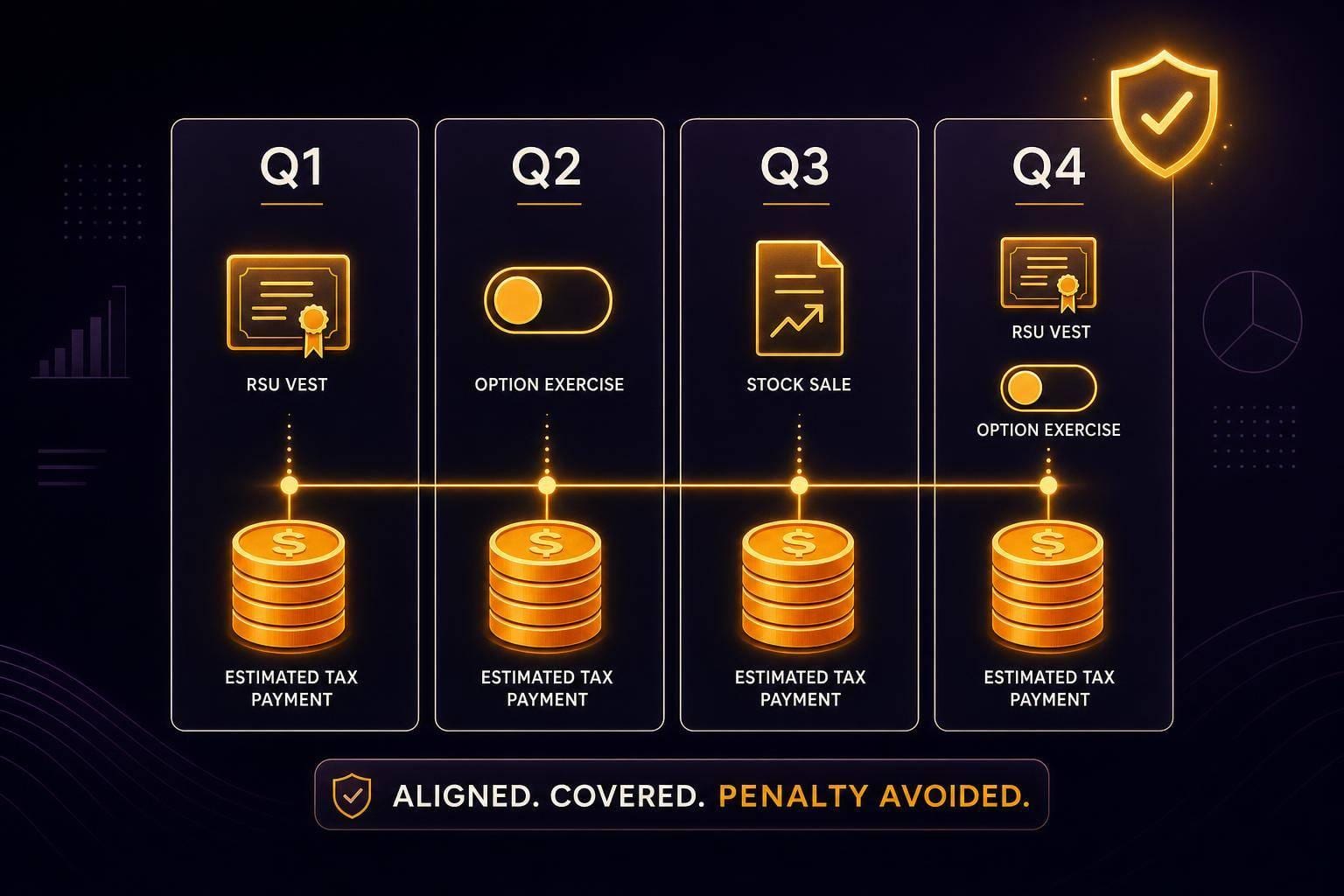
A big RSU vest, NSO exercise, ESPP sale, or stock sale may leave you owing tax before April 15. The main issue may be simple: equity income often shows up in chunks, while withholding may stay too low or arrive too late for the quarter when the income hit.
Here’s the short version:
- RSUs may create W-2 income on the vest date
- NSOs may create W-2 income on the exercise date
- ISOs may create an AMT adjustment on the exercise date
- ESPPs may create tax on the sale date
- Stock sales may create capital gains or losses on the trade date
- A flat 22% federal supplemental withholding rate may not match your full tax rate
- The IRS may look at each quarter separately, not just what you pay by filing time
- Safe harbor may depend on paying 90% of current-year tax or 100%/110% of prior-year tax
- 2026 estimated tax deadlines are April 15, 2026, June 15, 2026, September 15, 2026, and January 15, 2027
If I had to boil the article down to one point, it would be this: I may need to match each equity event to the quarter when it became taxable, then compare that tax with withholding and any estimated payments already made. That may be the difference between a small balance due and an underpayment penalty.
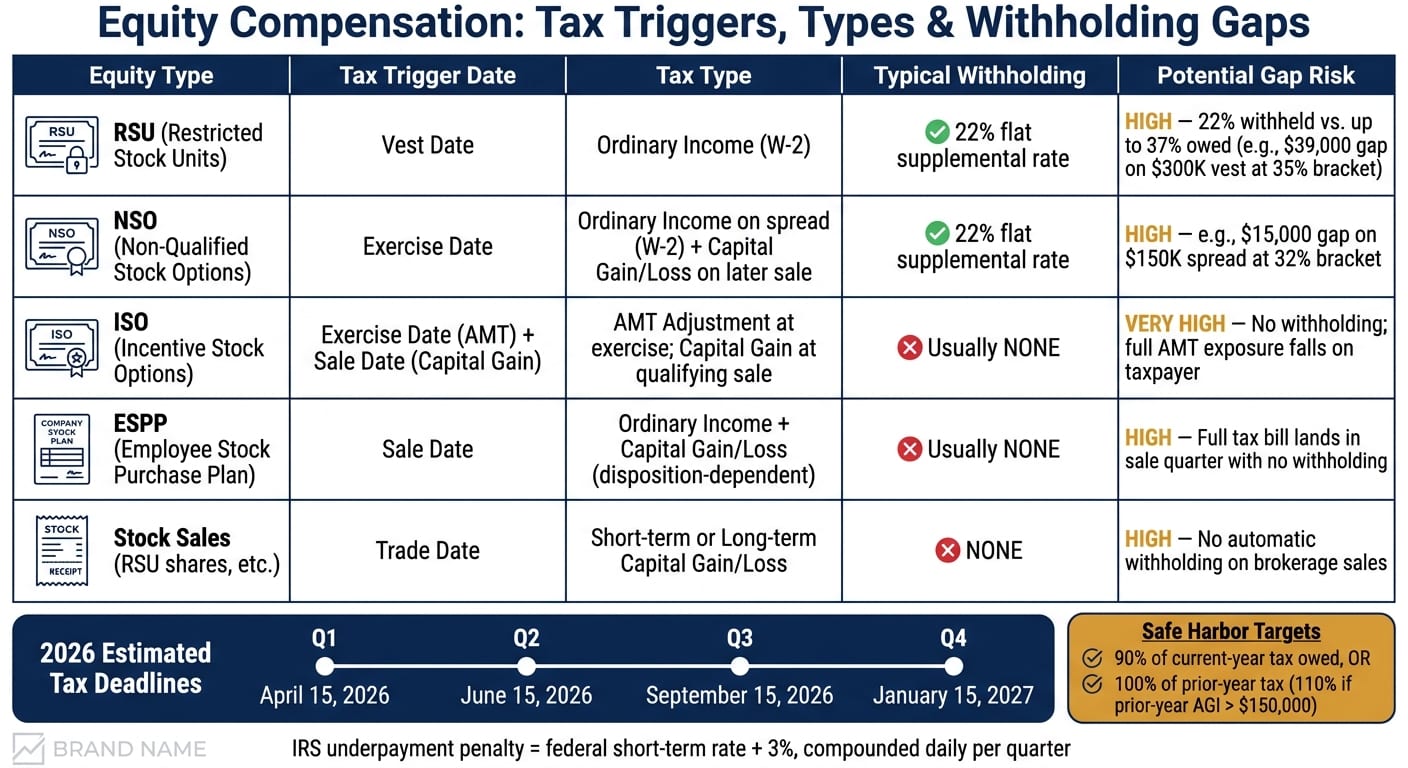
Quick comparison
A simple way to read this article: find the tax date, place it in the right quarter, check the gap, and see whether withholding or Form 1040-ES payments may need to cover it.
Which equity comp events are taxable and when they hit each quarter
Every equity comp event has a set point when tax may apply. The main issue usually isn’t the grant itself. It’s which quarter the tax lands in. If you use the tax trigger date to place each event in the right estimated-tax quarter, you may get a clearer view of any payment gap quarter by quarter.
Here’s how each tax trigger lines up.
RSUs and ESPPs: ordinary income before cash is available
RSU income usually shows up automatically at vest. When the shares vest, their fair market value becomes W-2 income. That vest-date tax generally may not be deferred. Employers often withhold at the flat 22% federal supplemental rate, or 37% on supplemental wages above $1 million, so people in higher brackets may still end up with a gap.
Take a $300,000 RSU vest. A taxpayer in the 35% bracket may owe $105,000 in federal tax. If withholding happens at 22%, only $66,000 may be covered. That leaves a $39,000 shortfall, which may need to be covered through added withholding or estimated taxes.
ESPP tax usually shows up when you sell. Whether the sale is a qualifying or disqualifying disposition changes how much may be treated as ordinary income and how much may be treated as capital gain or loss. In a disqualifying disposition, the discount at purchase is taxed as ordinary income, and any remaining gain or loss is capital. In a qualifying disposition - held at least one year after purchase and two years after the offering date - ordinary income is limited to the lesser of the discount based on the original offering-date FMV or the actual gain realized, with the rest taxed as long-term capital gain. There’s usually no payroll withholding tied to the sale, so the full tax bill may land in the quarter that includes the sale date.
NSOs, ISOs, and stock options: exercise timing, AMT risk, and capital gains
NSOs create ordinary income when you exercise. More specifically, it’s the spread between the stock’s fair market value and your strike price. That income is reported on your W-2 and subject to supplemental withholding, but the flat rate may still come in below your actual tax rate. If you exercise and hold the shares, the ordinary income lands in the exercise quarter. Any later capital gain or loss lands in the quarter when you sell. So a large Q2 exercise and a large Q4 sale may create two separate quarters with two separate payment gaps.
ISOs work differently. Exercise does not trigger regular income tax, but that doesn’t mean the tax issue goes away. The spread becomes an AMT adjustment at exercise. For large exercises, that may create AMT exposure for the year. And because employers usually don’t withhold for AMT on ISO exercises, the amount due may fall on the taxpayer to estimate and pay. Some people project AMT after each ISO exercise, especially when exercising in tranches.
Selling employer stock creates capital gain or loss on the trade date, with no federal withholding. Short-term gains are taxed at ordinary income rates. Long-term gains get lower rates. If someone sells several years of accumulated RSU shares in one quarter, that sale may produce a large unwithheld gain, and that amount may need to be included in that quarter’s estimated-tax math. Next, compare that gap with the safe-harbor rules that may limit penalty risk.
Safe-harbor rules that cut underpayment-penalty risk
Once you know which quarter the income lands in, the next issue is how much to pay. Safe-harbor rules may turn uneven equity income into a more fixed payment target. The IRS generally expects estimated payments when withholding and refundable credits fall below the smaller of these two targets: 90% of current-year tax or 100%/110% of prior-year tax. With equity comp, that may matter because RSU vests, option exercises, and stock sales may push tax due above flat W-2 withholding.
If your balance due after withholding and refundable credits is under $1,000, the penalty generally may not apply.
How to choose between the 90% current-year method and the 100% or 110% prior-year method
The 90% current-year method may track actual tax more closely, but it usually calls for repeated re-forecasting after each big vest, exercise, or sale.
For many equity-comp earners, the choice may come down to this: track this year closely, or use last year's tax as a fixed target. If your prior-year AGI was $150,000 or less ($75,000 or less if married filing separately), paying 100% of last year's total tax may be enough. If your prior-year AGI was above those thresholds, the target rises to 110% of prior-year tax.
Either way, the method ties back to last year's return instead of this year's equity-price swings. For example, if your prior-year tax was $25,000 and your AGI was $160,000, your safe-harbor target may be $27,500 (110% × $25,000), no matter how high this year's equity income may climb.
Use:
- 100% of prior-year tax if prior-year AGI was $150,000 or less ($75,000 if married filing separately)
- 110% of prior-year tax if AGI was higher
Penalty mechanics to know before missing a deadline
The underpayment penalty works more like interest than a flat fine. It's calculated on the underpaid amount for each quarter, multiplied by an annual rate equal to the federal short-term rate plus 3 percentage points, compounded daily.
The year is split into four installment periods, with 2026 deadlines on:
- April 15, 2026
- June 15, 2026
- September 15, 2026
- January 15, 2027
Each quarter stands on its own. A later payment may stop future accrual, but it does not erase the penalty already charged for an earlier underpayment.
That’s why the next step may be building a quarterly payment plan, not waiting until year-end.
Build a quarterly tax plan for RSUs, ESPPs, options, and stock sales
Safe-harbor targets may only work as intended when each equity event is tied to the right quarter. So the job is pretty simple in theory: put income on a calendar before the IRS due dates show up.
Estimate the gap: combine salary withholding, equity income, and sale gains
Start with last year's total tax liability from Form 1040, line 24. That gives you the baseline for your safe-harbor target. Depending on the method, the target may be 90% of current-year tax or 100%/110% of prior-year tax.
Next, project full-year federal withholding from your latest pay stub and spread it across Q1 through Q4. Then add each dated equity event: RSU vests, ESPP sales, NSO exercise spreads, ISO exercises, and planned stock sales. RSU vesting and NSO exercise spreads are ordinary income. Later stock-sale gains are capital gains. For qualified ESPPs, the sale date may be the tax event to watch.
Use Form 1040-ES and Publication 505 to estimate tax and required installments. Then compare those required payments with withholding and any estimated payments already made. The difference may be your gap.
Once you know the gap, the next step is choosing the fastest way to close it.
Choose between raising W-2 withholding and sending Form 1040-ES payments
These two tools may close the same gap, but the IRS may treat them differently. W-2 withholding is treated as if it were paid evenly across the year, even when you increase it late in the year. Estimated payments, on the other hand, only count when they are actually paid.
In practice, withholding may be the first lever to pull when payroll changes are easy to make. Form 1040-ES may make more sense when withholding may not be adjusted fast enough, when the income comes from outside payroll, or when one large event - like a planned NSO exercise - creates a gap that payroll may not absorb before the next due date.
3 hypothetical underpayment scenarios and what should have happened
The examples below show how the gap may show up in actual quarters.
Scenario 1 - Q1 RSU vest: In February, 800 RSUs vest at $90/share, adding $72,000 of ordinary wage income. The employer withholds at the 22% supplemental rate ($15,840), but a 32% marginal rate would imply $23,040 of federal tax on that income. That leaves a $7,200 gap. One possible response would have been a Form 1040-ES payment by April 15 or a W-4 update to increase withholding for the rest of the year.
Scenario 2 - Mid-year NSO exercise: In May, a taxpayer exercises NSOs with a $150,000 spread and sells the shares the same day. The employer withholds 22% ($33,000), but tax at a 32% rate comes to $48,000. That creates a $15,000 shortfall in Q2. Because the exercise was planned in advance, one clean fix may have been a targeted $15,000 Form 1040-ES payment before June 15.
Scenario 3 - Q3 stock sale: In August, a taxpayer sells a concentrated position and realizes $300,000 in long-term capital gains. No withholding applies to a brokerage sale, so the tax bill may depend on the capital gains rate that applies. A Form 1040-ES payment before September 15 may have closed the Q3 gap. Another option may have been increasing W-2 withholding from July through December to close part or all of the gap by year-end.
Track each event as it happens so the next quarter starts with an up-to-date estimate.
Track withholding gaps across payroll and brokerage accounts with Mezzi
Once you know your target, the next step is checking whether your payroll and brokerage totals may be keeping pace. A practical way to do that may be to pull payroll, brokerage, and equity data into one quarterly view.
Without that kind of side-by-side view, an RSU vest or NSO exercise may create a tax gap that stays hidden until filing time. The data usually sits in separate systems. Payroll shows salary withholding, your brokerage shows trade history, and your equity portal tracks grants and exercises. Those systems do not sync, so a shortfall may go unnoticed until you file in April.
Mezzi links payroll, brokerage, and equity-comp accounts in read-only mode, so vested income, exercise spreads, sale gains, and federal withholding appear together. That puts the inputs needed for the safe-harbor calculation into one quarterly tax picture.
Track events by tax type:
- RSU vest income and NSO spread may count as ordinary income.
- Stock-sale gains may count as capital gains.
What to track each quarter to avoid missing a payment
Use these inputs to compare what has already been withheld with what the quarter's tax bill may look like.
When these figures sit in one place, each quarter’s payment decision may get faster and a bit more exact.
Conclusion: a repeatable quarterly process beats year-end surprises
The end result may be a repeatable quarterly process that may reduce penalty risk.
FAQs
How do I know which quarter an equity event belongs in?
Use the date the taxable event happened.
- RSUs: vesting date
- NSOs and ISOs: exercise date
- Share sales: sale date
Record each date in MM/DD/YYYY format so you may match it to the right quarterly estimated tax payment deadline.
Should I increase withholding or make estimated tax payments?
Yes - if your RSUs, NSOs, or other equity events push your tax above payroll withholding, increasing withholding and/or making quarterly estimated tax payments may help you avoid IRS underpayment penalties.
A common trigger is a large vesting, exercise, or sale. Another is landing in a higher tax bracket, where sell-to-cover withholding may fall short. In those cases, some people base payments on their projected year-end tax and adjust along the way as needed.
How can I avoid an underpayment penalty with RSUs or stock sales?
To avoid underpayment penalties with RSUs or stock sales, it may help to manage the gap between your employer’s automatic withholding - often 22% - and your total tax liability.
One way some people handle that gap is through quarterly estimated tax payments or by adjusting W-4 withholding for expected equity income. Since RSUs are taxed as ordinary income when they vest, it may make sense to estimate the full tax liability ahead of time rather than relying only on the default withholding rate.
A sell-to-cover approach may also help cover taxes without using personal cash.
Disclosures:
- This content is for informational purposes only and does not constitute investment advice or a recommendation to buy or sell any security.
- Past performance is not indicative of future results. No guarantee of future performance or outcomes is implied.
Related Blog Posts
- Different Types of Equity Compensation: RSUs, ISOs, NSOs, ESPP
- Your RSUs Withheld 22% - You're in the 35% Bracket. Meet the April Surprise
- How to Close the RSU Withholding Gap Before December
- Double-Trigger RSUs at a Pre-IPO Company: The Tax Time Bomb at Liquidity
Use the date the taxable event happened.
- RSUs: vesting date
- NSOs and ISOs: exercise date
- Share sales: sale date
Record each date in MM/DD/YYYY format so you may match it to the right quarterly estimated tax payment deadline.
Yes - if your RSUs, NSOs, or other equity events push your tax above payroll withholding, increasing withholding and/or making quarterly estimated tax payments may help you avoid IRS underpayment penalties.
A common trigger is a large vesting, exercise, or sale. Another is landing in a higher tax bracket, where sell-to-cover withholding may fall short. In those cases, some people base payments on their projected year-end tax and adjust along the way as needed.
To avoid underpayment penalties with RSUs or stock sales, it may help to manage the gap between your employer’s automatic withholding - often 22% - and your total tax liability.
One way some people handle that gap is through quarterly estimated tax payments or by adjusting W-4 withholding for expected equity income. Since RSUs are taxed as ordinary income when they vest, it may make sense to estimate the full tax liability ahead of time rather than relying only on the default withholding rate.
A sell-to-cover approach may also help cover taxes without using personal cash.