
If I exercise startup options, I may be risking far more than the strike price. I may be putting cash, taxes, and years of liquidity on the line for shares that may never be sold. And if the company never exits, I may end up with a total loss on the money I put in.
Here’s the short version:
- I may need to count all-in cost, not just the exercise check
- That cost may include:
strike price
- ordinary income tax for NSOs
- AMT exposure for ISOs
- legal or tax prep fees
- I may also need to weigh:
how much of my liquid net worth this uses
- how much of my wealth already depends on my employer
- how long my money may stay locked up
- whether I may need that cash in the next 2 to 5 years
- A common rough screen some people use:
around 5% of liquid net worth may feel easier to absorb
- around 10% may feel like a bigger bet
- above 20% may look hard to justify for one illiquid company position
A simple example: if exercising costs $25,000, taxes may add $19,800, and fees add $1,200, the all-in amount may be $46,000. That may be a very different decision than writing a $25,000 check.
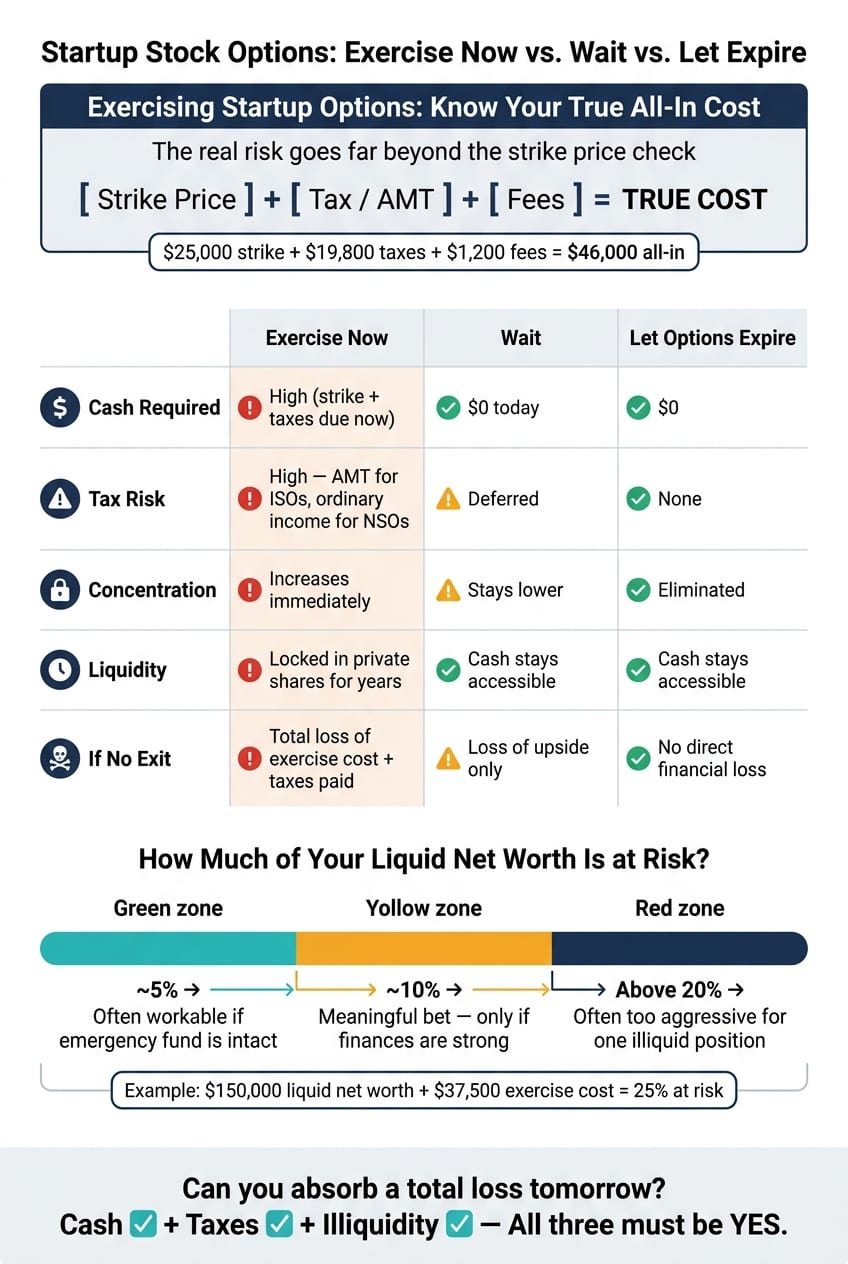
When Should You Exercise Stock Options? 5 Tax Strategies
Quick comparison
The core idea is simple: this may be less about upside and more about loss tolerance. If I may not be able to absorb a full loss of the exercise cost, tax bill, and tied-up cash, the math may not work for me even if the company story sounds strong.
Gather the facts first: option type, deadlines, and total cash at risk
Before you size the risk, gather the numbers that drive cost, tax, and liquidity.
The grant terms that change the decision
Two grants at the same company may come with very different risk profiles. A few details tend to shape the call more than anything else. Pull these from your equity portal or grant agreement before doing anything else:
How to calculate the full out-of-pocket cost
The main question here is total dollars at risk. Once you have the grant terms, turn them into actual dollars.
For NSOs, exercise cost equals vested shares × strike price. Taxes usually apply to the spread at exercise.
For ISOs, exercise cost works the same way. The spread may create AMT exposure instead of ordinary income tax.
Here’s a concrete example. Say you have 10,000 NSO options with a $2.50 strike price. The exercise cost would be $25,000. If the current 409A FMV is $8.50, the spread would be $6.00 per share, which creates $60,000 of taxable income. At a combined marginal tax rate of 33%, that may mean roughly $19,800 in tax. Add $1,200 in legal and tax fees, and your total dollars at risk may be about $46,000, not $25,000.
That gap matters. It’s the number you may want to compare against your liquid assets, not just the strike-price check.
How likely is it that your shares may stay locked up for years
Once you have the dollar figure, the next step is time. How long may that money stay tied up?
Private startup shares may reach liquidity through:
- an IPO
- an acquisition
- a company-organized tender offer
- a secondary market sale
- no exit at all
Each path may have different odds based on the company’s stage and direction. A later-stage, revenue-generating company with institutional investors may have a more plausible path to a tender offer or acquisition than a seed-stage startup with no product revenue. It may also be worth asking whether the company has ever run a tender program for employees, since some later-stage startups do offer partial liquidity before a formal exit.
Many venture-backed companies wind down, get acquired in a low-value deal with weak outcomes for common shareholders, or stay private for an indefinite period. If you may need access to that cash within three to five years, even a long IPO timeline may not be an acceptable trade-off, no matter how promising the company looks today.
With those numbers in hand, you may compare the exercise bill to your liquid net worth and near-term cash needs.
Size the risk before writing a check
Treat the grant like a household stress test. The key issue isn't just upside. It's how much cash, concentration, and time you may be able to absorb if the shares never become liquid.
A simple first pass: compare the full outlay to what you may lose without dipping into emergency savings.
Compare the exercise cost to your liquid net worth and near-term cash needs
Start with liquid net worth: cash, checking and savings accounts, money market funds, and brokerage accounts you may sell within a few days. Leave out home equity, retirement accounts with early-withdrawal penalties, and other assets that may be hard to tap.
A common guardrail is to avoid using money needed to keep a 3–6 month emergency fund in place or to cover essential expenses over the next 2–5 years.
Next, divide your total exercise outlay by your liquid net worth. That outlay may include:
- Strike price × shares
- Any tax bill you may expect in the next 12 to 18 months
The result is your exposure as a share of liquid assets. These rough ranges may help frame it:
Here's a plain example. If your liquid net worth is $150,000 and exercising plus taxes would cost $37,500, then 25% of your liquid assets may be at risk. If you also expect to need $40,000 for a home down payment within two years, that exercise may delay the purchase or leave you relying on consumer debt, even if the startup later succeeds.
Measure how much of your total wealth is already tied to this company
Cash is only the first screen. The next one is concentration: how much of your wealth may already depend on the same company.
Employer equity carries two risks at once: your paycheck and your financial exposure both depend on the same company's fortunes. Before exercising, add up every form of exposure you already have: vested RSUs, exercised options, ESPP shares, unvested equity at a conservative value, and your paycheck. Then look at your 401(k) and taxable accounts for sector-heavy funds that may hold peer companies or index funds tilted toward the same industry.
Many advisors suggest keeping employer stock at no more than 10–15% of total investable assets, and some use 5–10% as a tighter cap. If you're already near that range before exercising a single new option, adding more company exposure may be hard to support from a balance-sheet view, no matter how strongly you feel about the business.
Mezzi's X-Ray tool shows total concentration across brokerage, 401(k), and IRA accounts, including overlap inside index funds.
Exercise now, wait, or walk away: a side-by-side comparison
Each path comes with its own trade-offs. Exercising now is mostly a cash-and-tax decision. Waiting is more about keeping flexibility. Letting options expire is about keeping your capital on the sidelines.
If the company never exits, exercising now may mean losing the check, the tax bill, and the upside you paid for. If cash needs and concentration already put pressure on your balance sheet, tax timing may end up being the tiebreaker.
Tax and timing trade-offs that can flip the decision
Even if the exercise cost fits on paper, taxes may still make the move far riskier than it first appears.
How ISO and NSO taxes create very different risks
NSOs and ISOs may look similar at first. The tax hit may be very different.
With NSOs, the spread at exercise usually gets taxed as ordinary income, plus payroll taxes. That may create a tax bill before you sell anything. So you may owe money to the IRS even though you haven't received cash from the shares.
Take a simple example. If you exercise 10,000 NSOs with a $2 strike price and a current FMV of $8, the $60,000 spread may create roughly $21,000 in taxes due by next April, even if no shares are sold and no cash comes in.
With ISOs, the spread usually doesn't trigger regular income tax at exercise. Instead, it may count toward AMT income. Depending on your other income and deductions, that adjustment may trigger a five-figure AMT bill on shares you still can't sell. At that point, you're making a bet that the company may provide liquidity later, before that tax cost feels permanent.
Once you know when taxes may show up, the next issue is whether early exercise lowers that exposure or makes it worse.
When early exercise helps and when it backfires
Early exercise means exercising options before they fully vest. In some cases, that may offer two clear upsides.
- It may start the long-term capital gains clock sooner, so later appreciation may be taxed at lower rates.
- If the company qualifies under IRC §1202, it may also start the five-year QSBS holding period earlier, which may allow up to $10 million in gains to be excluded from federal tax entirely.
These upsides may matter more when the company is still early-stage, the 409A FMV remains close to your strike price, and the spread at exercise is near zero.
But early exercise may also backfire.
If the spread is already large, or your cash cushion is thin, the move may lock in tax risk too early. Exercising NSOs early on a high-spread position may create a large ordinary income bill today. Exercising ISOs early with a large spread may create AMT exposure now. And if the company later stalls or fails, that tax may be gone with nothing to offset it.
Making a 90-day decision after leaving the company
This gets more urgent after you leave the company. Under U.S. tax rules, ISOs must be exercised within 90 days of your last day to keep ISO status. After that, they usually lose ISO status and may convert to NSOs or expire, depending on the plan. Some companies offer extended windows of one to 10 years, but the IRS still treats any ISO exercise after 90 days as an NSO.
That short window may force a decision before your cash position or concentration limits are where you'd want them. It may help to treat this as a cash-risk decision, not a last-minute deadline problem.
Some people run a simple check:
- Add up the total cash needed to exercise.
- Estimate the tax bill.
- Compare both numbers against liquid net worth and near-term expenses.
If the outlay would strain your emergency fund or use more than 10% to 20% of your liquid assets during a stretch of income uncertainty, walking away from expiring options may be the safer financial choice.
Conclusion: A clear rule for deciding how much risk is reasonable
After sizing the cash, tax, and liquidity risks, use a plain test: could you absorb a total loss tomorrow after adding the exercise cost, estimated tax bill, and any AMT exposure? If that total may strain your finances, the answer may be no.
Keep the all-in cost formula simple: exercise cost + tax/AMT + near-term obligations. If the combined amount may shrink your liquid cushion or may delay important goals, the math may not support exercising right now. You may want a clear yes on cash, taxes, and illiquidity. All three may need to be yes.
Personal risk still depends on your balance sheet, not the company story. Your current pay and equity may already add concentration. Adding more exposure on top of that may concentrate the bet further.
Mezzi may surface concentration, cash-flow gaps, and tax exposure from your connected accounts before you decide whether the exercise fits your broader finances.
FAQs
How do I estimate my true all-in exercise cost?
Start with cash outlay + tax.
Cash outlay equals the exercise price × the number of vested options or shares you exercise.
Then add estimated tax on the spread between the FMV at exercise and the strike price.
For NSOs, that spread may be treated as ordinary income at exercise, often with state and payroll taxes layered on top.
For ISOs, the spread may not create regular income tax right away, but it may trigger AMT.
It may also make sense to use a downside 409A or valuation estimate and keep extra liquidity set aside for taxes before any sale.
When does exercising options become too risky for my finances?
Exercising may become too risky when it puts pressure on your cash or tax picture before you have a chance to sell. The same may be true if a bad outcome would have a meaningful effect on your finances.
A few red flags may point in that direction:
- The post-termination exercise deadline is close. In many cases, that window may be about 90 days.
- Your option expiration date is near.
- Exercising ISOs may trigger AMT.
- Your company stock may already make up a large share of your investable net worth, often around 10%–20%.
- You may end up holding shares that you aren't able to sell.
That mix may leave you with less flexibility, more tax exposure, and more company-specific risk at the same time.
Should I exercise before leaving the company or wait?
Usually, it may make sense to wait unless you have enough cash and tax room to exercise within your plan’s post-termination deadline and you may be able to absorb the worst-case risk: AMT for ISOs, a rising 409A/strike spread, illiquidity, and expiration or forfeiture.
ISOs often must be exercised within about 90 days after you leave to keep ISO tax treatment. If your strike price may be near or below the current 409A/FMV, exercising may be more reasonable.
Disclosures:
- This content is for informational purposes only and does not constitute investment advice or a recommendation to buy or sell any security.
- Past performance is not indicative of future results. No guarantee of future performance or outcomes is implied.
Related Blog Posts
- Making the Most of Your Non-Qualified Stock Options (NSOs)
- ISO vs NSO: What’s the Difference?
- Pre-IPO stock: how to track value before a liquidity event
- Incentive Stock Options and AMT: Exercise Strategy to Minimize Tax
Start with cash outlay + tax.
Cash outlay equals the exercise price × the number of vested options or shares you exercise.
Then add estimated tax on the spread between the FMV at exercise and the strike price.
For NSOs, that spread may be treated as ordinary income at exercise, often with state and payroll taxes layered on top.
For ISOs, the spread may not create regular income tax right away, but it may trigger AMT.
It may also make sense to use a downside 409A or valuation estimate and keep extra liquidity set aside for taxes before any sale.
Exercising may become too risky when it puts pressure on your cash or tax picture before you have a chance to sell. The same may be true if a bad outcome would have a meaningful effect on your finances.
A few red flags may point in that direction:
- The post-termination exercise deadline is close. In many cases, that window may be about 90 days.
- Your option expiration date is near.
- Exercising ISOs may trigger AMT.
- Your company stock may already make up a large share of your investable net worth, often around 10%–20%.
- You may end up holding shares that you aren't able to sell.
That mix may leave you with less flexibility, more tax exposure, and more company-specific risk at the same time.
Usually, it may make sense to wait unless you have enough cash and tax room to exercise within your plan’s post-termination deadline and you may be able to absorb the worst-case risk: AMT for ISOs, a rising 409A/strike spread, illiquidity, and expiration or forfeiture.
ISOs often must be exercised within about 90 days after you leave to keep ISO tax treatment. If your strike price may be near or below the current 409A/FMV, exercising may be more reasonable.