
FAANG employees often have high salaries and stock-based compensation, making their path to financial independence faster but more complex. While traditional FIRE focuses on frugality, FAANG FIRE emphasizes managing taxes, stock concentration, and equity compensation. Here's what sets it apart:
- Earnings Potential: Senior engineers can earn $250,000–$700,000 annually, enabling savings of $150,000+ per year.
- FIRE Timeline: With disciplined planning, tech workers may retire in 10–15 years, far shorter than the typical 20–30 years.
- Challenges: Taxes on RSUs, employer stock concentration, and healthcare costs before Medicare eligibility are key hurdles.
- Geographic Flexibility: Remote work allows high earners to relocate to lower-cost areas, reducing the required FIRE portfolio.
To navigate these complexities, tools like Mezzi offer tailored financial insights for tech professionals, helping them optimize savings, manage risks, and plan for early retirement.
The Truth About FIRE: 5 Methods to Reach Financial Independence
FAANG FIRE Goals and Common Challenges
What Financial Independence Means for Tech Workers
For many FAANG employees, financial independence is about having the freedom to decide your next steps without financial pressure. This could mean taking a sabbatical, transitioning to a less demanding role (commonly referred to as Barista or Coast FIRE), or even starting a business without the immediate need for success. A common aspiration among tech workers is achieving Fat FIRE - retiring with enough savings to maintain a lifestyle of $150,000 or more per year, rather than relying on a leaner budget. While high salaries in the tech industry make Fat FIRE possible, it requires detailed and disciplined financial planning.
"Seven figures in net worth doesn't automatically mean financial independence. Sometimes it just means your dependency is better compensated." - Vinod Sharma & Jo Dixit, Founders, BricksFolios
The first step toward financial independence is determining your personalized FIRE number.
How to Set Your FIRE Number
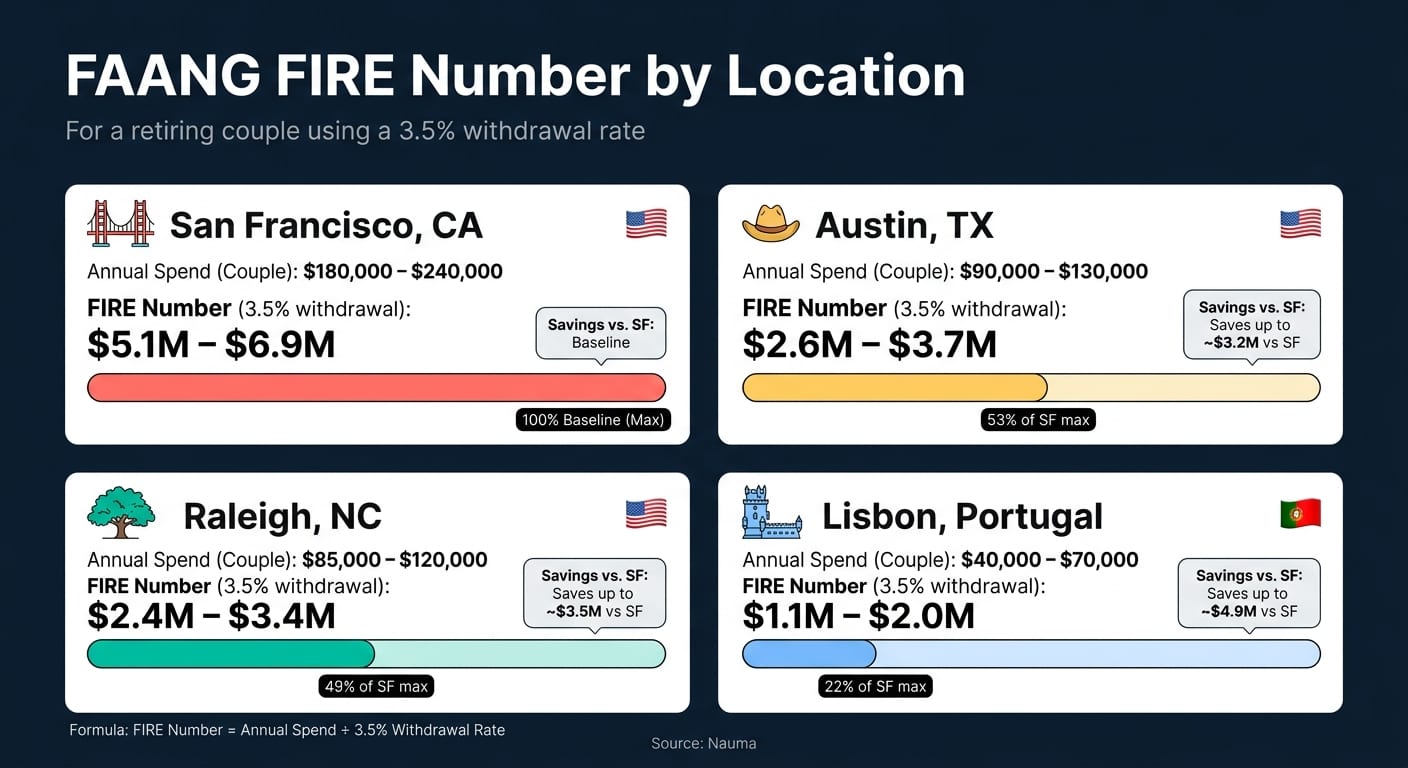
Your FIRE number represents the size of the portfolio you need to generate enough income to cover your expenses. To calculate it, divide your expected annual spending by your chosen withdrawal rate. Many early retirees use a conservative withdrawal rate of 3% to 3.5%, rather than the traditional 4%, to account for longer retirement periods of 40 to 50 years.
Where you plan to retire plays a major role in shaping your FIRE number. The table below highlights the impact of location, including an international example, to show how costs can vary widely:
(Source: Nauma [[2]](https://nauma.ai/knowledge/early-retirement/))
"Your FIRE number is driven by lifestyle cost, not salary - which means step one is actually knowing what you spend." - Mark Barnett, Lead DevOps Engineer, KPMG
Healthcare is another critical factor that often gets overlooked. Early retirees, who are not yet eligible for Medicare, may face monthly family premiums of $2,000–$3,000. However, structuring withdrawals to stay under the ACA subsidy threshold - approximately $83,000 in Modified Adjusted Gross Income (MAGI) for a married couple in 2026 - could result in annual savings of $10,000 to $20,000.
While managing healthcare costs is essential, understanding how vesting schedules work can also influence your FIRE timeline.
Golden Handcuffs: How Vesting Schedules Affect FIRE Timing
Vesting schedules can complicate financial independence for FAANG employees in ways that traditional retirement planning doesn’t typically address. Restricted Stock Unit (RSU) grants often vest over four years, with new grants issued annually. This means employees are frequently 12 to 18 months away from receiving a significant payout. This dynamic, often called the "one more vest" trap, can lead workers to postpone retirement repeatedly, potentially delaying their plans by years and leaving them tethered to the promise of future payouts worth hundreds of thousands of dollars.
A practical approach is to map out your vesting calendar and use key dates as checkpoints for reassessing your plans. For example, if you’re within a year of a major vesting event, it might make sense to wait. However, continuously delaying retirement for the next vesting milestone can stretch your timeline indefinitely, so it’s important to strike a balance.
Building a FIRE Plan Around FAANG Compensation
How to Allocate Your FAANG Compensation for FIRE
A senior software engineer at Google may earn total compensation of $390,000. While the income is substantial, the challenge lies in allocating it effectively. One approach to consider is the RSU Bridge Strategy: use your base salary to maximize contributions to tax-advantaged accounts, and rely on RSU vesting proceeds for living expenses. This method may help shield more of your income from taxes while allowing investments to grow over time.
When prioritizing contributions, follow a structured order. Start with 401(k) deferrals to take full advantage of any employer match. Next, maximize contributions to your HSA, which offers a triple-tax benefit. If your employer plan permits, the Mega Backdoor Roth - where after-tax 401(k) contributions are converted to Roth - could allow you to contribute up to $72,000 annually by 2026. After covering living expenses with RSU proceeds, any leftover funds can be allocated to a taxable brokerage account, which can act as a "bridge fund" for early retirement before age 59½.
For employees based in California, it's important to note that the state does not align with federal tax treatment for HSAs. Contributions and growth are taxed at the state level, which can make HSAs less appealing for California residents compared to those in states like Texas or Washington, where no state income tax applies.
Once your contributions are optimized, it's time to address the risks tied to holding too much employer stock.
Reducing Concentration Risk in Employer Stock
As part of the RSU Bridge Strategy, managing the risks associated with employer stock is essential. Even the most successful companies have faced steep declines. For instance, Meta experienced a roughly 75% drop from its peak in 2022, Netflix fell about 70% in a single year, and Amazon has seen declines of over 50% during major market corrections. These examples highlight the potential downside of holding a concentrated position in employer stock.
"If you would not voluntarily buy $X of your employer's stock with outside cash, you should not hold $X of it inside your portfolio." - Summitward
A practical approach is to sell RSUs as they vest, treating them like cash bonuses. The proceeds can then be reinvested into diversified index funds, such as VTI or VXUS. For those with large, appreciated positions, options like Exchange Funds or direct indexing may help diversify holdings while deferring taxes on gains.
Choosing an Asset Allocation Strategy for Early Retirement
After optimizing contributions and reducing stock concentration risk, the next step is designing an asset allocation strategy suited for early retirement. A key consideration here is sequence-of-returns risk. If markets drop significantly in the early years of retirement, withdrawing from a declining portfolio may have long-term effects on your financial health - even if markets recover later. To manage this, many FIRE planners in FAANG roles adopt a conservative withdrawal rate of 3% to 3.5%, particularly for retirement spans of 40 to 50 years.
A thoughtful asset allocation strategy balances growth and stability. Broad equity index funds, which drive growth, are often best held in tax-free Roth accounts. More stable assets, such as bonds or REITs, can be placed in tax-deferred accounts to avoid annual taxation on their income. High-growth investments, like small-cap or emerging market funds, may also fit well in Roth accounts, where gains remain untaxed. Additionally, maintaining one to two years of living expenses in cash or bonds provides a safety net, allowing you to avoid selling equities during market downturns. This approach focuses on placing the right assets in the right accounts, letting compounding and time work in your favor.
Tax Planning Strategies for FAANG FIRE
How Equity Compensation Is Taxed
Understanding how equity compensation is taxed is a critical piece of any FAANG FIRE plan. Tax treatment varies widely depending on the type of equity you receive.
RSUs (Restricted Stock Units) are taxed as ordinary income when they vest, based on their fair market value at that moment. Any gains after vesting are subject to capital gains tax - short-term if sold within a year, long-term if held longer. Since the ordinary income tax is already triggered at vesting, selling RSUs immediately doesn’t increase your tax bill and can reduce concentration risk.
ISOs (Incentive Stock Options) can offer more favorable tax treatment. If you hold the shares for at least two years from the grant date and one year from the exercise date, your gains qualify for long-term capital gains rates. However, the spread at exercise (the difference between the stock price and the strike price) is considered an AMT (Alternative Minimum Tax) preference item, which may lead to a higher tax bill. To manage this, many people spread ISO exercises over several years to avoid triggering AMT.
NSOs (Non-Qualified Stock Options) are more straightforward but less tax-friendly. The spread at exercise is taxed as ordinary income, similar to wages. ESPPs (Employee Stock Purchase Plans) can provide better tax treatment if you hold the shares for at least two years from the offering date and one year from the purchase date. This allows part of the gain to qualify for capital gains rates instead of ordinary income tax.
It’s also worth noting that companies often withhold only 22% in federal taxes when RSUs vest. For high earners in the 32–37% tax brackets, this withholding may fall short, leaving a gap of up to 15%. Setting aside cash to cover this difference can help you avoid a hefty tax bill come April.
Tax-Loss Harvesting and Asset Location
Beyond equity compensation, these strategies can help further reduce your tax burden.
Tax-loss harvesting involves selling investments that have decreased in value to realize a loss, which can offset gains elsewhere in your portfolio. However, the wash sale rule prohibits repurchasing a substantially identical security within 30 days before or after the sale. For those managing multiple accounts - like a taxable brokerage, 401(k), or Roth IRA - this rule applies across all accounts, making it easy to accidentally trigger a wash sale in a secondary account.
Asset location focuses on placing investments in account types that minimize taxes over time. The general idea is to keep high-tax assets in tax-advantaged accounts and tax-efficient investments in taxable accounts.
For those holding large, highly appreciated positions in employer stock, direct indexing may be a useful tool. This approach involves owning individual stocks that mimic an index, creating opportunities for harvesting losses while systematically selling employer stock. This can be especially valuable for individuals in the 37% federal tax bracket.
Mezzi’s AI helps simplify this process by monitoring your accounts year-round to identify tax-loss harvesting opportunities and flag potential wash sale risks before they occur. By having visibility across all your accounts, Mezzi can help you avoid costly mistakes that might arise from managing accounts separately.
Roth Conversions and Withdrawal Sequencing in Early Retirement
The years between leaving your FAANG job and turning 59½ present a unique tax planning opportunity. With significantly lower income during this period, you may fall into a lower tax bracket, making it an ideal time to implement a Roth conversion ladder.
This involves converting a portion of your traditional 401(k) or IRA into a Roth IRA each year. While you’ll pay ordinary income tax on the converted amount, future withdrawals from the Roth will be tax-free. Additionally, converted funds become penalty-free after five years, so starting this process early is essential.
Withdrawal sequencing - the order in which you draw from different accounts - can also impact your lifetime tax burden. A common approach is to withdraw from taxable accounts first (to take advantage of lower long-term capital gains rates), followed by tax-deferred accounts, and save Roth accounts for last to maximize their tax-free growth. However, the best strategy depends on your specific income and tax situation each year.
Another factor to consider during early retirement is keeping your Modified Adjusted Gross Income (MAGI) below 400% of the Federal Poverty Level. For a couple, this threshold is expected to be around $83,000 in 2026. Staying under this limit can qualify you for ACA marketplace subsidies, potentially saving $10,000–$20,000 annually on health insurance premiums. Since Roth conversions count toward MAGI, it’s important to size them carefully to avoid losing these subsidies.
Mezzi’s AI can analyze your account balances and projected income to help you determine the optimal timing and amount for Roth conversions, offering a tailored approach rather than relying on generic rules.
These strategies work together to optimize your tax planning, ensuring that every dollar supports your early retirement goals efficiently.
Managing Your FAANG FIRE Plan with Mezzi
Building on earlier steps of optimizing income and investments, managing your FIRE plan involves careful spending strategies and addressing potential risks.
Shifting from Saving to Spending: The Drawdown Phase
Reaching FIRE means transitioning from growing your wealth to preserving it. During your FAANG career, the focus was on maximizing income and compounding investments. In retirement, the challenge shifts to ensuring your portfolio lasts for the next 40–50 years.
This shift is both a mental and financial adjustment. Without regular income, every dollar spent may reduce future growth, making it essential to follow a clear, rule-based withdrawal plan. Research suggests that early retirees aim for an initial withdrawal rate of 3–3.5%, adjusting spending modestly based on market performance.
Mezzi simplifies this process by categorizing your expenses into fixed costs (like housing, healthcare, and insurance) and variable costs (such as travel and home repairs). By securely connecting to your accounts with read-only access, Mezzi provides projections that reflect your actual financial situation. You can ask Mezzi specific questions about withdrawal rates, cash flow timing, or the sustainability of your spending, and it delivers insights tailored to your portfolio rather than relying on generic assumptions.
Once you have a drawdown strategy in place, staying vigilant against risks that could disrupt your retirement plan becomes critical.
Key Risks to Watch and How to Stay on Track
The first decade of retirement is often the most critical for your portfolio. Sequence-of-returns risk - when poor market performance occurs early in retirement - can have a lasting impact on your financial stability.
For FAANG retirees, specific challenges add to this:
- Employer Stock Concentration: Many tech professionals may have a large portion of their wealth tied to a single stock or sector, increasing the risk of significant capital loss. Mezzi’s X-Ray tool scans your portfolio, including hidden exposures in ETFs, to identify concentration risks that might need attention.
- Healthcare Costs: Healthcare can be one of the largest and most unpredictable expenses, particularly before Medicare eligibility at 65. Premiums, deductibles, and out-of-pocket costs often vary based on income. Managing your Modified Adjusted Gross Income (MAGI) could help maintain ACA subsidies, potentially saving you thousands annually. Mezzi can model the impact of actions like Roth conversions or selling concentrated stocks on your healthcare expenses.
- Policy and Tax Changes: Future changes to capital gains rules, retirement account regulations, or ACA subsidies could affect your plan. Mezzi allows you to run what-if scenarios to test how different tax and policy environments might impact your strategy.
Why Mezzi Works as a FIRE Co-Pilot for Tech Professionals
From market volatility to evolving tax policies, navigating these complexities requires a comprehensive approach. Mezzi stands out by addressing the unique financial intricacies of FAANG professionals, such as RSUs and mega backdoor Roth contributions.
As an SEC-registered fiduciary, Mezzi is committed to acting in your best interest, without earning commissions from product recommendations. By securely connecting to all your accounts, Mezzi gains a complete view of your financial landscape without requiring you to transfer assets. This visibility helps identify risks like overlapping holdings or wash sale violations that might otherwise go unnoticed.
Mezzi provides ongoing, personalized guidance that historically would have cost thousands of dollars annually. Whether it’s determining the best timing for a Roth conversion, deciding when to sell concentrated employer stock, or ensuring your withdrawal rate remains sustainable after market fluctuations, Mezzi offers data-driven insights tailored to your needs.
For tech professionals transitioning from aggressive wealth-building to maintaining financial independence, having an intelligent, continuous co-pilot like Mezzi can make navigating this new phase significantly smoother.
Conclusion: Your Path to Financial Independence as a FAANG Professional
Achieving FIRE as a tech professional isn't just about earning a high salary - it’s about crafting a financial plan tailored to your specific situation. As Nauma aptly states: "Early retirement for tech workers is not a fantasy - it is an arithmetic problem." Let’s revisit the key steps to help you work toward your FIRE goals.
Where you live plays a major role in determining the size of the portfolio you'll need, which can directly influence your retirement timeline. Beyond that, having structured savings strategies and allocating your accounts wisely are essential. Managing the tax impact of RSUs and other equity compensation is equally important. Steps like diversifying away from employer stock, creating a Roth conversion ladder for access before age 59½, and keeping your MAGI in check to maintain ACA subsidies could potentially save you $10,000–$20,000 a year.
Mezzi simplifies this process by consolidating your financial data and providing actionable insights in real time. Its X-Ray tool identifies hidden concentration risks, daily tax scans highlight opportunities for tax-loss harvesting, and its AI offers guidance on complex decisions like withdrawal sequencing or Roth conversions - all based on your actual portfolio, not generic models. And at $299 per year, it’s a flat fee that stands in contrast to the typical 1% of assets charged by traditional advisors.
FAQs
How do I pick my FIRE number?
To figure out your FIRE number, begin by estimating your annual expenses - this calculation focuses on spending, not income. A widely used rule of thumb is to multiply your yearly expenses by 25. For tech professionals, it’s important to account for unique considerations like stock holdings, taxes on equity compensation, and personal objectives such as healthcare needs. Tools like Mezzi’s AI can assist by evaluating your financial details and preferences to offer a personalized, data-backed projection for achieving your FIRE goals.
Should I sell my RSUs right when they vest?
When your RSUs vest, selling them right away may help manage risk effectively. At vesting, the fair market value of the shares is treated as ordinary income for tax purposes. Holding onto the shares is essentially the same as reinvesting that income entirely in your employer’s stock, which could expose you to additional risk. Selling the shares upon vesting could help you avoid over-concentration in one stock, provide liquidity, and result in little to no extra tax burden.
How can I get health insurance before Medicare?
Before reaching Medicare eligibility at age 65, there are several health insurance options to consider:
- ACA Marketplace Plans: You can buy insurance through Healthcare.gov or your state’s exchange. If you qualify, income-based subsidies may help reduce premiums. Managing your Modified Adjusted Gross Income (MAGI) carefully could make you eligible for these subsidies.
- COBRA Coverage: This allows you to extend your employer-sponsored insurance for up to 18 months. However, you’ll be responsible for the full premium cost, plus an additional 2% administrative fee.
- Spouse’s Employer Plan: If your spouse has employer-sponsored insurance, you may be able to join their plan, which could be a convenient and cost-effective option.
Each choice has its own costs and benefits, so it’s worth evaluating which fits your situation best.
Disclosures:
- This content is for informational purposes only and does not constitute investment advice or a recommendation to buy or sell any security.
- Past performance is not indicative of future results. No guarantee of future performance or outcomes is implied.
- Always consult with a qualified financial advisor before making investment or financial planning decisions.
Related Blog Posts
- Income vs net worth: why high earners are often still asset-poor
- How to manage wealth after a company acquisition or IPO exit
- Coast FIRE and Chubby FIRE: Comfortable Early Retirement Strategies
- FAANG FIRE: High-Income Tech Worker Early Retirement
To figure out your FIRE number, begin by estimating your annual expenses - this calculation focuses on spending, not income. A widely used rule of thumb is to multiply your yearly expenses by 25. For tech professionals, it’s important to account for unique considerations like stock holdings, taxes on equity compensation, and personal objectives such as healthcare needs. Tools like Mezzi’s AI can assist by evaluating your financial details and preferences to offer a personalized, data-backed projection for achieving your FIRE goals.
When your RSUs vest, selling them right away may help manage risk effectively. At vesting, the fair market value of the shares is treated as ordinary income for tax purposes. Holding onto the shares is essentially the same as reinvesting that income entirely in your employer’s stock, which could expose you to additional risk. Selling the shares upon vesting could help you avoid over-concentration in one stock, provide liquidity, and result in little to no extra tax burden.
Before reaching Medicare eligibility at age 65, there are several health insurance options to consider:
- ACA Marketplace Plans: You can buy insurance through Healthcare.gov or your state’s exchange. If you qualify, income-based subsidies may help reduce premiums. Managing your Modified Adjusted Gross Income (MAGI) carefully could make you eligible for these subsidies.
- COBRA Coverage: This allows you to extend your employer-sponsored insurance for up to 18 months. However, you’ll be responsible for the full premium cost, plus an additional 2% administrative fee.
- Spouse’s Employer Plan: If your spouse has employer-sponsored insurance, you may be able to join their plan, which could be a convenient and cost-effective option.
Each choice has its own costs and benefits, so it’s worth evaluating which fits your situation best.