
A family investment company may give some families one place to hold investments, pass wealth over time, and keep decision-making with parents or grandparents.
If you’re trying to understand whether a FIC may fit your family, here’s the short version:
- It usually puts stocks, funds, real estate, cash, or private assets inside one private entity
- It often splits control from ownership, so older family members may keep voting power while younger family members may receive growth or income rights
- It may be used for high-net-worth financial planning strategies like estate and tax management
- It often comes with legal fees, tax filings, appraisals, and family politics
- For many families, it may make more sense only when wealth is closer to $10 million+ and the plan may play out over 10 to 15+ years
Here’s the hard part: a FIC may look neat on paper, but the tax treatment, transfer rules, and day-to-day recordkeeping may get heavy fast.
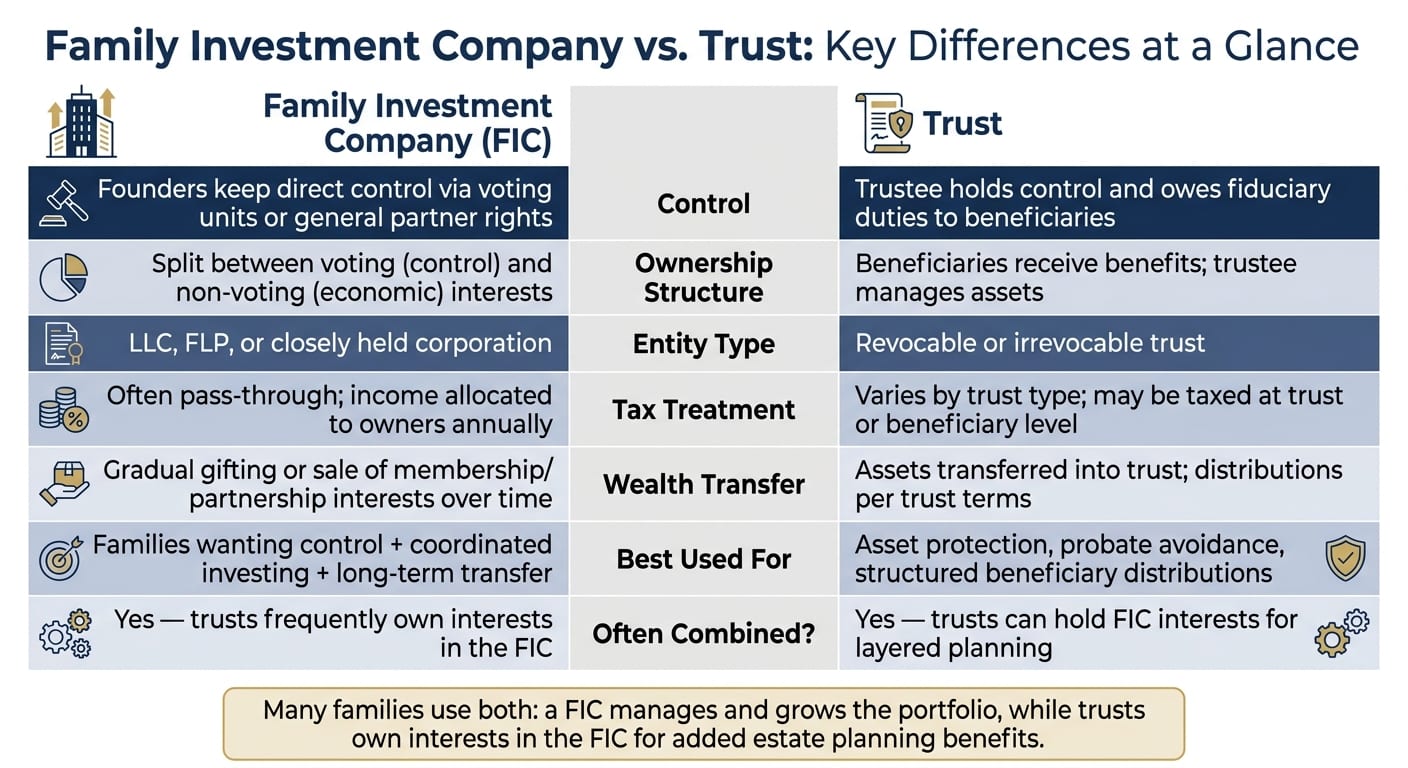
A lot of families compare a FIC with a trust, but they don’t do the same job. A trust usually puts a trustee in charge. A FIC may let the family keep direct control through voting shares, manager rights, or general partner rights. Some families use both.
What this article covers, in plain English:
- what a FIC may be
- how control and share rights may be split
- which assets may go inside it
- how gifting, loans, and transfers may work
- where tax planning may fit in
- how trusts and FICs differ
- who may use these structures
- the main costs, risks, and tradeoffs
- the basic checks a family may want to review before setting one up
If you want the simplest takeaway, it’s this: a FIC may work best when a family wants shared investing and long-term wealth transfer without giving up control right away. But if assets are modest or cash needs are high, a simpler setup may be enough.
Webinar: Could a Family Investment Company be the key to smarter tax and estate planning?
What a Family Investment Company Is and How It Works
A Family Investment Company is a closely held entity that holds and grows investments, often using high-net-worth investing strategies, often through a family LLC, FLP, or closely held corporation. In the U.S., families may choose among these setups based on tax treatment, liability concerns, and governance goals tied to long-term family wealth planning.
How Ownership, Control, and Share Rights Are Structured
The key design choice in a family investment entity is often the split between control and economic ownership.
In a family LLC, that usually means two classes of membership units:
- Voting units held by the founders
- Non-voting units gifted or sold to children or grandchildren
That setup may let the founders keep decision-making power, while younger family members may own a growing share of the economic value, such as future income and appreciation, without day-to-day control.
In a family limited partnership, the same idea shows up through the general partner / limited partner structure. Parents often act as general partners and keep control over investment decisions, while children hold limited partner interests that may give them a share of profits but not management rights. Parents may retain only a small general partner interest and still control partnership decisions.
These rights are usually laid out in:
- Operating agreements for LLCs
- Partnership agreements for FLPs
- Shareholder agreements for corporations
A well-drafted operating agreement may cover distribution policies, transfer restrictions, voting thresholds, and what may happen if a family member wants to leave. Some families also use a family governance charter to spell out shared values, the investment mission, and ways to handle conflict.
How Families Fund the Entity and What It Can Hold
Families often fund these entities through cash contributions, asset transfers, gifts of membership or partnership interests, or intrafamily loans, so future growth may build inside the entity.
The entity may hold many types of assets, including publicly traded stocks and ETFs, mutual funds, fixed income securities, rental real estate, private equity interests, or stakes in closely held businesses. Real estate shows up often. For example, families may deed rental properties into an FLP or LLC to bring management under one roof and make later transfers simpler.
Funding choices may carry tax effects. Intrafamily loans must charge at least the IRS-published applicable federal rate (AFR) to avoid treatment as taxable gifts. Transfers of appreciated assets into the entity may trigger capital gains, depending on how the transfer is set up. And gifting membership or partnership interests to children may call for a professional appraisal to support the value used for gift tax purposes.
How FICs Compare to Trusts
For families looking at estate-planning tools, a family investment entity and a trust may both serve estate planning goals, but they work in different ways.
A trust places control with a trustee, who owes fiduciary duties to beneficiaries. A family LLC or FLP may let founders keep direct, documented control through voting units or general partner status. In practice, many families use both: a family LLC or FLP may hold and manage the portfolio, while one or more trusts own interests in that entity for added estate planning and asset protection features. That combined structure may be what allows the tax and transfer benefits to work.
Why Families Use FICs for Tax Planning and Wealth Transfer
FICs may give families a way to organize assets, handle tax planning, and pass future growth to the next generation while still keeping control where they want it. That split matters. In many setups, one group keeps the decision-making power, while another group receives more of the future upside. That's the part that may make the tax and transfer approaches below possible.
Tax Efficiency When Profits Stay Inside the Entity
In the U.S., family LLCs and FLPs are often set up as pass-through entities. That means income usually flows through to the owners, instead of being taxed first at the entity level. For some families, that may create room to allocate income among relatives in lower tax brackets.
Some families choose C-corp tax treatment instead. That may allow earnings to stay inside the entity, but any later dividend payments may face a second layer of tax.
There's a catch here. Pass-through taxation does not defer tax. Owners in an FLP or LLC may still owe tax each year on their allocated share of income, even when no cash gets distributed. So the upside may be less about delaying tax and more about shaping how income gets divided and handled.
That same setup may also move future appreciation out of the senior generation's estate over time.
Transferring Wealth Over Time Without Giving Up Control
A family LLC or FLP may let parents pass future growth to children without handing over day-to-day control. In many cases, the senior generation keeps voting interests or general partner interests, while non-voting interests or limited partner interests get transferred over time to children or irrevocable trusts.
Those transfers may happen through annual exclusion gifts, use of the lifetime gift and estate tax exemption, or structured sales to grantor trusts. And because these interests are often hard to value and aren't easy to sell on an open market, appraisers may support valuation discounts that lower the taxable value of gifts or sales.
That said, the IRS pays close attention to these setups. Discounts may be challenged if the entity lacks a real investment or business purpose beyond lowering tax. Internal Revenue Code §2036 may also come into play. If the founder keeps too much practical control over transferred assets, those assets may be brought back into the taxable estate. In that kind of case, defensible valuations, formal governance, and written non-tax reasons may carry a lot of weight.
Who Typically Uses a FIC and When It Makes Sense
FICs tend to be more common among physicians, executives, tech employees with concentrated stock, and business-owning families with sizable taxable portfolios who want a more coordinated succession plan. These families may have enough taxable wealth that coordination across the whole family matters more than managing each account on its own.
Many advisors suggest these structures may start to make sense when a family's investable assets are around $10 million or more, especially once legal setup costs, annual tax filings, appraisal fees, and governance work are part of the picture. Below that range, the legal and administrative load may outweigh the upside. Still, the trigger may not be a fixed number. It may come down to the mix of asset size, tax exposure, and how many family members or generations need to be coordinated.
Those upsides may depend on whether the structure's costs, filings, and governance remain manageable.
Benefits, Risks, and Costs of a Family Investment Company
Where a FIC Can Add Value
A FIC puts rules around how a family handles control, approves distributions, and sets investment guardrails. That kind of structure may matter most when a family wants control without confusion.
It may also bring brokerage accounts, private funds, and real estate under one roof. In some cases, that may make reporting easier and cut duplicate oversight. That's a big part of why some families use a FIC for coordinated family wealth management.
Where a FIC Can Go Wrong
The same traits that may make a FIC useful may also create friction. The main pressure points are cost, conflict, and illiquidity.
- Control conflicts: Tension may come up when heirs have economic ownership but little or no voting power. If control sits with one person or one branch of the family, resentment may build fast.
- Compliance cost: Setup may involve legal drafting, entity formation, and asset appraisals. Yearly costs may include K-1s, tax filings, accounting, reporting, and governance records. Those costs may climb further if the entity holds real estate, private funds, or assets outside the U.S.
- Liquidity limits: If a FIC holds private real estate or other long-term investments, it may not be easy to distribute cash to a member who needs steady cash flow. Transfer limits may also make it hard to exit.
C-corp treatment may also lead to double taxation on later distributions. Depending on a family's cash needs, that may make the setup less tax-efficient than holding investments personally.
How Much in Assets You Need to Justify the Costs
FICs may fit best when a family has enough assets, complexity, and long-range planning goals to justify the legal, tax, and reporting burden. The bigger issue may not be a set dollar amount. It may be the mix of complexity, illiquidity, and time horizon. A longer holding period may strengthen the case for a FIC, since any upside from the structure may build over time. If the cost and hassle outweigh that upside, simpler accounts or trusts may be a better fit.
The next step may be to weigh those upsides against the reporting load, governance demands, and family tradeoffs in your situation.
How to Decide If a FIC Is Right for Your Family
A Decision Checklist Before Setting One Up
Before setting up a FIC, it may help to pressure-test whether your family’s assets, control goals, and transfer timeline line up with how the structure works.
If several answers are yes, a FIC may be worth looking into. If liquidity needs are high or assets are modest, the cost and complexity may outweigh the upside. And if the structure seems to fit, the next step may be less about setup and more about day-to-day oversight.
Using Mezzi to Monitor a FIC Alongside Personal Accounts
A FIC may affect the household balance sheet, not just one account. Mezzi gives families a read-only view across the FIC and personal accounts, while families and advisers keep full control of each decision.
In practice, Mezzi may flag concentration risk when the same large-cap fund shows up in both the FIC and personal portfolios. It may surface hidden fees inside layered fund structures. It may also identify tax-inefficient assets sitting in taxable accounts and highlight wash sale risk when a loss sold in one account gets repurchased in another, including the FIC.
On top of that, it may surface tax-loss harvesting candidates across the full household, which families may then review with their advisers.
Those monitoring issues are why the last test isn’t just whether a FIC works on paper. It’s whether the family may be able to run it in a steady, organized way.
Key Takeaways
FICs may appeal to families that want control, tax-aware investing, and structured wealth transfer in one entity. They may fit best when assets, complexity, and time horizon are large enough to justify the legal, accounting, and governance burden. Used well, a FIC may play a helpful role in a long-range wealth plan. Used poorly, it may become an expensive source of friction.
FAQs
How is a FIC different from a trust?
A Family Investment Company (FIC) is a private company used to manage and grow family wealth. A trust is a legal arrangement where a trustee holds assets for named beneficiaries.
Both may be used for wealth transfer and tax planning, but they work in different ways. Trusts often offer stronger creditor protection and more tailored distribution rules. A FIC, by contrast, is a corporate structure designed for shared family control and investment management.
What assets work best inside a FIC?
FICs may be most useful with assets that have strong growth potential, since future gains may happen outside the primary estate and may reduce later tax liabilities.
Common examples include diversified stock portfolios, investment funds, and real estate. They may also suit assets that may be gifted in fractional interests, which may let families keep control while gradually shifting wealth to heirs.
When is a FIC worth the cost?
A Family Investment Company (FIC) may be worth the cost when a family wants a more involved way to pass wealth across generations while keeping tight control over shared assets.
It may become more relevant as an estate gets closer to the federal tax exemption threshold, which is scheduled to drop to about $6.8 million per person in 2026. For families that may want to shift income and future growth to relatives in lower tax brackets, manage stocks or property in one place, and reduce probate burdens, the long-term tax savings and added control may justify the costs.
Disclosures:
- This content is for informational purposes only and does not constitute investment, tax, or legal advice.
- Family investment partnerships and holding companies involve complex legal and tax considerations. Consult with qualified legal and financial advisors before establishing any such structures.
- Past performance is not indicative of future results. Investment structures that work for some families may not be appropriate for others.
Related Blog Posts
- Top Tax Mistakes in Estate Transfers
- Should you set up an LLC for investing? What changes at different wealth levels
- Intentionally Defective Grantor Trusts (IDGTs): Advanced Estate Planning
- Private Family Foundations: Tax Deductions and Philanthropic Control
A Family Investment Company (FIC) is a private company used to manage and grow family wealth. A trust is a legal arrangement where a trustee holds assets for named beneficiaries.
Both may be used for wealth transfer and tax planning, but they work in different ways. Trusts often offer stronger creditor protection and more tailored distribution rules. A FIC, by contrast, is a corporate structure designed for shared family control and investment management.
FICs may be most useful with assets that have strong growth potential, since future gains may happen outside the primary estate and may reduce later tax liabilities.
Common examples include diversified stock portfolios, investment funds, and real estate. They may also suit assets that may be gifted in fractional interests, which may let families keep control while gradually shifting wealth to heirs.
A Family Investment Company (FIC) may be worth the cost when a family wants a more involved way to pass wealth across generations while keeping tight control over shared assets.
It may become more relevant as an estate gets closer to the federal tax exemption threshold, which is scheduled to drop to about $6.8 million per person in 2026. For families that may want to shift income and future growth to relatives in lower tax brackets, manage stocks or property in one place, and reduce probate burdens, the long-term tax savings and added control may justify the costs.