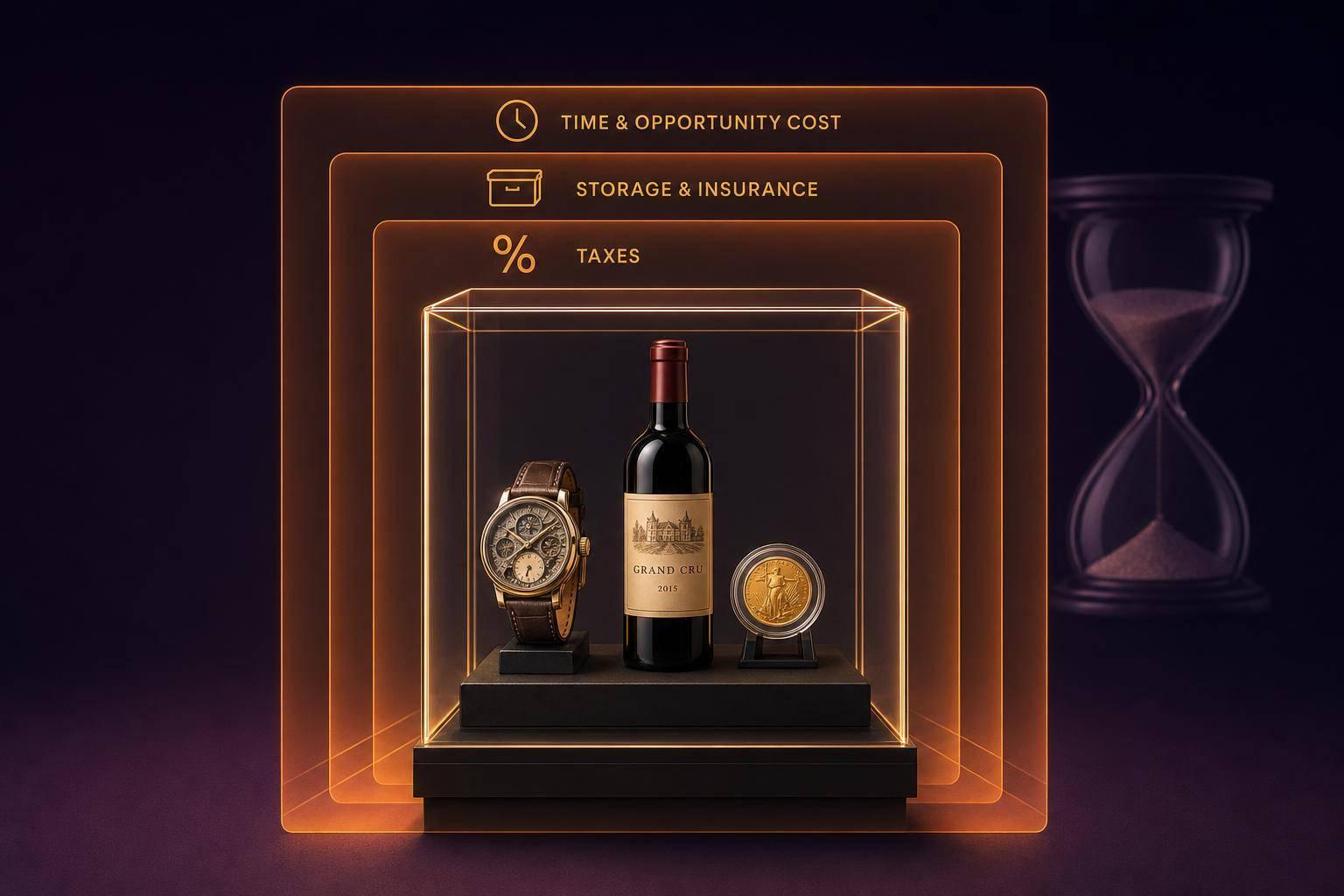
Collectibles may look like investments, but net returns may end up far lower than headline gains suggest. Between taxes, auction fees, insurance, storage, and slow sales, an item may need to gain 25% to 40% just to get past round-trip costs.
If I were sizing this part of a high-net-worth financial plan, I’d keep the big picture simple:
- Watches may offer the easiest resale path, but value may depend on model, condition, parts, and paperwork.
- Wine and whiskey may ride on scarcity, but storage mistakes and fraud risk may cut resale value.
- Handbags, art, cars, and memorabilia may have upside, yet each market may come with its own fee load and slow exit path.
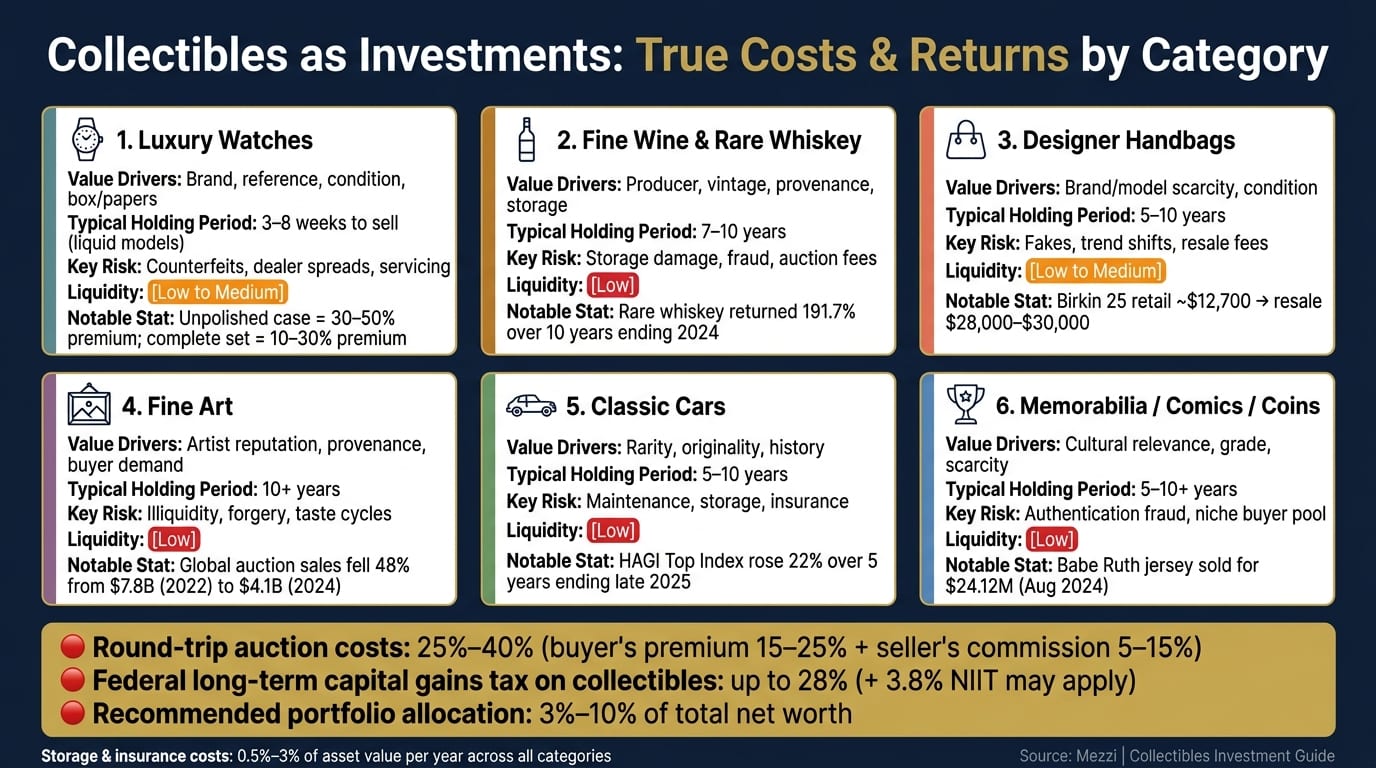
- Taxes may bite harder than many people expect: long-term gains on collectibles may face a federal rate of up to 28%, and some investors may also owe the 3.8% NIIT.
- Position size may matter more than passion: some investors treat collectibles as a small slice of net worth, often around 3% to 10%.
Here’s the short version: collectibles may fit as a small, long-term, well-documented holding. But they may not work like stocks, bonds, or cash. They don’t pay income, pricing may be less clear, and selling may take weeks, months, or longer.
Why Investors Are Turning to Collectibles and Hard Assets in 2026
Quick Comparison
So before I’d treat a collectible like an asset, I’d look past the story and focus on the math: fees, taxes, records, holding period, and how hard it may be to sell when cash is needed.
Luxury watches: what drives value and where investors lose money
Many luxury watches may lose 20% to 40% of value at retail. In this market, price may depend less on luxury branding by itself and more on the brand, the exact reference, the watch’s condition, and how deep the resale market is. A narrow group of brands and models tends to draw most buyer interest, while everything outside that group may get marked down fast.
Brands, models, and price ranges that matter
Rolex, Patek Philippe, and Audemars Piguet account for roughly 64% of total secondary market value, with a lot of that tied to stainless steel sports models. Watches with real resale demand may start around $5,000 to $10,000, while many references viewed as more investable tend to sit above that range.
Buying pre-owned may make more sense for some buyers than buying new, since the first owner may already have absorbed the early depreciation hit.
The factors that determine watch prices
Once the right model is on the table, condition and completeness may drive the next jump in price.
An unpolished case - one that still has its original factory edges and bevels - may be worth 30% to 50% more than the same reference with a refinished case. On the flip side, one deep scratch or a bad polish job may cut resale value by 10% to 15%.
Completeness matters just as much. A complete set - box, papers, and receipts - may command a 10% to 30% premium over the same watch sold by itself. Missing paperwork may create questions about provenance, which may make buyers more cautious and push offers lower.
The real costs: counterfeits, fees, insurance, and exit risk
Counterfeits are a major risk, and a fake watch has zero investment value. The problem isn’t limited to obvious fakes either. Buyers may also run into assembled-from-parts watches, built from mismatched components across different production years. Those pieces may lose up to 60% of their value compared with verified originals.
Some buyers stick with dealers that provide documentation and warranties, then verify serial numbers on their own as a second check.
Ownership costs may pile up faster than people expect. Insurance may run 0.5% to 1% of value each year, storage may add 1% to 3% per year, and servicing adds another layer over time. Put together, a $50,000 watch may carry $15,000 to $25,000 in ownership costs over a decade.
Liquidity is the other gut check. Rolex steel sports models typically take 3 to 8 weeks to sell at fair value through a reputable dealer or auction. Complicated Patek Philippe references draw a smaller buyer pool and may take months to find the right offer. If a seller needs to exit fast, bids may come in lower.
It may also help to track each watch digitally:
- purchase date
- cost basis
- serial number
- high-resolution photos of each component
- service receipts
These records may support cost-basis tracking, resale prep, and portfolio management. Mechanical servicing may also need to be budgeted every 3 to 5 years, ranging from roughly $800 for a basic Rolex service to $5,000 or more for a complicated Patek Philippe movement. Wine and whiskey tend to follow the same scarcity logic, but with those assets, storage may become the bigger risk.
Fine wine and rare whiskey: scarcity helps, but storage can ruin returns
Wine and whiskey may rise in value as bottles get opened and supply shrinks. But scarcity alone usually isn't enough. In this market, storage and provenance may matter almost as much as the label on the bottle.
What makes a wine or whiskey investment-grade
Only a small part of the market has the mix of traits that may support resale: a well-known producer or distillery, an active secondary market, limited supply, documented provenance, and repeat buyer demand. For wine, that often points to Bordeaux First Growths and top Burgundy producers like Domaine de la Romanée-Conti (DRC). For whiskey, the names that come up most often are Macallan and Port Ellen.
Scores may also shape demand. A 100-point score from Robert Parker or Wine Spectator may have a strong effect on buyer interest, and strong vintages may hold value longer than average ones. Even so, only a narrow slice of bottles tends to meet this bar.
Performance data helps explain the appeal. Rare whiskey was the top-performing luxury collectible over the 10 years ending in 2024, with a 191.7% return, while fine wine prices rose 146% over the 10 years ending in Q4 2023. Both categories pulled back in 2024.
Storage, fraud, and market-cycle risk
The upside may depend on one simple thing: keeping the bottle intact from producer to resale. A bottle may be damaged without anyone noticing until it's opened. Temperature swings, excess humidity, or light exposure may permanently reduce value, even for a sought-after bottle. That's why investment-grade bottles are often kept in professional climate-controlled storage.
Auction pricing may also hinge on condition. Label quality, cork integrity, and ullage - the air gap between the wine and the cork - may affect what a buyer is willing to pay. Fraud adds another layer of risk at the top end of the market. Older high-value bottles may be exposed to refilling and label manipulation, which is why documented custody from producer to storage to buyer may matter so much.
Costs may take a noticeable bite too. Professional storage and insurance may run about 1% to 2.85% of the asset's value each year. Then there are auction fees. Buyer's premiums typically run 15% to 25%, while seller's commissions add another 5% to 15%, so round-trip costs may reach 25% to 40% of value.
Buying bottles directly versus using managed access
How someone enters this market may shape cost, control, and day-to-day hassle. Buying bottles directly gives full ownership, but it also means handling sourcing, authentication, and storage on your own. Managed access may reduce that workload, though annual fees of about 2% to 2.85% may still weigh on long-term results.
Even the right access route doesn't remove the exit issue. Storage, insurance, and transaction fees may eat into gains, so some investors may need a 7- to 10-year holding period before net gains start to matter.
The same mix of scarcity, provenance, and operating costs may also show up in handbags, art, cars, and memorabilia.
Other rare goods: handbags, art, cars, and memorabilia
Other rare goods tend to follow the same basic pattern. Scarcity may support prices, but each category comes with its own fees, proof-of-origin work, and selling risk. Where they differ most is in cost, upkeep, and how hard it may be to get out.
The main categories worth knowing
Designer handbags are led by Hermès, especially Birkin and Kelly models. Hermès keeps supply tight, which may support a strong resale market where some pieces trade well above retail. A Birkin 25 that retailed for about $12,700 in 2025 could fetch $28,000 to $30,000 on the resale market.
Fine art has historically returned 8% to 12% annually for top-tier works by established artists, though that range may not hold across periods or segments. At the same time, total global auction sales at major houses fell from $7.8 billion in 2022 to $4.1 billion in 2024, a 48% drop. Entry-level investment-grade paintings typically start around $25,000. Art may be illiquid, cyclical, and costly to trade.
That same trade-off shows up in cars and memorabilia, where ownership costs and proof of origin may matter just as much as the sticker price.
Classic cars may be expensive to own and maintain. The HAGI Top Index for investment-grade cars rose 22% over the five years ending in late 2025. Digital platforms like Bring a Trailer have opened the market to more buyers, but the asset class still tends to demand a lot of ongoing attention.
Sports memorabilia and rare comics round out the category. In August 2024, a game-worn Babe Ruth jersey from the 1932 World Series sold at Heritage Auctions for $24.12 million, the most expensive piece of sports memorabilia ever sold. In April 2024, a first-edition Action Comics #1 sold at Heritage Auctions for $6 million.
Value drivers that repeat across categories
Millennial and Gen Z demand is lifting prices for 1980s toys, 1990s video games, and early 2000s sports cards as those generations move into peak earning years. Brand strength and cultural relevance may also support demand across market cycles.
On the surface, these markets may look quirky and all over the map. But the evaluation habits are pretty similar. Buyers often focus on the best quality they can authenticate, keep tight records, and think about the exit before the purchase.
Category-specific risks and operating burden
Costs vary a lot by category, as the table shows.
Insurance is another place where the fine print may matter. Standard homeowners' insurance policies often cap collectible coverage at $2,500, which may sit far below the value of many investment-grade pieces. Specialty agreed-value insurance from carriers like Chubb or AXA Art typically costs 0.5% to 2% of the asset's value per year.
Concentration risk also matters here. If a large share of capital sits in one narrow pocket - like a single artist or one car brand - a change in taste or a slump in that segment may hit at the same time that selling gets harder.
These differences shape how much room collectibles may realistically take up in a portfolio.
Portfolio fit, taxes, and tracking collectibles with Mezzi
Once collectibles are priced and bought, the next issue may be portfolio fit. In practice, that often comes down to three things: position size, taxes, and tracking.
How much of your portfolio should be in collectibles
Collectibles are often treated as a small, noncore allocation. A common guideline suggests 5–10% of total portfolio value, while some experts point to a tighter 3–5% ceiling for high-net-worth investors due to operational complexity and high transaction costs.
The key point: size collectibles against total net worth, not just one account. These assets may take months to sell, so a cash need may force a sale at the wrong time.
Before allocating, it may help to ask:
- Do you have real expertise in the category?
- Can you hold for at least 7–10 years without needing the cash?
- Can you cover storage, insurance, and appraisals without relying on the principal?
U.S. tax and estate issues that affect net returns
Taxes are a major reason collectible returns may look better on paper than they do after tax. The 28% federal long-term capital gains rate on collectibles, covered earlier, may matter even more once state taxes are added. In high-tax states like California, the combined federal and state burden may reach 45.1% on a collectible gain. Short-term gains on items held one year or less are taxed at ordinary income rates, which may reach 37% at the federal level.
Estate planning may matter too. Under IRC Section 1014, assets transferred at death receive a step-up in basis to fair market value, which may remove embedded capital gains for heirs.
Good records matter just as much as a good appraisal. Accredited appraisers typically charge $200–$400 per hour. And if you can't produce purchase receipts, inheritance records, or gift tax returns, the IRS may assume a $0 cost basis.
For each item, some owners keep a records file with:
- Original invoices
- Certificates of authenticity
- Annual appraisal updates
That paperwork may support insurance claims, cost-basis tracking, and estate planning.
Using Mezzi to see collectibles in context
Because collectibles sit outside brokerage statements, they usually need separate tracking. Mezzi pulls connected liquid accounts - 401(k), brokerage, Roth IRA, and taxable accounts - into one read-only view, so off-platform collectibles may be viewed alongside the rest of your financial picture.
That broader view may make it easier to spot concentration, liquidity, or risk mismatches that might otherwise go unseen. Mezzi's X-Ray may flag overlap in liquid holdings, which may be useful if stocks or funds share exposure tied to a physical collection. Before a sale, Mezzi may model after-tax proceeds and cash flow impact.
Mezzi does not custody assets or execute trades. It serves as a read-only portfolio tracking platform, giving you a broad view of wealth so collectibles may stay properly sized, tracked, and accounted for next to the rest of net worth.
Conclusion: Treat collectibles as assets, not just stories
Collectibles may add diversification to a portfolio, but the math may look less appealing once fees, storage, taxes, and exit timing are included. Auction houses often charge a buyer's premium of 15% to 25% and a seller's commission of 5% to 15%, so an item may need to appreciate 25% to 40% just to break even. Storage, insurance, and trading costs may also chip away at returns, turning a strong gross gain into a weaker net result.
That trade-off may vary by category. Watches may be the most liquid. Wine and whiskey may depend more on storage and provenance. Art, handbags, cars, and memorabilia often come with the heaviest operating burden.
Then there are taxes. Those may shape the final result just as much as the purchase price or sale price. Collectibles may face a higher long-term federal rate than stocks.
That’s why position size may matter more than enthusiasm. Collectible value may be tied more to scarcity, documentation, and exit readiness than to personal taste or brand lore. For some investors, the strongest case for collectibles may be a small, well-documented allocation held for the long term. Clean records and regular appraisals may make ownership easier to manage over time. Tracking collectibles in Mezzi keeps the full picture visible and may help limit concentration risk.
FAQs
Are collectibles an investment or a hobby?
Collectibles often sit in a gray area between a hobby and an investment. As passion assets, they may offer personal enjoyment and may also hold long-term value.
Unlike stocks, bonds, or funds, a collectible’s value may depend on things like scarcity, provenance, and condition. There may also be extra costs in the mix, such as storage, insurance, and upkeep. Because of that, some people view collectibles as a complement to a traditional portfolio rather than a replacement for one.
How do I know if a collectible is authentic?
Look for third-party authentication and clear documentation. In some categories, services like PSA, PCGS, and NGC may verify an item’s identity and condition.
For other collectibles, check provenance - the ownership history. Reputable auction houses often trace this. Items without clear documentation may carry more uncertainty, and for major purchases, some buyers consider an independent appraisal from someone not affiliated with the seller.
When do collectibles make sense in a portfolio?
Collectibles may make sense when they complement, not replace, stocks, bonds, and property. Since they often move on different cycles than public markets, they may add diversification and may improve risk-adjusted returns for some investors.
They’re often viewed as a better fit for people who already have a solid base in stocks, bonds, and property. Some experts suggest keeping collectibles to about 5% to 10% of total wealth and treating them as a long-term commitment, not short-term speculation.Disclosures:
- This content is for informational purposes only and does not constitute investment advice or a recommendation to buy or sell any security.
- Past performance is not indicative of future results. No guarantee of future performance or outcomes is implied.
- Savings and performance examples are hypothetical and for illustrative purposes only. Actual results will vary based on individual circumstances, portfolio composition, market conditions, and fees.
Related Blog Posts
- Non-correlated assets: how to diversify beyond stocks and bonds
- The Complete Guide to Alternative Investments including farmland, art, pre-ipo, and private credit
- Fractional Jet Ownership: Costs, Benefits, and Tax Considerations
- Fine Wine and Whiskey Investing: Returns, Storage, and Tax Treatment
Collectibles often sit in a gray area between a hobby and an investment. As passion assets, they may offer personal enjoyment and may also hold long-term value.
Unlike stocks, bonds, or funds, a collectible’s value may depend on things like scarcity, provenance, and condition. There may also be extra costs in the mix, such as storage, insurance, and upkeep. Because of that, some people view collectibles as a complement to a traditional portfolio rather than a replacement for one.
Look for third-party authentication and clear documentation. In some categories, services like PSA, PCGS, and NGC may verify an item’s identity and condition.
For other collectibles, check provenance - the ownership history. Reputable auction houses often trace this. Items without clear documentation may carry more uncertainty, and for major purchases, some buyers consider an independent appraisal from someone not affiliated with the seller.
Collectibles may make sense when they complement, not replace, stocks, bonds, and property. Since they often move on different cycles than public markets, they may add diversification and may improve risk-adjusted returns for some investors.
They’re often viewed as a better fit for people who already have a solid base in stocks, bonds, and property. Some experts suggest keeping collectibles to about 5% to 10% of total wealth and treating them as a long-term commitment, not short-term speculation.Disclosures:
- This content is for informational purposes only and does not constitute investment advice or a recommendation to buy or sell any security.
- Past performance is not indicative of future results. No guarantee of future performance or outcomes is implied.
- Savings and performance examples are hypothetical and for illustrative purposes only. Actual results will vary based on individual circumstances, portfolio composition, market conditions, and fees.