
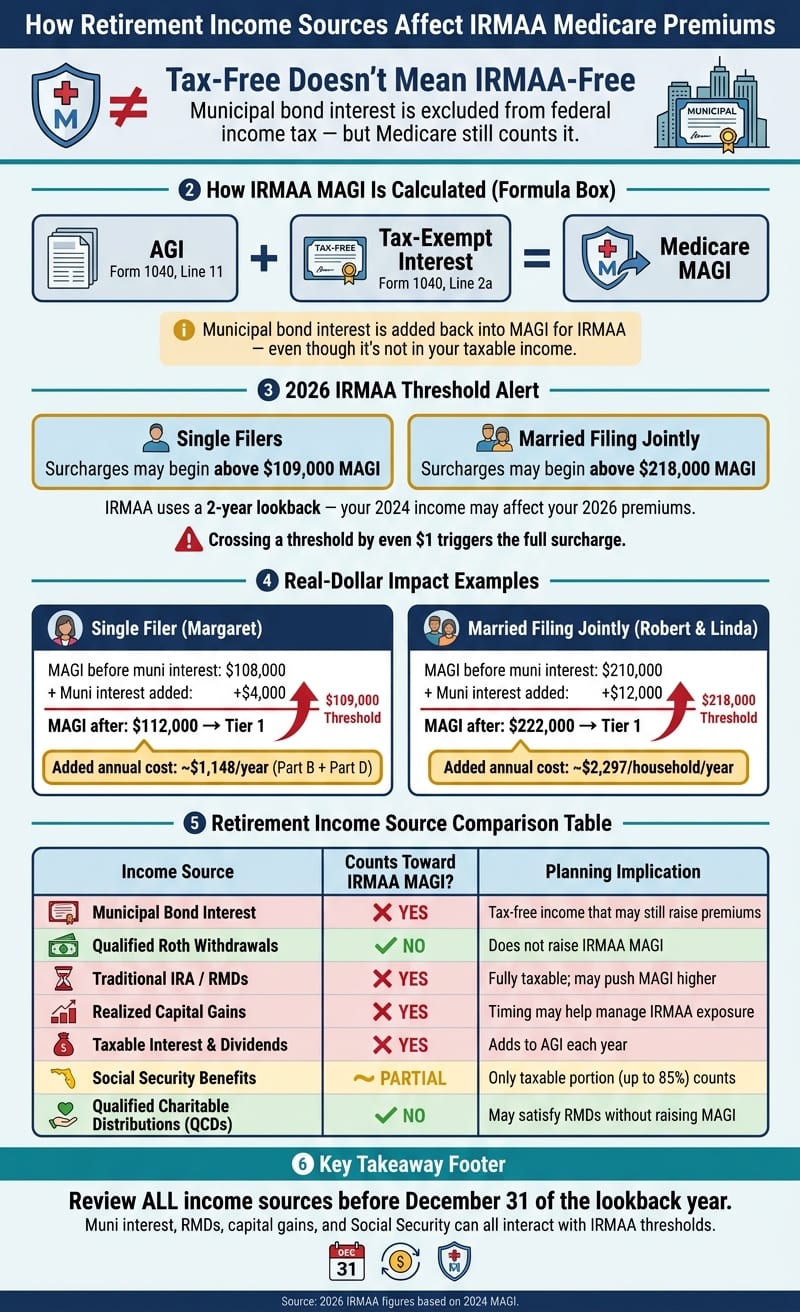
Tax-free municipal bond interest may still lead to higher Medicare premiums. That’s because IRMAA uses MAGI, not taxable income - and for this Medicare test, tax-exempt interest gets added back.
Here’s the short version:
- Muni interest may be free from federal income tax
- But it may still count for IRMAA
- For 2026, surcharges may start above $109,000 for single filers and $218,000 for married couples filing jointly
- IRMAA uses a 2-year lookback, so 2024 income may affect 2026 premiums
- Going over a threshold by even $1 may mean a full monthly surcharge for Part B and Part D
A simple example: if a single filer’s Medicare MAGI moves from $108,000 to $112,000 after adding $4,000 of muni interest, that person may land in the first IRMAA tier. Based on the figures in this piece, that may mean about $1,148 more per year in Medicare costs.
Here’s the main point in plain English: “tax-free” for the IRS may not mean “ignored” by Medicare. This piece sums up how muni interest fits into IRMAA, how it compares with Roth withdrawals, IRA distributions, capital gains, and Social Security, and why some households review all income sources before year-end.
Quick comparison
If you own muni bonds, this article may help connect two systems that often get treated separately: tax planning and Medicare premium planning.
Medicare IRMAA: The Income Rules Most Agents Get Wrong
What IRMAA counts and why municipal bond interest is included
IRMAA is a surcharge added to Medicare Part B and Part D premiums when income goes above set thresholds. The Social Security Administration (SSA) uses a two-year lookback and pulls income data from the federal tax return filed two years earlier. So the return SSA reviews may include older muni interest. Once SSA pulls that return, tax-exempt interest gets added back into MAGI.
IRMAA uses MAGI, and muni interest is included
For IRMAA, SSA uses MAGI = AGI + tax-exempt interest, based on Form 1040: AGI (Line 11) plus tax-exempt interest (Line 2a).
Municipal bond interest stays out of AGI, so it may not affect your federal income tax bill. But SSA adds it back when figuring Medicare MAGI, which means it may still affect IRMAA.
Here’s the key distinction at a glance:
When you earn interest from municipal bonds or a muni bond fund, that income is reported on Form 1040, Line 2a. It does not flow into AGI. But SSA may pull that amount and add it to AGI to arrive at Medicare MAGI. That difference between taxable income and Medicare MAGI may be easy to miss.
Once you know how MAGI works, the next step is looking at whether muni income may put you over an IRMAA threshold.
When municipal bond income pushes you into a higher IRMAA bracket
IRMAA works like a cliff. If income goes over a threshold by even $1, the full surcharge may apply. A simple single-filer example may make that easier to see.
Single filer example: crossing a threshold with muni income
Take a hypothetical retiree, Margaret. Her 2024 MAGI is $108,000, which puts her just under the $109,000 single-filer threshold. At that level, she pays the standard 2026 Part B premium of $202.90 per month and no IRMAA surcharge.
Now add $4,000 in municipal bond interest. For IRMAA, that interest goes back into MAGI, bringing her total to $112,000. That moves her into Tier 1 ($109,001-$137,000).
At that tier, she may face:
- An $81.20 per month Part B surcharge
- A $14.50 per month Part D surcharge
Over a year, that comes to about $974 more for Part B and $174 more for Part D. Put together, that's roughly $1,148 per year in added Medicare costs tied to $4,000 of muni interest.
For married couples, the same issue may hit both spouses at once.
Married filing jointly example: how combined income compounds the issue
Consider a hypothetical couple, Robert and Linda. Their 2024 MAGI is $210,000, which is below the $218,000 joint threshold. At that income, both pay only the standard Part B premium.
Their municipal bond portfolio produces $12,000 in tax-exempt interest. Once that amount is added back to MAGI for IRMAA, their total reaches $222,000. That places them in Tier 1 ($218,001-$274,000).
Because IRMAA applies to each spouse, the household may then pay:
- $81.20 per month per person for Part B
- $14.50 per month per person for Part D
On a yearly basis, that's about $2,297 in added Medicare costs for the household, tied entirely to muni interest.
2026 IRMAA bracket comparison table
The table below shows how muni interest may push income across a threshold, using 2026 premiums based on 2024 MAGI.
This cliff effect may show up at every tier, not just the first one. For example, a couple with MAGI of $217,500 and only $600 in muni interest would end up at $218,100. That may push them over the joint threshold and trigger surcharges for both spouses for the full year.
Municipal bonds may be only one part of the IRMAA picture. Roth income, IRA withdrawals, and other retirement income sources may shape it too.
How municipal bonds compare with other retirement income sources for IRMAA
Retirement income may affect IRMAA in very different ways depending on where the money comes from. That’s why the source of income may matter just as much as the tax rate when people think about Medicare costs.
Why Roth withdrawals are treated differently than muni interest
Municipal bond interest is federally tax-exempt, and qualified Roth withdrawals are generally not taxable. But for IRMAA, they may lead to very different results.
Qualified Roth withdrawals generally stay out of AGI and IRMAA MAGI. Nonqualified withdrawals may add taxable earnings. So, a Roth withdrawal may cover spending without lifting IRMAA MAGI, while the same dollar amount from a municipal bond fund may increase MAGI by that full amount.
Other income sources, like IRA withdrawals and capital gains, have their own rules.
How IRA distributions, RMDs, capital gains, and Social Security affect IRMAA
Traditional IRA withdrawals and required minimum distributions (RMDs) are taxed as ordinary income, so they go straight into AGI and count toward IRMAA MAGI. Large RMDs may push a retiree into a higher IRMAA tier by themselves. Add muni interest on top, and the total may stack up fast.
Realized capital gains also count toward IRMAA MAGI, whether they’re short-term or long-term. Timing and tax-loss harvesting may help manage when those gains show up. Social Security works a bit differently: only the taxable portion, up to 85%, counts toward IRMAA MAGI.
Income source and IRMAA treatment comparison table
The table below shows which common retirement income sources may lift IRMAA.
For IRMAA, muni interest may behave much like taxable income. Roth withdrawals and QCDs do not raise MAGI.
How to plan around IRMAA when you hold municipal bonds
Review income sources before the two-year lookback year closes
Once you know muni interest counts, the next step may be timing each income source before year-end. IRMAA uses a two-year lookback, so income recognized by December 31 may lead to higher premiums two years later.
A practical way to check this is to run a mid-year income estimate that includes municipal bond interest, IRA withdrawals, RMDs, realized capital gains, and the taxable portion of Social Security. Then compare that projected MAGI with your IRMAA threshold. If the estimate lands close to the line, there may still be time to adjust. Some people delay an IRA withdrawal, move a Roth conversion to a later year, or spend from Roth assets instead.
Why bother over a small gap? Because crossing a bracket by even $1 may add about $1,148 per person per year in combined Part B and Part D surcharges at Tier 1, with larger surcharges at higher tiers.
If the estimate looks tight, account-level visibility may help spot the leak before it shows up in IRMAA.
Use account-level visibility to spot IRMAA exposure
Separate accounts may hide the full picture. A single household view may make threshold risk easier to see.
Municipal bond interest is easy to miss because it does not appear in AGI. But for IRMAA MAGI, that interest gets added back.
Mezzi's account aggregation shows taxable, IRA, Roth, and muni income in one household view. If projected MAGI is near a threshold, that household view may help identify the income source that results in the lowest MAGI.
Conclusion: tax-free does not mean IRMAA-free
Municipal bond interest may still be tax-free, but it may also raise Medicare premiums. That tax-free muni income still counts because IRMAA uses Medicare MAGI, not taxable income. One common way people manage around that is by reviewing all income sources before year-end.
FAQs
How do I calculate my IRMAA MAGI?
Start with your AGI from the tax return you filed two years ago. Then add the income Medicare includes for IRMAA, such as tax-exempt municipal bond interest, untaxed foreign income, and non-taxable Social Security benefits.
That gives you your MAGI before the standard deduction. From there, you may compare that total with the IRMAA income brackets for the year that applies to see whether surcharges may apply.
Do state tax rules for muni bonds matter for IRMAA?
No. IRMAA is based on your federal MAGI, not state tax rules.
Even if municipal bond interest may be exempt from state or local taxes, it still gets included in federal MAGI for IRMAA. So state-level tax breaks may not reduce Medicare surcharges.
Can I appeal IRMAA if my income drops later?
Yes. You may appeal an IRMAA surcharge if a qualifying life-changing event is associated with a major drop in income.
Here’s the catch: Social Security bases premiums on tax returns from two years earlier, so changes may not happen automatically.
To request a review, file Form SSA-44 and include supporting documentation. Qualifying events may include:
- Retirement
- Reduced work hours
- Marriage
- Divorce
- Annulment
- Death of a spouse
- Loss of income-producing property due to disaster or fraud
- Loss of pension income
- Employer settlement payments
Disclosures:
- This content is for informational purposes only and does not constitute investment advice or a recommendation to buy or sell any security.
- Past performance is not indicative of future results. No guarantee of future performance or outcomes is implied.