
If you want cash before an IPO, you may have four main paths: tender offers, company buybacks, secondary sales, and stock-backed loans. Each path may involve a different mix of price cuts, taxes, company approval, fees, and timing.
Private-company stock may look valuable on paper. But turning it into cash may be slow and expensive. In some cases, sellers may face 20% to 50% discounts, 3% to 5% platform fees, 30- to 60-day ROFR delays, or tax issues tied to ISOs, NSOs, RSUs, AMT, or QSBS.
Here’s the short version:
- Tender offers may be the cleanest option if your company opens one.
- Buybacks may be simpler than a marketplace sale, but tax treatment may differ.
- Secondary sales may give access to outside buyers, though approval risk and fees may cut net proceeds.
- Stock-backed loans may provide cash without selling, but interest, collateral terms, and exit timing may add risk.
- Waiting may preserve upside, though it may leave you concentrated in one private asset for years.
How to Sell Pre-IPO Stock Options Before Your Company Goes Public
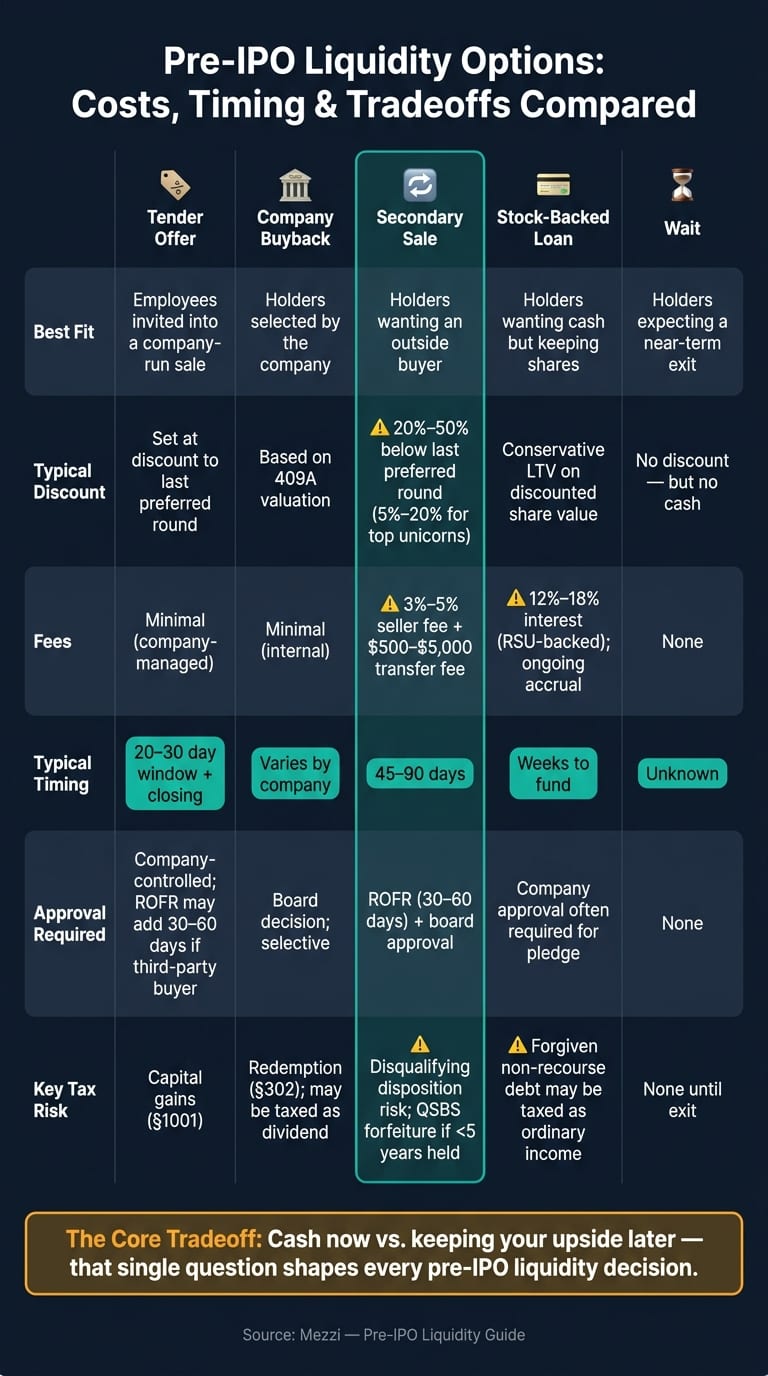
Quick Comparison
The key question may be simple: Do you want cash now, or do you want to keep your upside later? That tradeoff shapes almost every pre-IPO liquidity choice.
Tender offers and company buybacks
When a company runs its own liquidity event, a lot of the usual friction may fall away. These tend to be the most controlled paths to liquidity because the company sets the rules. The main differences usually come down to price, eligibility, taxes, and timing.
How tender offers work in practice
A tender offer is a company-sanctioned event where the company, or a designated buyer, offers to purchase shares from eligible holders at a defined fixed price. The company sets the eligibility rules, pricing, volume caps, and paperwork, then opens the offer to a specific group of shareholders with formal disclosures.
The participation window typically lasts 20 to 30 days. During that period, eligible holders decide whether to sell and how much. The price is fixed and is usually set at a discount to the most recent preferred round valuation.
Not everyone gets invited. Eligibility is often limited to current or former employees with vested shares, and some offers may add limits based on tenure or shareholder class. Volume caps are standard, with participants often allowed to sell only 10% to 25% of their vested holdings. Those caps may be meant to keep employee ownership at a meaningful level after the sale.
Tender offers are generally cleaner than private sales because they use one price and a standard process.
If you miss the offer window or don't qualify, secondary sales may be the next route.
How buybacks differ from tender offers
A company buyback happens when the company repurchases shares with its own cash. Tender-offer sales are usually taxed as capital gains, while buybacks are taxed as redemptions and may be treated as dividends if IRS tests fail.
Buybacks also tend to be more selective and less predictable. They're often ad hoc, tied to available company cash or a specific board decision, and may target only certain share classes or employee groups. Pricing is typically set by the board and is often anchored to the 409A valuation rather than the most recent preferred round price.
Tax treatment for ISO, NSO, and RSU shares may differ, and AMT or disqualifying dispositions may matter. It may make sense to review your grant documents before accepting a buyback offer.
Tender offers vs. buybacks: a side-by-side comparison
If the offer involves a third-party buyer, check whether ROFR applies, since closing may take 30 to 60 extra days. That may be worth factoring into any cash-timing plan.
Secondary marketplaces and direct private-share sales
If a company tender offer or buyback isn't available, the next path may be a private sale through a marketplace or a direct buyer. Secondary marketplaces connect private shareholders with accredited buyers, but these sales usually take longer, cost more, and carry more approval risk than tender offers. ROFR, board approval, discounts, and fees may all affect the outcome.
If you sell straight to a private buyer instead of using a marketplace, you may have more say over price and who you're dealing with. But you also take on the legal compliance work and the buyer-vetting process yourself.
How a secondary market sale closes, step by step
It usually starts with registration on a platform and a document review. In most cases, you'll submit your stock grant notice and the latest 409A valuation so the platform can verify ownership.
Once that check is done, the platform lists your shares and looks for an accredited buyer match.
After you agree on price, you send a formal Notice of Proposed Transfer to your company. That starts the Right of First Refusal, or ROFR, window. During that period - usually 30 to 60 days - the company may match the price and buy the shares instead.
That's a big reason secondary sales may feel less certain than company-run liquidity events.
If the company waives ROFR, the board may still need to approve the transfer to that specific buyer before anything closes.
Once approval comes through, funds go to escrow, the company's transfer agent updates the cap table, and escrow releases payment to you - usually one to two weeks after final approval. From start to finish, most pre-IPO secondary sales take 45 to 90 days.
Companies may also block transfers during active fundraising rounds or in the run-up to an IPO. Blackout periods are common, and they rarely get announced ahead of time.
The real costs of selling on the secondary market
This process has real friction. Secondary market bids for common stock typically land 20% to 50% below the most recent preferred-round valuation. That's largely because common shares don't come with the liquidation preferences that VC-held preferred shares carry.
Even in well-known unicorns like SpaceX or Stripe, the discount is usually 5% to 20% below the last primary round.
Then there are the fees. Platform fees typically run 3% to 5% from the seller and another 3% to 5% from the buyer. Companies may also charge administrative transfer fees of $500 to $5,000 to process the cap table update.
Minimum deal sizes may narrow the field too:
- Forge Global generally requires positions of at least $100,000
- EquityZen may handle smaller positions starting around $10,000 to $50,000
Taxes may matter just as much as price. Selling ISO shares before holding them for one year after exercise and two years after grant triggers a disqualifying disposition, which may convert what otherwise may have been long-term capital gains into ordinary income.
And if you've held shares for less than five years, you may give up a Section 1202 QSBS exclusion that may have sheltered up to $10 million in gains from federal tax entirely.
Secondary sales compared: speed, fees, and approval friction
EquityZen often uses SPVs to bundle smaller positions. Hiive's live order book may give faster price visibility.
If selling creates too much tax friction, cost, or timing risk, borrowing against private shares may be the next option.
Borrowing against private shares instead of selling
If selling may be too expensive or too slow, borrowing may offer a way to get cash without forcing a sale. Stock-backed lending lets you borrow against vested private shares without selling them. You keep the upside, and the loan may be repaid at an IPO or acquisition. Lenders usually focus on late-stage companies with a credible path to liquidity.
When a private-share loan can make sense
Borrowing fits when you need cash now but want to keep your equity.
This route may fit best if you believe strongly in the company but need cash now. A founder who may be wealthy on paper but needs money for a home purchase or a large tax bill is a classic case.
Employees dealing with the 90-day post-termination exercise window may use stock-backed financing to exercise vested ISOs and cover taxes instead of letting options expire.
Loan proceeds are usually not taxable when you receive them. Selling, by contrast, may trigger an immediate capital gains or ordinary income tax event.
The risks that matter most with stock-backed lending
The biggest risk is taking on debt against an asset that may still be hard to turn into cash. If the company stays private longer than expected, interest keeps accruing. Some RSU-backed loans carry interest rates of 12% to 18%. Lenders also use conservative loan-to-value ratios based on discounted share value. So in practice, you usually won't borrow dollar-for-dollar against the headline value of your shares.
There may also be a tax risk with non-recourse loans. If a non-recourse loan is forgiven, the canceled amount may still be taxed as ordinary income. That means you may owe taxes on money you never actually kept.
Company approval may be another hurdle. Even if you aren't selling shares, pledging them as collateral may still trigger the company's Right of First Refusal or require board approval. Some agreements treat a pledge as a transfer, so it may make sense to verify the stock purchase agreement before moving ahead.
Borrowing vs. selling: a direct comparison
The tradeoff gets easier to see when tax timing, upside, and approval burden sit side by side.
Borrowing doesn't remove risk. It swaps sale-timing risk for debt and collateral risk. The better fit may depend on taxes, timing, and how certain a future exit may be. These tradeoffs may help frame the choice between selling, borrowing, or waiting.
How to choose the right path and avoid common mistakes
Once you’ve looked at the mechanics and the costs, the choice may come down to five things: vesting, timing, concentration, approval, and taxes. Across tender offers, secondary sales, buybacks, and loans, the better path may depend on cost, timing, and how much control you want to keep.
When selling, borrowing, or waiting each makes sense
A few common patterns may help frame the decision:
- Sell when you need cash or want to reduce concentration risk, even if that means accepting a private-market discount.
- Borrow when you need liquidity but want to keep the shares and have a clear repayment path.
- Wait when an exit may be close and the current discount or fees may wipe out too much value.
Mistakes that turn a liquidity event into an expensive one
The biggest mistakes often start as small oversights.
Assuming last-round valuation equals your sale price is one of the most common. After marketplace fees and company transfer fees, net proceeds may be much lower than expected.
Missing the QSBS deadline may be costly. Selling before the 5-year QSBS mark may forfeit a major tax break. A Section 1045 rollover may defer the gain, but the 60-day window is tight.
Underestimating ROFR friction is another trap. ROFR may delay or stop a third-party sale. A transfer without board approval may fail outright. And some states tax capital gains even when federal QSBS rules apply, which may change the math.
Conclusion: Check eligibility, taxes, timing, and control before acting
Before acting, it may help to check four things: eligibility, taxes, timing, and company control. Mezzi may help you see concentration risk and tax exposure across your portfolio.
FAQs
How do I know if selling now is worth the discount?
Weigh the cash you may want today against the uncertainty of a future exit. A 409A valuation may serve as a conservative baseline, while the latest preferred round price may work as an upper bound. Secondary bids often come in 20% to 50% below that preferred price.
It also may make sense to factor in:
- Fees of 5% to 10%
- Possible 30- to 60-day delays tied to Right of First Refusal
- Tax effects, since selling too early may reduce long-term tax benefits
Can my company block a pre-IPO share sale?
Yes. Private companies often require board or company approval before any share transfer.
They may also use a right of first refusal (ROFR). That means the company or current investors may get the option to buy your shares on the same terms before an outside buyer does.
Some companies also limit transfers more heavily. In some cases, they may block sales entirely or ban transfers to certain parties, such as competitors.
When is borrowing against private shares better than selling?
Borrowing against private shares may make more sense than selling if you need liquidity but still want to keep some future upside. For some shareholders, that approach may fit when they still believe in the company and want cash for spending or diversification without fully exiting.
The tradeoff is higher complexity and risk. Borrowing may come with high costs, conservative terms, margin calls, forced sales, and multi-year commitments.Disclosures:
- This content is for informational purposes only and does not constitute investment advice or a recommendation to buy or sell any security.
- Past performance is not indicative of future results. No guarantee of future performance or outcomes is implied.
Related Blog Posts
- Pre-IPO stock: how to track value before a liquidity event
- How to manage wealth after a company acquisition or IPO exit
- Post-IPO Wealth Management: Lock-Up Periods, 10b5-1 Plans, Diversification
- Founder Liquidity: Secondary Rounds, Tender Offers, Structured Sales
Weigh the cash you may want today against the uncertainty of a future exit. A 409A valuation may serve as a conservative baseline, while the latest preferred round price may work as an upper bound. Secondary bids often come in 20% to 50% below that preferred price.
It also may make sense to factor in:
- Fees of 5% to 10%
- Possible 30- to 60-day delays tied to Right of First Refusal
- Tax effects, since selling too early may reduce long-term tax benefits
Yes. Private companies often require board or company approval before any share transfer.
They may also use a right of first refusal (ROFR). That means the company or current investors may get the option to buy your shares on the same terms before an outside buyer does.
Some companies also limit transfers more heavily. In some cases, they may block sales entirely or ban transfers to certain parties, such as competitors.
Borrowing against private shares may make more sense than selling if you need liquidity but still want to keep some future upside. For some shareholders, that approach may fit when they still believe in the company and want cash for spending or diversification without fully exiting.
The tradeoff is higher complexity and risk. Borrowing may come with high costs, conservative terms, margin calls, forced sales, and multi-year commitments.Disclosures:
- This content is for informational purposes only and does not constitute investment advice or a recommendation to buy or sell any security.
- Past performance is not indicative of future results. No guarantee of future performance or outcomes is implied.