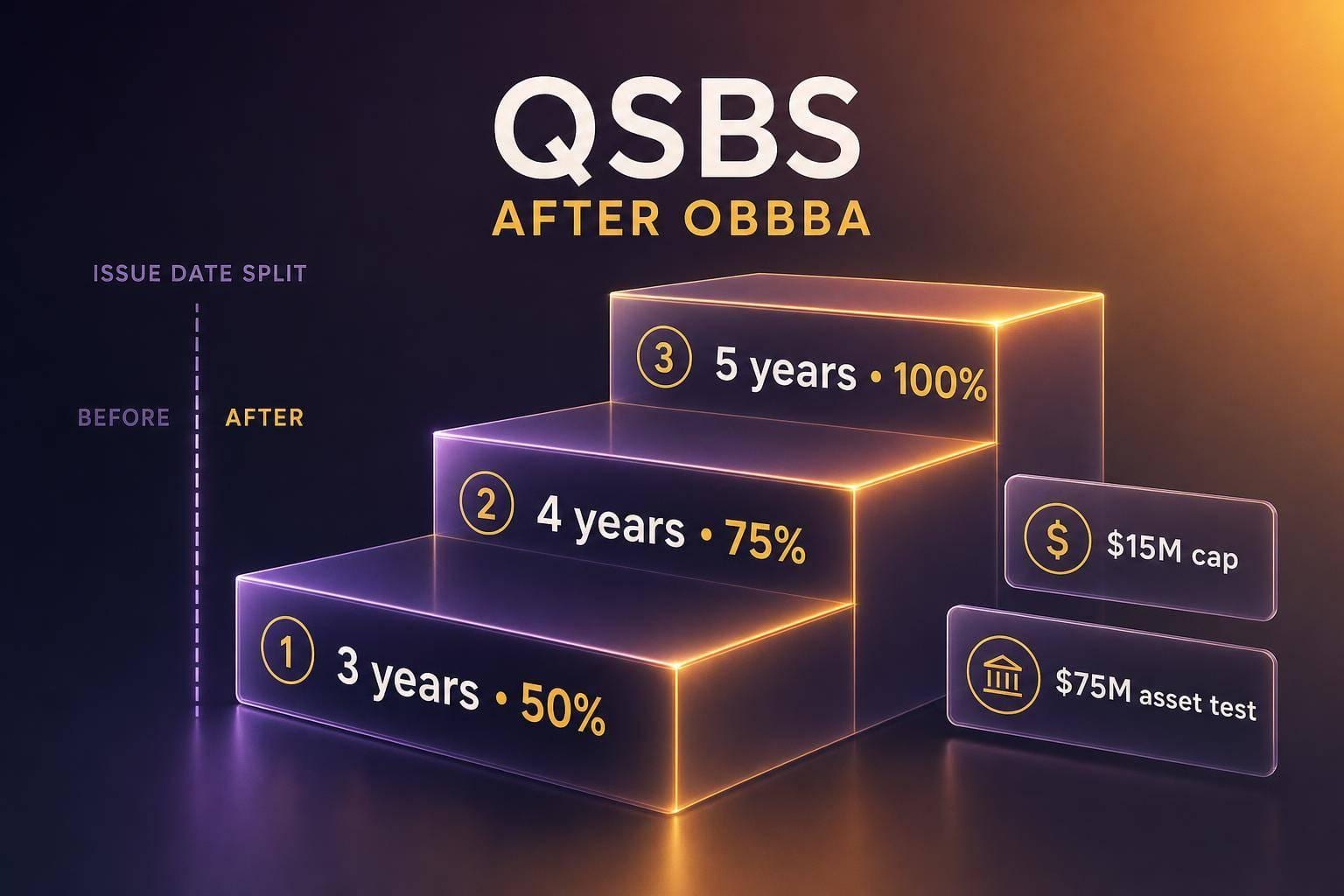
If your shares were issued before July 4, 2025, one QSBS rule set may apply. If they were issued on or after July 4, 2025, another may apply. That split may change how much gain may be excluded, when a partial exclusion may start, and how a sale at year 3, 4, or 5 may be taxed.
Here’s the plain-English takeaway:
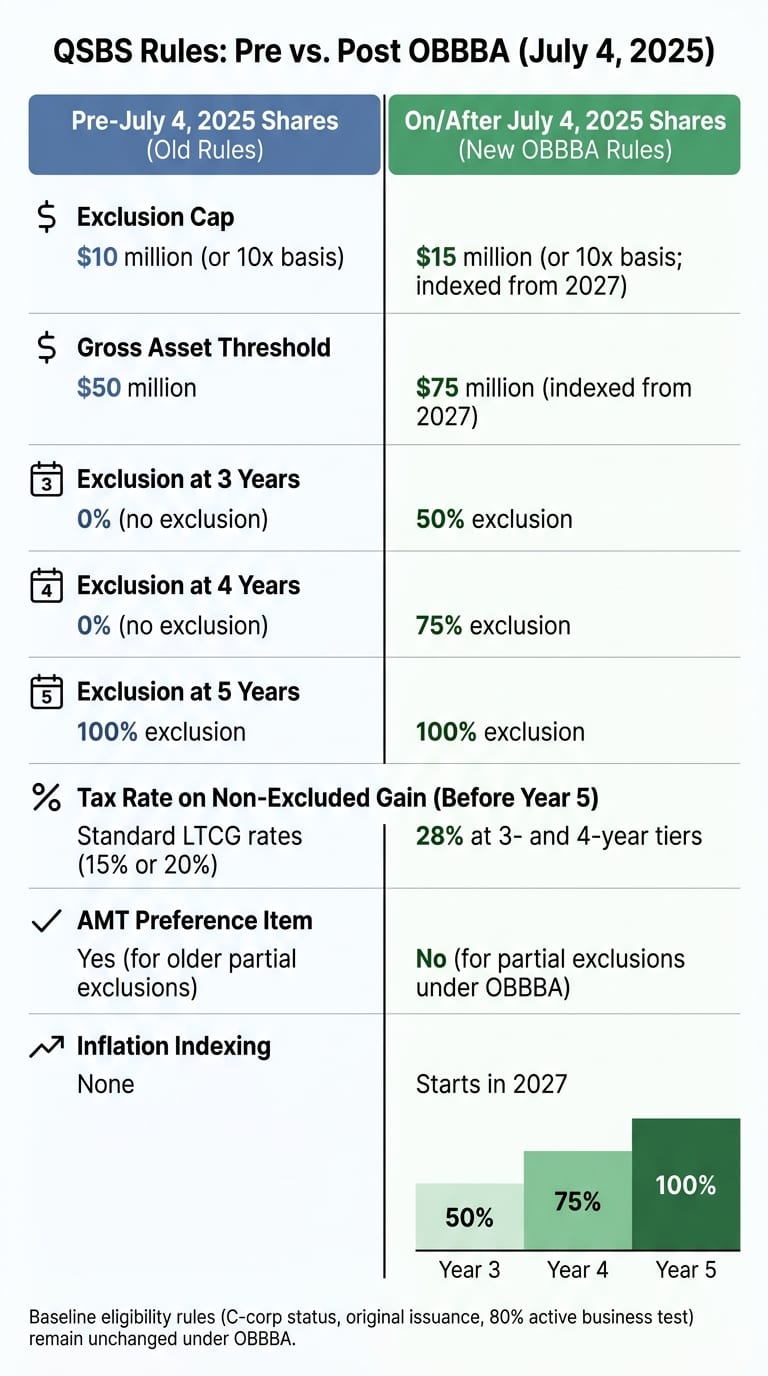
- Pre-July 4, 2025 shares may stay under the old rules:
$10 million exclusion cap
- $50 million gross-asset test
- No exclusion before 5 years
- On/after July 4, 2025 shares may fall under the new rules:
$15 million exclusion cap
- $75 million gross-asset test
- 50% exclusion after 3 years
- 75% exclusion after 4 years
- 100% exclusion after 5 years
- Taxable gain at the 3- and 4-year tiers may face a 28% federal rate
That sounds simple. The hard part may be the share-by-share details.
A single person may now hold:
- founder stock issued under old rules
- option shares exercised under new rules
- RSUs with a later start date
- secondary shares that may not qualify at all
And that may change the tax result by a lot.
Qualified Small Business Stock Explained (IRC section 1202)
Quick take
If I were summarizing the whole article in a few lines, I’d put it this way:
- Issue date may now drive the rule set
- Holding period may drive the exclusion percentage
- How shares were acquired may decide whether QSBS applies at all
- Later funding rounds may block new shares without changing old shares
- Poor lot tracking may lead to mistakes near a sale, exercise, or tender offer
- State taxes may still apply, including in places like California and Pennsylvania
Quick comparison
What this article may help you sort out
This article may be most useful if you’re trying to figure out:
- whether your stock may qualify in the first place
- when your QSBS clock may have started
- whether old and new lots need to be tracked apart
- how an early exit may change the tax math
- where options, RSAs, RSUs, redemptions, and late funding rounds may create problems
Bottom line: QSBS may no longer be just “wait 5 years and pay no federal tax.” For many founders, employees, and investors, it may now be a lot-specific timing question tied to issuance date, entity status, and paperwork.
That’s the frame for everything that follows.
What OBBBA Changed and What It Did Not
The Baseline QSBS Eligibility Rules That Did Not Change
For founders, employees, and investors, the old QSBS tests still decide whether the new OBBBA rules may matter at all. QSBS still rests on the same core IRC Section 1202 rules. Stock still must come from an original issuance by a domestic C corporation, directly from the company, in exchange for cash, services, or property. For most of the holding period, at least 80% of the company’s assets still must be used in an active qualified business. And the holder still must be a non-corporate taxpayer, which may mean an individual, trust, or estate.
OBBBA did not change those baseline rules. The C-corp requirement, original issuance requirement, and 80% active business test still apply. The disqualified-business list also stays the same.
Those rules still decide whether QSBS may apply in the first place.
The OBBBA Updates That Affect Exclusion Timing and Limits
OBBBA changed three core QSBS variables for shares issued after July 4, 2025: the asset threshold, the exclusion cap, and the holding-period setup.
Before OBBBA, QSBS had a hard five-year cliff. After OBBBA, shares issued on or after July 4, 2025 follow a three-year tiered schedule instead. That means post-OBBBA shares may start to carry tax value earlier than before, so exit timing may matter more.
Under the new schedule, post-OBBBA shareholders may get a 50% exclusion after three years and a 75% exclusion after four years, before reaching the full 100% exclusion at five years. For the taxable portion at the three- and four-year tiers, the rate is 28%, not the usual 15% or 20% long-term capital gains rate.
Use the comparison below to see which shares fall under each rule set:
At the three- and four-year tiers, the excluded gain is not an AMT preference item. Starting in 2027, both the $15 million cap and the $75 million asset threshold will be indexed for inflation.
That puts more weight on issue date, lot tracking, and exit timing. A small difference in when shares were issued or sold may change which QSBS rules apply.
Where QSBS Planning Breaks: Eligibility, Holding Periods, and Sale Timing
Eligibility Traps for Founders, Option Holders, and Secondary Buyers
The most common QSBS mistake may be assuming stock qualifies when it does not. In many cases, the problem may trace back to how the shares were acquired, when the holding period started, or whether the stock met the original-issuance rule.
After OBBBA, many QSBS mistakes may still come from execution rather than the new rules. The clock starts on issuance, not intent. That one detail may shape almost every issue in this section.
For founders and early employees with restricted stock (RSAs), the QSBS clock may start on day one only if a valid Section 83(b) election is filed within 30 days. If that 30-day deadline is missed, the QSBS clock may not start at grant.
RSUs do not start the QSBS clock until vesting. For some employees, that difference may push QSBS timing back by years.
For options, early exercise may start the QSBS clock sooner if the 83(b) election is filed on time. Exercising while the 409A valuation remains low may also lock in a lower fair market value.
Secondary purchases usually fail the original-issuance test. In general, the stock may need to come directly from the corporation, not from another shareholder.
Once eligibility is set, the next issue may be the amount each holding-period tier actually protects.
How Holding Periods Change the Tax Bill
These tiers may make sale timing matter more than it did before.
Take a founder with $10 million in eligible post-OBBBA gain who sells at year three. The 50% exclusion may shelter $5 million. The remaining $5 million may be taxed at 28%, which would produce a $1.4 million federal tax bill. If the sale happens at year four instead, the 75% exclusion may cut the taxable portion to $2.5 million, which may reduce tax by about $700,000 compared with the three-year exit. If the founder waits until year five, the full $10 million may be excluded.
Pre-OBBBA shares still get no partial exclusion before five years.
Early Exits, Section 1045 Rollovers, and Liquidity Event Timing
When a liquidity event shows up early, Section 1045 may preserve part of the tax treatment.
If the original QSBS was held for more than six months, Section 1045 may allow gain deferral if the proceeds are reinvested into new QSBS within 60 days. That may matter most in tender offers and acquisitions that happen before year five.
Even when exit timing lines up, entity structure and later financing may still disrupt QSBS treatment. That brings up the next failure point: entity structure, funding rounds, and other disqualifiers.
Entity Structure, Funding Rounds, and Other QSBS Failure Modes
Why C-Corp Status and Business Type Still Decide Most Outcomes
Even if the holding period lines up, issuer-level problems may still wipe out QSBS treatment.
The first gate is entity type. Only domestic C corporations may issue QSBS. LLCs, partnerships, and S corporations do not qualify. If a company converts later, QSBS generally does not carry over through that conversion. In many cases, the clock may start when the C-corp stock is issued.
Business type matters too. The company may also need to stay in an eligible trade or business. If it shifts into a disqualified service or finance business, later share issuances may become ineligible.
How Later Funding Rounds Can Affect New Shares but Not Old Ones
After entity type, the next issue is whether later financing changed which shares may still qualify.
The gross assets test applies when the shares are issued, not when they are sold. So if a later round pushes gross assets above $75 million, shares issued after that point may be ineligible.
Older shares are generally not affected. New shares are a different story. That may include option exercises completed after the round closes. For employees and option holders, exercising before a major financing closes may preserve QSBS treatment for that specific lot.
Redemptions, Documentation Gaps, and Other Preventable Disqualifiers
Two problems often get less attention than they deserve: redemptions and missing records.
On redemptions, certain buybacks near the issuance date may disqualify newly issued shares. Before any repurchase, some teams review the redemption rules and the timing around the grant or issuance.
On documentation, QSBS status may be hard to prove without a clean paper trail. If proof of asset levels or active business use is missing, the IRS may challenge eligibility. That’s why companies often keep gross asset balance sheets from the issuance date, 409A valuations, and stock certificates in one place.
Use the table below to review issuer-level risks before exercise or sale.
How to Review QSBS Exposure Across Accounts with Mezzi
QSBS mistakes often come from scattered lot records, not bad intent. When issue dates, vesting schedules, and exercise records sit across separate portals and accounts, it’s easy to miss a milestone or read the clock the wrong way. That’s why account-level visibility may matter most right before a sale or exercise.
What Mezzi Can Help You See Before You Sell or Exercise
Mezzi uses read-only connections to your brokerage, stock plan, and taxable accounts to surface the dates and lot details tied to QSBS treatment. That view may matter most when you’re close to an issue date, vesting date, exercise date, or sale date.
Near a QSBS milestone, the issue usually isn’t the rule itself. It’s which lot gets there first. Under OBBBA, post-July 4, 2025 shares follow a tiered schedule - 50% at three years, 75% at four years, 100% at five years - while pre-OBBBA shares still require five years for any exclusion. Mezzi may help flag those dates across lots, so you may spot the right question to bring up before a sale.
If a sale happens early, the next date that may matter is the rollover window. Mezzi may flag the 60-day Section 1045 deadline after an early QSBS sale, which may give you a clearer view of the timeline before that window closes.
Conclusion: The QSBS Checks That Matter Now
Use Mezzi to line up dates, lots, and account data before deciding whether to sell or exercise. The main checks are simple:
- Confirm C-corp status
- Verify gross assets at issuance
- Separate pre- and post-OBBBA lots, since they follow different rules
Mezzi may help organize that review across accounts and surface the timing questions that may be worth discussing with your tax professional as you review the full picture.
FAQs
How do I know which of my shares follow the new QSBS rules?
Check your stock’s issuance date. The new QSBS rules under OBBBA - including the $75,000,000 gross asset threshold and $15,000,000 gain exclusion cap - may apply to stock issued on or after July 4, 2025.
Eligibility may also depend on holding periods and company-level requirements, so some investors may want to keep a close eye on their holdings to stay aligned with current federal tax rules.
When does the QSBS holding period start for RSAs, RSUs, and options?
The QSBS holding period may start when you actually acquire the shares.
That timing may differ depending on how you received the equity:
- Options: the clock may start when you exercise the option and buy the stock, not when the option is granted
- RSAs: the clock may start when the shares are issued to you
- RSUs: the clock may start when the units vest and the shares are settled or transferred to you
Can my shares lose QSBS status after a funding round or company buyback?
Yes. Your shares may lose QSBS status if the company repurchases them from you within two years of your acquisition. Under Section 1202, that may make them disqualified stock.
To preserve eligibility, it may make sense to closely monitor your holding period and company activity. Certain share redemptions may unintentionally disqualify your stock and eliminate your ability to exclude capital gains.
Disclosures:
- This content is for informational purposes only and does not constitute investment advice or a recommendation to buy or sell any security.
- Tax treatment of Qualified Small Business Stock (QSBS) is subject to change and may vary based on individual circumstances. Consult a qualified tax advisor for personalized guidance.
- Past performance is not indicative of future results. No guarantee of future performance or outcomes is implied.
Related Blog Posts
- QSBS: the tax break most startup employees don't know about
- QSBS and 83(b) Elections: 0% Tax on Startup Equity
- QSBS: 0% Federal Tax on Startup Equity Explained
- QSBS Gifting: Stacking $15M Exclusions Across Trusts in 2026
Check your stock’s issuance date. The new QSBS rules under OBBBA - including the $75,000,000 gross asset threshold and $15,000,000 gain exclusion cap - may apply to stock issued on or after July 4, 2025.
Eligibility may also depend on holding periods and company-level requirements, so some investors may want to keep a close eye on their holdings to stay aligned with current federal tax rules.
The QSBS holding period may start when you actually acquire the shares.
That timing may differ depending on how you received the equity:
- Options: the clock may start when you exercise the option and buy the stock, not when the option is granted
- RSAs: the clock may start when the shares are issued to you
- RSUs: the clock may start when the units vest and the shares are settled or transferred to you
Yes. Your shares may lose QSBS status if the company repurchases them from you within two years of your acquisition. Under Section 1202, that may make them disqualified stock.
To preserve eligibility, it may make sense to closely monitor your holding period and company activity. Certain share redemptions may unintentionally disqualify your stock and eliminate your ability to exclude capital gains.