
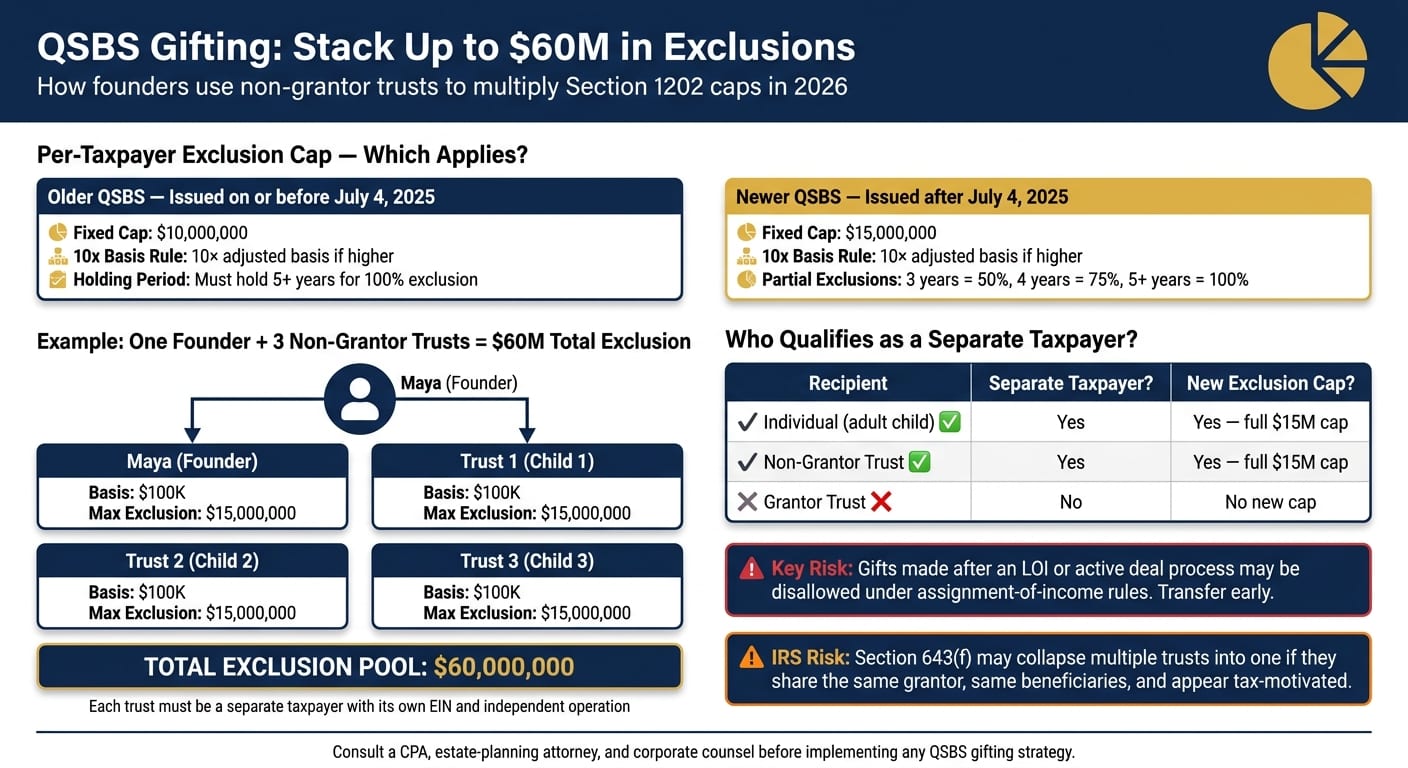
Yes - one block of QSBS may sometimes support more than one Section 1202 exclusion. If shares are gifted to separate taxpayers before a sale, a founder may end up with multiple exclusion caps in play. For stock issued on or after July 4, 2025, that cap may be up to $15,000,000 per taxpayer per issuer, or 10x basis if that amount is higher.
Here’s the short version:
- Stacking means one founder may spread QSBS across multiple taxpayers, such as family members or non-grantor trusts
- Grantor trusts usually do not add a new exclusion cap
- Timing matters: a late gift, especially after an LOI or deal process starts, may face assignment-of-income issues
- Trust setup matters: if trusts look too similar, the IRS may treat them as one under Section 643(f)
- Holding period rules changed for newer stock:
3 years: up to 50% exclusion
- 4 years: up to 75%
- 5+ years: up to 100%
- The fixed cap for newer QSBS may be $15,000,000; older QSBS may still use $10,000,000
- The company, stock issuance, active business use, basis records, gift tax reporting, and state tax rules all still need to line up
A simple example: if a founder splits QSBS among four taxpayers - the founder plus three non-grantor trusts - the total exclusion pool may reach $60,000,000 if each taxpayer qualifies for the full $15,000,000 cap.
QSBS Stacking Timing: Why Most Founders Gift Too Early (When to Actually Start) | Tax Strategy 2025
Quick comparison
Bottom line: this article says QSBS gifting may work, but only when the stock qualifies, the transfer happens early enough, the recipient counts as a separate taxpayer, and the trust facts are strong on paper and in practice.
Step 1: Confirm the stock and the owner qualify for Section 1202
Stacking starts with the stock itself. If the shares don't qualify under Section 1202, a trust setup may not fix that. In other words, stacking only comes into play after the stock qualifies.
Issuer, original issuance, and active business tests
Start with the shares. The company must be a domestic C corporation, not an LLC or S corporation. The shares must have been acquired from the company at original issuance, in exchange for money, property, or services. If someone buys shares from another shareholder on the secondary market, that purchase generally may disqualify the stock for Section 1202 treatment.
The company's aggregate gross assets must not have exceeded $75,000,000 for stock issued after July 4, 2025, and $50,000,000 for earlier stock, at the time of issuance and immediately after issuance. On top of that, at least 80% by value of the company's assets must be used in the active conduct of one or more qualified trades or businesses. Excluded businesses include most personal-service, financial, farming, and hospitality businesses.
Holding period and gift tacking rules
After the issuer tests are met, the holding-period rules may determine how much exclusion is left after a gift. Recipients generally tack the donor's holding period. That means the recipient may keep the donor's holding period, which is what makes pre-sale stacking possible.
The issue date matters here. For stock issued before July 5, 2025, the five-year holding period remains absolute. Missing it by even one day may eliminate the exclusion entirely. For stock issued after July 4, 2025, partial exclusions may become available after three years (50%) and four years (75%), while the full 100% exclusion still requires five years.
How the $15,000,000 or 10 times basis cap works
Each qualifying taxpayer may exclude the greater of the fixed cap or 10 times basis. The 10x basis rule may matter most when the original basis is high.
Say a founder paid $2,000,000 for shares. Their cap under the 10x rule would be $20,000,000, which is above the $15,000,000 fixed limit. That same math may apply separately to each eligible taxpayer who holds qualifying shares, which is why stacking may become powerful when the numbers line up.
If the stock qualifies, the next issue may be whether timing and recipient choice preserve the exclusion. Once the stock clears these tests, Step 2 turns to who may receive it and when.
Step 2: Transfer QSBS early enough and to the right taxpayers
Transfer timing and recipient choice may determine whether stacking works.
Gifts to family members vs. non-grantor trusts
Only separate taxpayers get separate Section 1202 caps. Individual family members may qualify. So may non-grantor trusts. Grantor trusts do not create a new taxpayer, so they do not create a new Section 1202 cap.
Once the stock sits with the right taxpayer, another issue may come up: the transfer may happen too late.
Why timing before a letter of intent or binding deal matters
Recipient type alone may not be enough. Timing also needs to be clean. Late gifts may fail under assignment-of-income and step-transaction rules. If shares are gifted after signing a letter of intent, or while a sale process may already be underway, the IRS may treat the gain as yours no matter who holds the stock at closing.
Some advisors run tax review before any binding sale document is signed.
What makes separate trusts more likely to be respected
The IRS may collapse multiple trusts into a single taxpayer under Section 643(f) if they share substantially the same grantor, substantially the same primary beneficiaries, and a principal purpose of the trusts is tax avoidance. So the details matter. A lot.
Advisors generally look for a few things:
- Separate EINs and independent bank or brokerage accounts for each trust
- Distinct trustees
- Different distribution standards - for example, one trust uses "health, education, maintenance, and support" language while another grants fully discretionary powers
- Clearly stated non-tax purposes in the trust instrument itself, such as funding a specific child's education versus long-term legacy planning for grandchildren
Distinct trust terms and day-to-day operations may help keep each trust separate under Section 643(f). In plain English, each trust may need to stand on its own, not just on paper.
Step 3: Model how a founder could stack exclusions up to $15,000,000 each
Once you have separate taxpayers in place, the next step is simple: check whether the math may stack the way you expect.
Hypothetical: one founder, three non-grantor trusts, and retained shares
Say a founder - call her Maya - co-founded a software startup in early 2021 and bought shares directly from the company for a total adjusted basis of $400,000. The company was a domestic C-corp, its gross assets were under $75,000,000 at issuance, and the stock meets the Section 1202 requirements.
Before any letter of intent is signed, Maya gifts equal portions of her shares to three separate non-grantor trusts - one for each of her three adult children - while keeping an equal portion herself. Each trust takes carryover basis and tacks Maya's holding period. That leaves four separate taxpayers: Maya plus three trusts.
If the $400,000 of basis is divided evenly across the four taxpayers, each one has $100,000 of adjusted basis. Under that rule, each taxpayer's 10x basis cap comes to $1,000,000. That's below $15,000,000, so the fixed cap may be the binding limit for each taxpayer.
Result: four taxpayers, up to $15,000,000 each, or $60,000,000 total.
When 10 times basis matters more than the $15,000,000 fixed cap
The $15,000,000 cap may not always be the limit. If a recipient trust holds shares with a high adjusted basis - say, $2,000,000 - then 10 times that basis equals $20,000,000. In that case, the trust may be able to exclude up to $20,000,000 of gain, not just $15,000,000.
A simple rule of thumb: if a trust's basis is above $1,500,000, run the 10x test.
The data you need before running the numbers
Before you model anything, gather the core inputs. Without them, the spreadsheet may look neat but still miss the point.
- Original share issuance dates
- Acquisition documents proving original issuance from a domestic C-corp
- Current cap table
- Current 409A valuation or FMV estimate for Form 709
- Expected exit price
- Each taxpayer's adjusted basis
- Any prior Section 1202 exclusion already used
- State of residency for both you and each trust
- Remaining federal gift and estate tax exemption
Once the numbers are mapped, the structure may then be tested for tax, valuation, state, and compliance risk.
Step 4: Test the plan for tax, valuation, state, and compliance risk
Anti-abuse rules that can collapse multiple trusts into one taxpayer
After the math in Step 3, the next issue is whether the setup may hold up under review. The main structural risk is IRC Section 643(f). That rule may let the IRS treat multiple trusts as one taxpayer when they share the same grantor and the same beneficiaries, and tax avoidance appears to be a principal purpose. The IRS may also look past the paperwork and focus on substance.
Each trust may need a real, documented reason to exist beyond tax savings. That may include a set distribution schedule, a legacy goal, education planning, or another non-tax purpose. Put simply, if the trust exists only to multiply the Section 1202 exclusion, the structure may face more scrutiny.
Valuation, Form 709, and QSBS sale reporting
If the trust design appears to pass the anti-abuse test, the next choke point may be valuation and reporting. Gifted private stock needs a supportable valuation. In many cases, that means a qualified appraisal. Minority discounts may apply too, but they may need support in the record.
The gift gets reported on Form 709. For 2026, the annual gift tax exclusion is $19,000 per recipient, and the lifetime exemption is $15,000,000. Gifts above the annual exclusion may reduce that lifetime exemption, so some founders track remaining exemption before transferring shares. When the shares are later sold, each taxpayer may report the gain exclusion on Form 8949 and Schedule D.
State tax traps and the advisor team most founders need
Federal qualification may not be the finish line. Federal QSBS treatment does not always carry over at the state level. California does not recognize the Section 1202 exclusion, while New York does, and New Jersey recently moved to conform as well.
"New York recognizes QSBS; California does not." - Alessandro Chesser, Founder and CEO, Dynasty
This type of planning often involves a few moving parts, and many founders use a team that may include:
- A CPA
- An estate-planning attorney
- Corporate counsel
- A valuation professional
It may also require cap table records, 409A records, issuance records, and related documents. Having that file in order before deciding whether to move ahead may make the review process smoother.
Conclusion: A checklist for deciding whether QSBS gifting is worth pursuing now
After the tax, timing, and trust checks above, this final checklist may help you decide whether to move forward. If the stock still qualifies, the recipients may be treated as separate taxpayers, and the transfer happens before a liquidity event, QSBS gifting may be worth pursuing.
This approach may make the most sense when the potential gain is large and there’s enough time to set up and document separate trust structures before a sale.
Mezzi may help organize your holdings with read-only access, so you may go into the advisor meeting with cleaner records and sharper questions.
What to gather before your planning meeting
Your meeting may only be as useful as the records you bring. The next step may be gathering the documents that show the structure and support the numbers.
Bring these records to your planning meeting so your advisor may test the structure more quickly:
A complete file may make the review faster and more useful.
FAQs
Can I stack QSBS exclusions with family members?
Yes. In some cases, people may be able to multiply the Section 1202 capital gains exclusion by gifting shares to multiple non-grantor trusts for family members.
Here’s the basic idea: each separate trust for legitimate beneficiaries, such as children or parents, may potentially qualify for its own $15 million exclusion.
There’s a catch, though. The gifts must be completed. And anti-abuse rules, including IRC Section 643(f), may treat multiple trusts as one if they are mainly set up for tax avoidance.
When is it too late to gift QSBS before a sale?
QSBS gifting usually isn't a last-minute move. In many cases, it needs to happen well before a liquidity event because the full Section 1202 exclusion generally depends on a five-year holding period.
If a sale may be imminent or may already be in progress, transferring shares to trusts may be too late. Exit planning may work best when it starts three to five years in advance, so the structure and documentation may already be in place.
How different do multiple non-grantor trusts need to be?
They must stay separate legal entities so the IRS may not treat them as one trust under Section 643(f).
Each trust should have its own substance. That may include different beneficiaries, different trustees, and separate administration.
The main risk involves IRS consolidation if the trusts have substantially the same grantors and primary beneficiaries, and if a principal purpose may be tax avoidance.
Disclosures:
- This content is for informational purposes only and does not constitute investment advice or a recommendation to buy or sell any security.
- Past performance is not indicative of future results. No guarantee of future performance or outcomes is implied.
Related Blog Posts
- Generation-skipping trust: how it works and who should consider it
- Estate Planning 101: Wills, Trusts, and Tax-Efficient Transfers
- QSBS and 83(b) Elections: 0% Tax on Startup Equity
- QSBS: 0% Federal Tax on Startup Equity Explained
Yes. In some cases, people may be able to multiply the Section 1202 capital gains exclusion by gifting shares to multiple non-grantor trusts for family members.
Here’s the basic idea: each separate trust for legitimate beneficiaries, such as children or parents, may potentially qualify for its own $15 million exclusion.
There’s a catch, though. The gifts must be completed. And anti-abuse rules, including IRC Section 643(f), may treat multiple trusts as one if they are mainly set up for tax avoidance.
QSBS gifting usually isn't a last-minute move. In many cases, it needs to happen well before a liquidity event because the full Section 1202 exclusion generally depends on a five-year holding period.
If a sale may be imminent or may already be in progress, transferring shares to trusts may be too late. Exit planning may work best when it starts three to five years in advance, so the structure and documentation may already be in place.
They must stay separate legal entities so the IRS may not treat them as one trust under Section 643(f).
Each trust should have its own substance. That may include different beneficiaries, different trustees, and separate administration.
The main risk involves IRS consolidation if the trusts have substantially the same grantors and primary beneficiaries, and if a principal purpose may be tax avoidance.