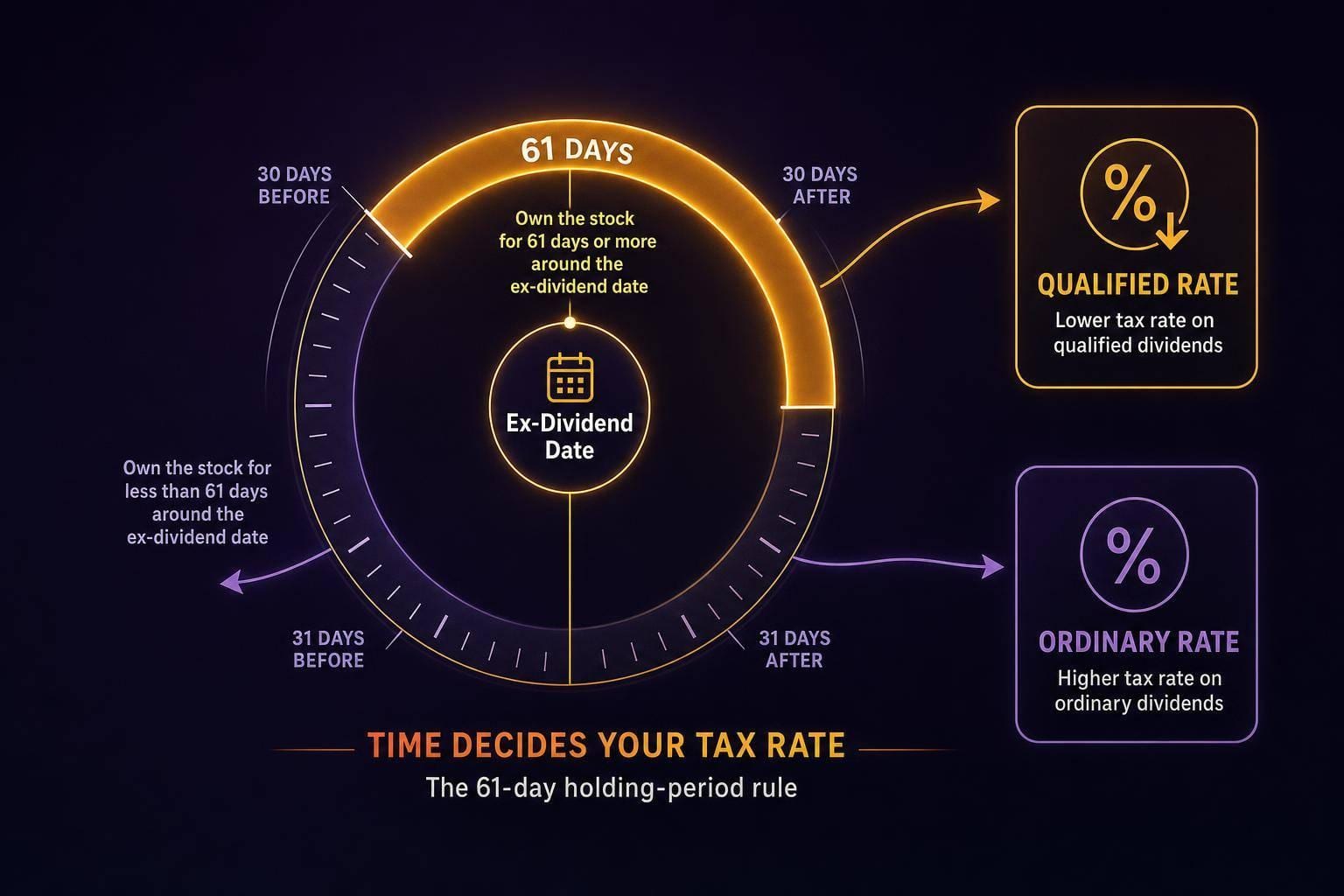
The same dividend may be taxed at 15% or 32%+ based on one timing rule: how long I held the shares around the ex-dividend date.
Here’s the short version:
- Qualified dividends may be taxed at 0%, 15%, or 20%
- Ordinary dividends may be taxed at regular income tax rates, up to 37%
- For most common stock, I generally need to hold the shares for more than 60 days during the 121-day period tied to the ex-dividend date
- If I buy right before the ex-dividend date and sell soon after, that payout may lose qualified status
- Form 1099-DIV may show the split:
Box 1a = total ordinary dividends
- Box 1b = the part that may qualify for the lower rate
A simple example shows why this gets attention: on a $1,000 dividend, the federal tax gap may range from $70 to $170, depending on the investor’s tax bracket.
Qualified vs Ordinary Dividends - Tax Differences Explained,
Quick Comparison
Bottom line: a dividend payment may look the same in my account, but the tax result may change if I miss the IRS holding-period test, use offsetting positions, or trade in and out of funds near the ex-dividend date.
Qualified vs Ordinary Dividends: What Changes
Qualified and ordinary dividends may pay the same cash amount. What changes is how they may be taxed on Form 1099-DIV and on your tax return.
Qualified dividends are taxed at lower federal rates
A dividend may be qualified if it comes from an eligible U.S. or qualified foreign corporation, meets IRS eligibility rules, and meets the holding-period rule. Qualified dividends may be taxed at long-term capital gains rates: 0%, 15%, or 20%, depending on taxable income and filing status. For many mid-income investors, that may mean a 15% federal rate on dividend income.
Ordinary dividends are taxed at your regular income rate
If a dividend misses those tests, it may be treated as ordinary. The full amount may be taxed at your ordinary federal income tax rate, which ranges from 10% to 37%. For an investor in the 24% bracket receiving $2,000 in dividends, qualified treatment may result in $300 in federal tax, while ordinary treatment may result in $480 - $180 more on the same payout.
Here’s the short version:
Box 1b includes only the qualified portion of Box 1a. So if Box 1b is smaller than Box 1a, the gap shows the portion of dividends that did not qualify for the lower rate.
At a glance, this may look like a small paperwork detail. It isn’t. The same dividend payment may face a different federal tax rate based on whether it passes the IRS tests.
And in many cases, the key issue comes down to one thing: how long you held the shares around the ex-dividend date.
The Holding-Period Rule Around the Ex-Dividend Date
Here’s how the IRS counts the days. For most common stock, qualified status may require at least 61 days of holding within the 121-day window that starts 60 days before the ex-dividend date and ends 60 days after it. You must own the shares before the ex-dividend date; owning them on that date alone may not be enough.
How to count the days correctly
Count from the day after purchase through the sale date. That means exactly 60 days may not be enough - the dividend may be taxed as ordinary income. The days do not need to be consecutive, but hedged days may not count toward the total.
Example: buy date, ex-dividend date, and sale date
A quick example makes the rule easier to follow. Say a stock goes ex-dividend on 07/01/2026. The 121-day window runs from 05/02/2026 through 08/30/2026.
- Qualifies: You buy on 06/01/2026 and sell on 08/05/2026. Counting starts on 06/02. You accumulate 29 days in June, 31 in July, and 5 in August - 65 qualifying days. The dividend may be treated as qualified.
- Doesn't qualify: You buy on 06/25/2026 and sell on 08/15/2026. Counting starts on 06/26. You get 5 days in June, 31 in July, and 15 in August - 51 qualifying days. The dividend may be taxed as ordinary income.
Funds and preferred shares may follow different day-count rules
The 61-days-in-121-days standard applies to most common stock, but not every dividend-paying security follows the same rule. Preferred stock may use a different test: more than 90 days in a 181-day window around the ex-dividend date.
For mutual funds and ETFs, both the fund and the shareholder may need to meet the holding-period rules. The fund must satisfy the rule for its underlying securities, and you must also satisfy the 61-day test for your fund shares around the fund’s own ex-dividend date. If every dividend position is treated as though it follows the same timing rule, that may lead to an unexpected tax bill.
When a Dividend Loses Qualified Status
Once you know the holding-period rule, the usual ways a dividend loses qualified status are pretty easy to spot. In general, a dividend may lose qualified status when the payer or investor fails the IRS holding-period or hedging rules. When that happens, the dividend may remain in Box 1a instead of Box 1b and may be taxed at ordinary income rates, which may reach 37% at the federal level.
Selling too soon after the ex-dividend date
One of the most common mistakes involves buying shares right before the ex-dividend date, collecting the payout, and then selling soon after. That pattern often fails the 61-day test. Simply owning the stock on the ex-dividend date may not be enough.
A buy-right-before, sell-right-after trade may leave the payout taxed as ordinary income, even if the dividend still appears in your account as expected.
Hedges and offsetting positions can break the holding-period test
Owning the shares is only part of the story. If you reduce your market risk with a deep-in-the-money put, a short sale, or another offsetting position, those days may not count. The IRS treats those as noncountable days under the same rule.
Put plainly, a position may look held on paper but still fail the test if much of the market risk was removed.
Mutual funds and ETFs add another layer to dividend reporting
Mutual funds and ETFs add a second layer because both your holding period and the fund’s status may matter. On Form 1099-DIV, Box 1a shows total ordinary dividends, while Box 1b shows only the portion that qualifies for the lower tax rate.
A quick comparison between Box 1a and Box 1b may show whether your trading pattern is reducing the qualified portion.
That’s why some investors review their holding days and account history before selling.
How to Estimate the Tax Impact Before You Sell
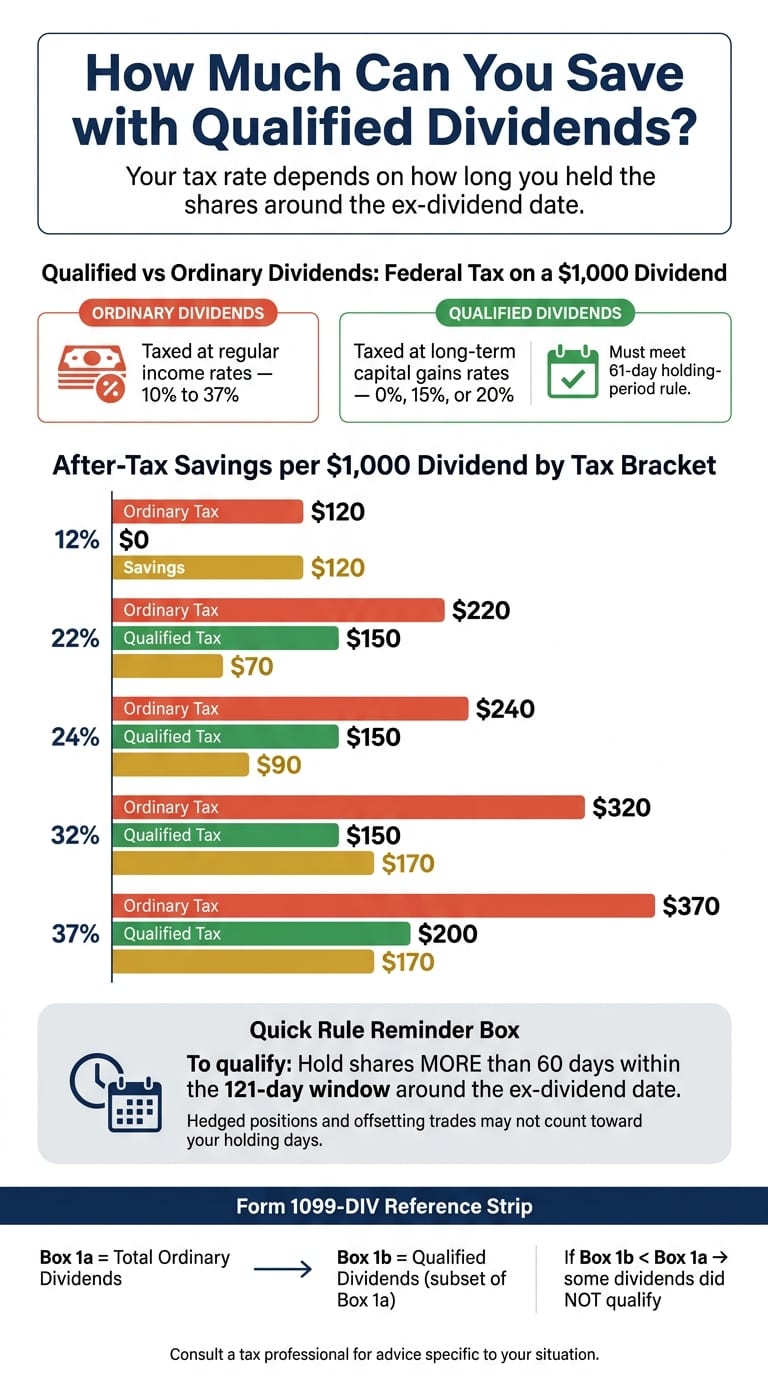
Knowing the holding-period rule may help. But the bigger question is simpler: may the tax break be worth the wait?
A short check to run before placing a sell order
Use this check before you sell.
First, confirm the ex-dividend date in your brokerage account. Second, count your eligible days inside the 121-day window. Third, check for offsetting positions such as puts or short sales. Finally, compare the tax under each scenario using your marginal rates.
A $1,000 dividend may lead to anywhere from $70 to $170 in federal tax savings, depending on your bracket.
If the tax savings are more than the likely price risk, waiting may be worth it.
What to look for on Form 1099-DIV and your account history
Start with Box 1a and Box 1b. Then line up any gap between the two with your trade dates.
Your broker's dividend history may help you match pay dates, ex-dividend dates, and dividend status to your trades. Frequent short-term trades around ex-dividend dates may reduce qualified income.
One catch: brokers may report Box 1b even when they may not be able to verify your holding period, so it's worth checking that part yourself.
Using a full-account view to track dividend tax exposure
A full-account view may make this process easier to run across every taxable position. Doing it across a taxable brokerage account, an IRA, a 401(k), and a joint account at the same time may get messy fast.
A consolidated view across all accounts lets you see:
- which positions may be approaching or inside a 121-day window
- which dividends are landing in taxable accounts versus tax-advantaged ones
- where your qualified exposure stands at the portfolio level
Dividends inside a traditional IRA or 401(k) aren't subject to current-year 1099-DIV reporting, so the gap between ordinary and qualified treatment may matter most in taxable accounts.
Mezzi's read-only connected-account view brings linked accounts into one place without moving assets. That may make holding-period risk easier to spot before it shows up on your 1099-DIV.
Conclusion: The Holding-Period Rule Is What Changes the Rate
The holding-period test is what may decide the rate. If you meet it, qualified dividends may be taxed at 0%, 15%, or 20%. If you miss it, that same dividend may be taxed at ordinary income rates, up to 37%.
Each dividend stands on its own. Sell too soon, use hedges or offsetting positions, or trade in and out of a mutual fund or ETF, and that dividend may lose qualified status.
Before selling, some investors run a simple three-part check:
- Confirm the ex-dividend date
- Count actual holding days within the required window
- Compare Box 1a with Box 1b on Form 1099-DIV
Know your holding period, and you may be able to estimate the dividend tax rate before you sell.
FAQs
How do I count holding days correctly?
For the lower long-term capital gains tax rates, you may need to hold the stock for more than 60 days during the 121-day window that begins 60 days before the ex-dividend date.
Miss that holding-period threshold, and the dividend may be taxed as ordinary income at your regular rate instead.
You may confirm how your dividends were classified on your annual Form 1099-DIV.
Do ETF and mutual fund dividends follow the same rule?
Yes. ETF and mutual fund dividends follow the same holding-period rules for tax treatment.
To receive the lower long-term capital gains tax rates of 0%, 15%, or 20%, you may need to meet the required holding period for the fund shares. ETFs and mutual funds differ in tax efficiency and in how they handle internal capital gains, but their dividends are still classified as qualified or ordinary under the same rules.
Can options or hedges make a dividend non-qualified?
The available information here does not address whether options or hedges may make a dividend non-qualified.
It only explains the holding-period rule: to qualify for lower tax rates, you may need to hold the stock for more than 60 days during the 121-day period that begins 60 days before the ex-dividend date.
Disclosures:
- This content is for informational purposes only and does not constitute investment advice or a recommendation to buy or sell any security.
- Past performance is not indicative of future results. No guarantee of future performance or outcomes is implied.