The BoostMezzi’s Sunday email about one decision shaping your wealth.
Same $1 million IRA. Same investments. Different tax decisions.
In the hypothetical example below, one path leaves about $833,000 more after tax by age 90. That result depends on the assumed tax rates, investment returns, and how withdrawals are reinvested. It is not a forecast.
A Roth conversion moves money from a traditional IRA into a Roth IRA. You pay income tax on the taxable amount now, ideally in years when your rate is lower. Once you meet the qualified-withdrawal rules, the money and its growth come out free of federal income tax. See the IRS’s Roth IRA guidance.
Here are three reasons to explore it. The first comes down to one question: will this money face a higher tax rate later?
1. Pay a lower rate now. Keep more later.
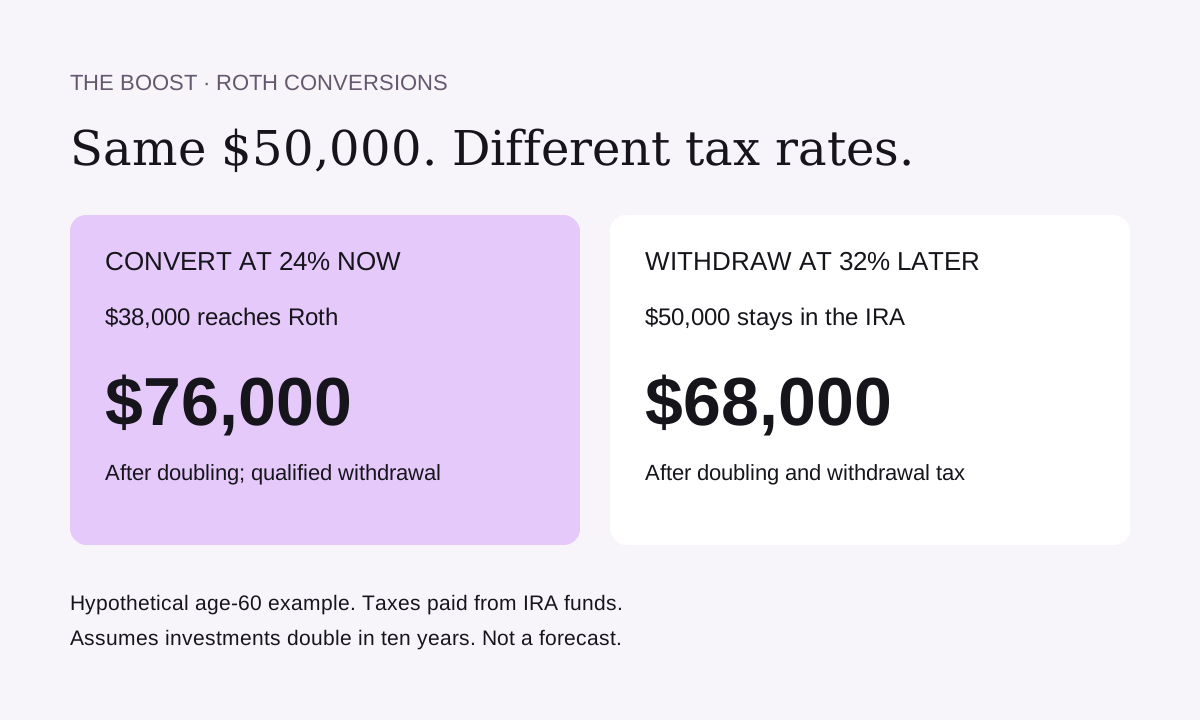
Here’s an example: you’re 60 with a $1 million traditional IRA, all funded with pretax money, and you’re considering using $50,000 for a Roth conversion.
Assume the applicable federal tax rate is 24% today and 32% in ten years, and the investments double over that time. You pay the conversion tax from the $50,000.
| What happens to the $50,000 | Convert now | Keep the traditional IRA |
|---|---|---|
| Tax paid now | $12,000 | $0 |
| Amount left to invest | $38,000 in Roth | $50,000 in traditional IRA |
| Value after doubling | $76,000 | $100,000 |
| Federal tax on the later withdrawal | $0, if qualified | $32,000 |
| Amount available after tax | $76,000 | $68,000 |
Converting leaves $8,000 more in this example. Both investments doubled, so the benefit comes from the difference in tax rates, not faster growth.
If the rate is the same, these two choices leave the same amount under these assumptions. If it is lower later, waiting leaves more.
Converting a lot in one year can push part of it into a higher bracket. Spreading conversions across several years may cost less.
What could that mean over 30 years?
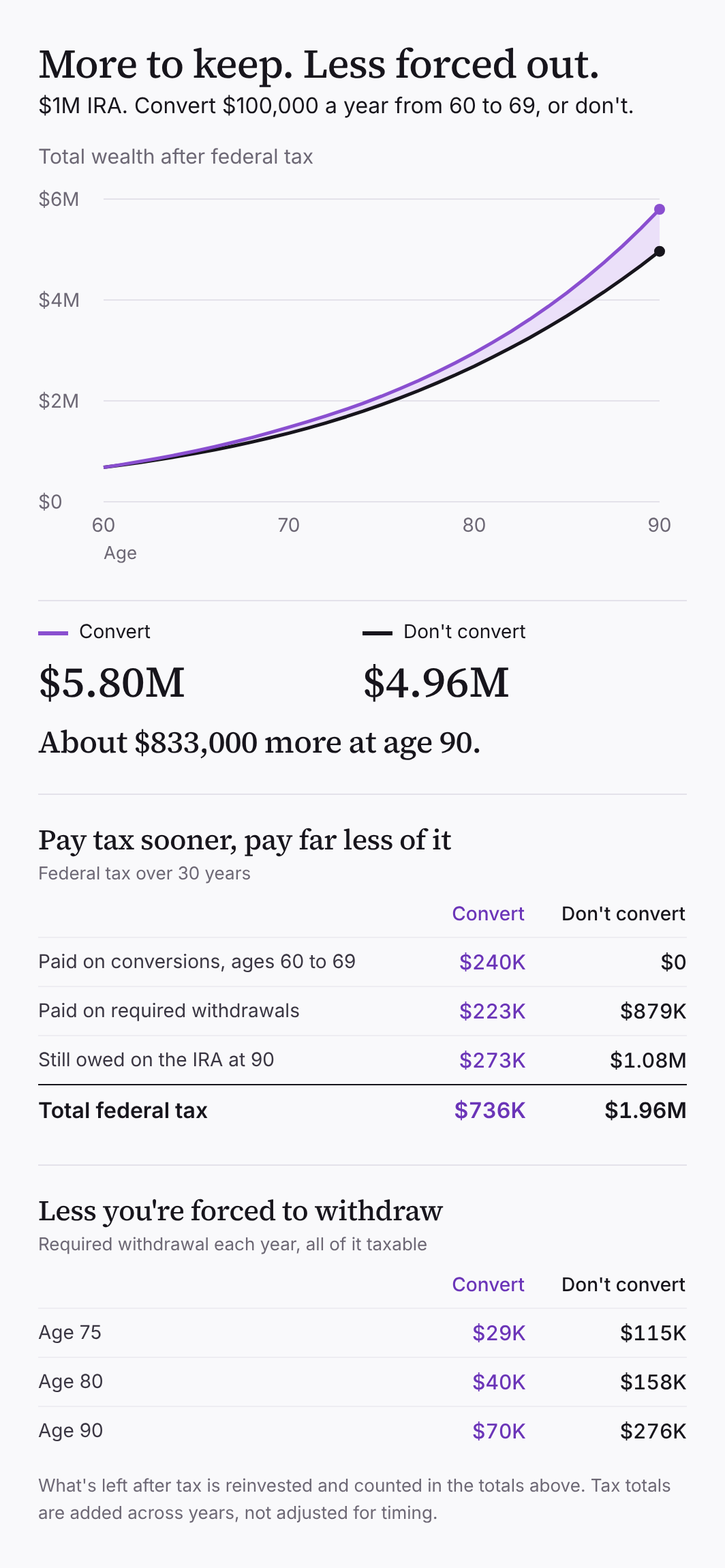
Start with the same $1 million pretax IRA at age 60. For ten years, take $100,000 from the IRA at the start of each year: $24,000 pays the assumed federal tax, and $76,000 lands in the Roth. No cash from outside the IRA is used.
Then let both accounts grow. Beginning at age 75 in this illustration, take the required withdrawals from what remains in the traditional IRA, pay the tax, and invest the rest in a taxable account.
| At age 90 | Phased conversions | No conversions |
|---|---|---|
| Total wealth after modeled federal tax | $5,797,323 | $4,964,302 |
| Conversion taxes paid | $240,000 | $0 |
| Taxes paid on required withdrawals through age 89 | $222,612 | $878,628 |
| Tax allowance on the remaining traditional IRA at age 90 | $273,325 | $1,078,786 |
That is approximately $833,021 more after tax by 90, after accounting for the conversion taxes. The total-wealth figures include Roth assets, the traditional IRA after its assumed tax, and reinvested after-tax required withdrawals.
The difference reflects both the lower assumed conversion tax rate and keeping more money growing inside a tax-sheltered account. Required withdrawals move money into a taxable account, where taxes reduce the growth that can compound.
Even if later IRA withdrawals were also taxed at 24%, this model would leave approximately $396,959 more with conversions. That comparison still assumes the taxable account grows more slowly after tax than the retirement accounts; it is not a universal benefit from converting.
Model assumptions: Retirement investments earn a constant annual return of approximately 7.177%, doubling every ten years. Gross IRA amounts of $100,000 are taken at the start of ages 60–69; $76,000 each year enters Roth after the assumed 24% tax. Required withdrawals start at age 75, use the IRS Uniform Lifetime Table and the preceding year-end balance, and are taken at the start of each modeled year. After-tax withdrawals are reinvested at 5% annually after all modeled investment taxes. Values are measured at the start of age 90, before that year’s required withdrawal. Remaining traditional IRA balances are reduced by the assumed future withdrawal tax rate to compare spendable wealth; this is not an assumption that the entire account is liquidated in one tax year. State taxes, Medicare costs, fees, spending, and changes in tax law are excluded. Actual returns fluctuate and may be lower; lower future tax rates could favor waiting.
2. Fewer forced withdrawals
A required minimum distribution, or RMD, is the amount you must withdraw from a traditional IRA each year once you reach the applicable age, even if you do not need it. The taxable portion counts as income and can raise your Medicare premiums.
Convert some money, and less remains in the traditional IRA used to calculate those withdrawals. A Roth IRA has no required withdrawals during the original owner’s lifetime, so money you do not need can stay invested. The IRS explains the distribution rules and tables.
| Required withdrawal in this example | Phased conversions | No conversions |
|---|---|---|
| Age 75 | About $29,000 | About $115,000 |
| Age 80 | About $40,000 | About $158,000 |
| Age 90 | About $70,000 | About $276,000 |
One catch: conversions count as income too. Medicare generally uses income from two years earlier, so a conversion at age 63 or later can affect premiums once you are enrolled. See Social Security’s explanation and our earlier Boost on retirement costs you did not plan for.
3. Leave your children less tax to pay
Your children generally pay income tax on the taxable portion of an inherited traditional IRA withdrawal, potentially during their highest-earning years. Inherited Roth withdrawals can generally be tax-free once the owner’s Roth IRA five-tax-year holding period has been met.
If their applicable tax rate would be higher than yours, paying the tax now may leave them more.
For example, a $100,000 pretax IRA withdrawal at 35% leaves $65,000 after federal income tax. Using the same $100,000 at a 24% rate to fund a conversion leaves $76,000 in Roth after paying $24,000 of tax from the IRA. This simplified comparison ignores growth, timing differences, state taxes, and other effects.
Most adult children who are not eligible designated beneficiaries must empty either inherited account by the end of the tenth year after the owner’s death. An inherited Roth generally does not require annual withdrawals during that ten-year period. An inherited traditional IRA may require annual distributions as well, depending on when the owner died. Exceptions apply; see the IRS’s beneficiary rules.
Explore a Roth conversion with Mezzi
Make sure your Financial Profile, including AI Personalization, is complete and your accounts are connected. Upload your 2025 tax return, or a 2026 draft if available, in your Mezzi chat, plus a recent pay stub if you are still working. Explain what has changed since the return was prepared.
Ask Mezzi
Would a Roth conversion help my retirement or family goals?
Explore my Roth conversion optionsBefore you convert
A conversion cannot be recharacterized back to a traditional IRA. Required distributions cannot be converted. After-tax IRA contributions can change how much is taxable, and withdrawing IRA money to pay the tax before age 59½ may trigger an additional tax unless an exception applies. The IRS explains conversion rules and withdrawal rules.
Each link opens a personalized prompt in Mezzi:
- Check when I can use the money — distinguish the five-year rule for earnings from the separate conversion rules.
- Check how much would be taxable — include traditional, SEP, and SIMPLE IRAs and any nondeductible contributions.
- Compare ways to pay the tax — weigh cash, investment sales, and IRA funds against your spending needs.
- Check my other taxes and insurance costs — consider Medicare, Marketplace assistance, and other tax effects.
- Check what I must withdraw first — take required distributions in the right sequence.
- Compare converting before and after a move — account for residency and state taxes.
- Review my plan before I commit — resolve missing information before choosing an amount.
More from the year-end tax planning guide
- Before you sell your biggest winner — compare giving cash with donating shares.
- Don’t let the tax bill make the decision — weigh the tax cost of reducing a large holding.
- What your CPA may not be telling you — understand fund payouts, dividends, and unused investment losses.
- The year I left money on the table — consider opportunities in a lower-income year.
The goal is not to convert as much as possible. It is to keep more for the life—and the people—you are planning for.