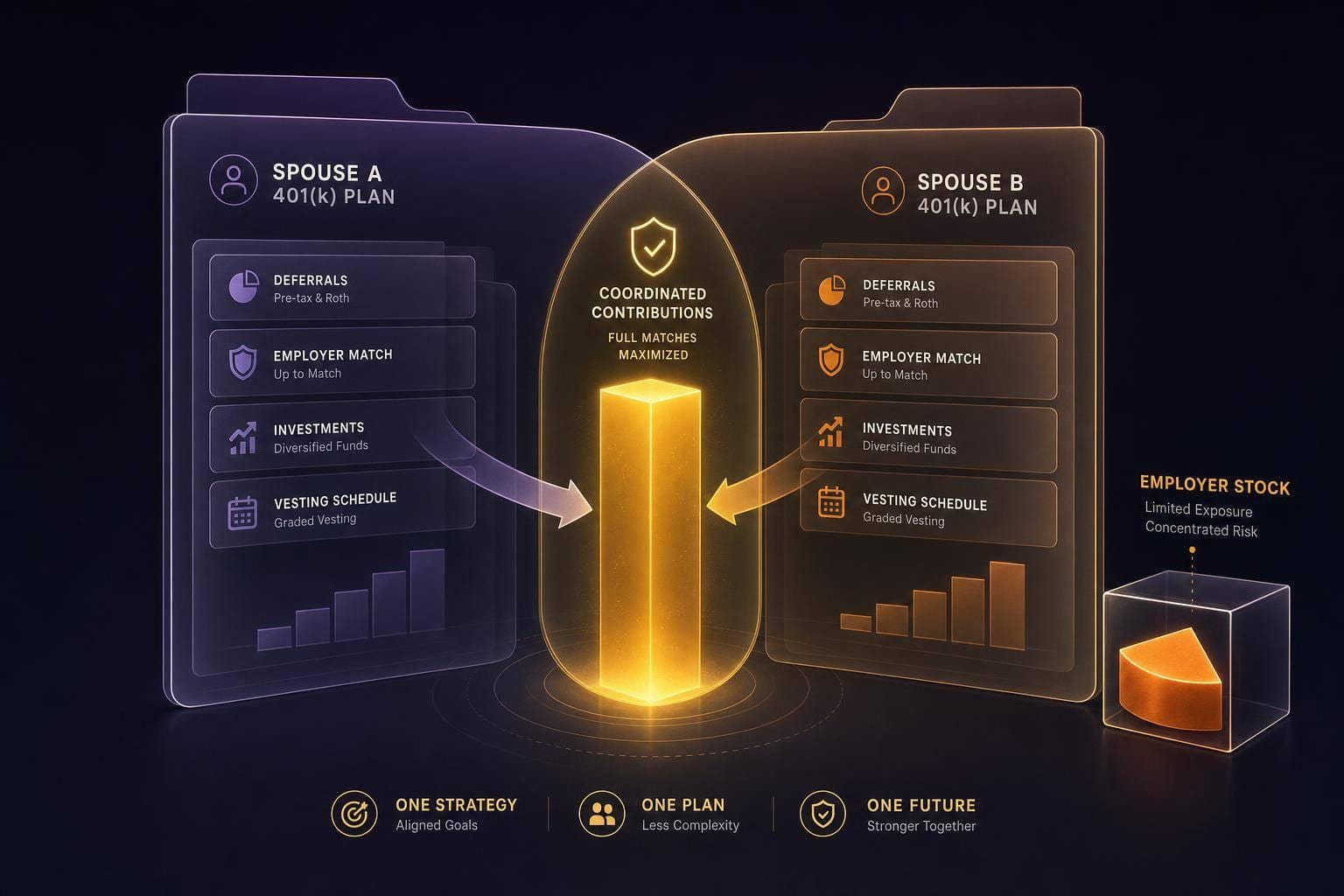
Two careers may leave one messy retirement setup. If each spouse handles 401(k)s, old plans, and equity pay alone, a household may miss employer match dollars, hold too much company stock, or drift into overlapping funds.
Here’s the short version:
- One spouse’s match may be worth more in actual dollars, even if the formula looks similar
- Vesting rules may change the real value of that match if a job change happens first
- Old 401(k)s may add fees, clutter, and rollover mistakes
- Two solid accounts may still add up to one uneven household allocation
- RSUs, options, ESPP shares, and company stock inside a 401(k) may all add to the same employer risk
- Tax withholding on equity pay may fall short, especially in high-income vesting years
A few data points stand out:
- Some research found poor 401(k) contribution splits may cost couples about $14,000
- A large study found about 1 in 4 employees may miss part or all of their employer match
- Missing match dollars averaged about $1,336 per year in that study
- Some planners treat 10% to 20% in one employer’s stock as a warning range
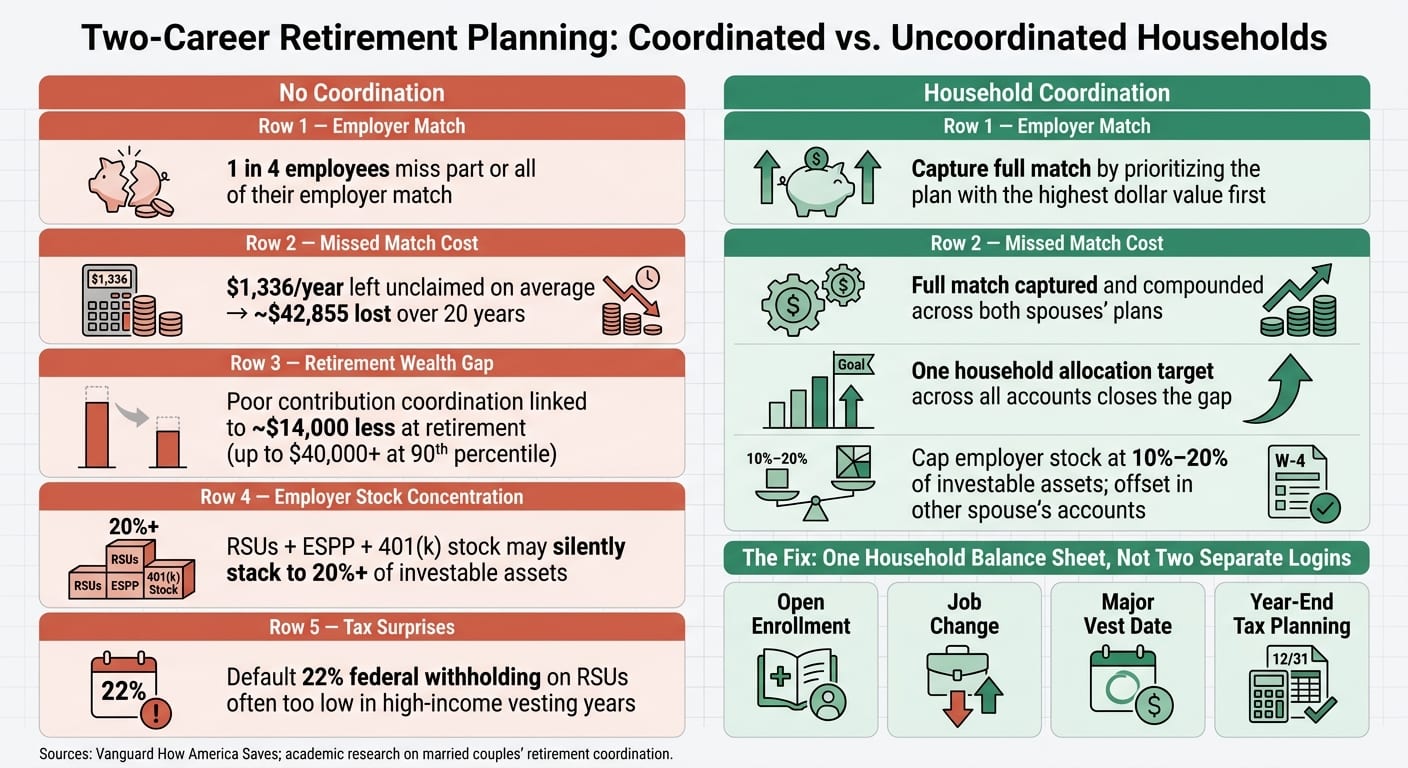
Quick Comparison
Put simply: this piece frames retirement planning as one household balance sheet, not two separate logins. I’d read it as a playbook for lining up match rules, old accounts, fund choices, equity exposure, and tax timing in one view.
Step 1: Coordinate both 401(k)s before investing an extra dollar
Start by putting both spouses’ current and old plan details into one table: match formula, vesting, balance, contribution rate, investment options, and fees. The point isn’t to tune one plan by itself. It’s to look at the household as a whole and send savings where they may do the most good.
With that household view in place, begin with the highest stated return available: the match.
Compare the real dollar value of each employer match
Match formulas may look close on paper and still lead to very different dollar amounts. Convert each formula into actual dollars based on each spouse’s salary. That’s the cleanest way to compare them.
In this example, the same employee contribution unlocks twice as much employer money in Spouse A’s plan, so that plan may come first. One large study found that one in four employees misses some or all of their employer match, leaving an average of $1,336 per year unclaimed - money that may compound to roughly $42,855 over 20 years.
Match size is only part of the picture. Ownership timing may shape what the household actually keeps.
Factor in vesting schedules and expected job tenure
A match may matter only if the employee stays long enough to keep it. Cliff vesting delays ownership until a set date. Graded vesting builds ownership over time. Under U.S. rules, the longest allowed cliff schedule is three years, while graded schedules may run up to six years.
For a spouse who took a slower-moving role or may expect another move, vesting may matter more than the headline match. If a spouse may change jobs within 12 to 24 months, a three-year cliff may wipe out much of the match’s value. In that case, a smaller match with immediate vesting or faster graded vesting may end up being worth more. When comparing plans, some households look at likely job tenure right alongside the match percentage, because those two details may tell very different stories about what the household may keep.
Once the current plans are ranked, the next step may be dealing with old accounts that no longer fit the household plan.
What to do with old 401(k)s after a job change
Job changes often leave behind old accounts. They’re easy to forget, and that may get expensive. The four options are to leave the account where it is, roll it into a new plan, roll it into an IRA, or cash it out.
Cashing out may be the costliest path in many cases. Before age 59½, the distribution may be subject to ordinary income tax plus a 10% early-withdrawal penalty, and the money may lose future tax-deferred growth. Some households choose to consolidate old accounts so their allocation may be easier to read and rebalance, whether that means using the new employer’s plan or an IRA.
When doing a rollover, a direct rollover may reduce friction. With an indirect rollover, the old plan withholds 20% in federal taxes, and the employee must redeposit the full original amount - including the withheld 20% - within 60 days to avoid taxes and penalties. If the 60-day window is missed, the transfer may be treated as a taxable distribution. A direct rollover avoids that setup.
Step 2: Build one household allocation across separate accounts
Once contributions and old accounts are settled, the next job is getting both accounts to act like one portfolio. Two solid 401(k) plans may still add up to a weak household mix if each spouse picks funds in isolation. The better starting point may be one target allocation for the household, then a clear role for each account.
Set one target allocation and assign each account a role
Start with three inputs: how long until retirement, how stable both incomes are, and how much drawdown the household may tolerate. A couple in their mid-30s with stable jobs and 25–30 years to retirement may target 80% stocks / 20% bonds / 0–5% cash. A couple in their mid-50s with one spouse in a volatile startup role may target 60% stocks / 35% bonds / 5% cash, given the shorter runway and higher income risk.
Once that household target is written down, each account gets a specific job based on its fund menu and tax treatment. If Spouse A's 401(k) offers a low-cost S&P 500 index fund at 0.03% but a mediocre bond fund at 0.70%, that account may carry more U.S. stock exposure. If Spouse B's plan has a strong total bond market index at 0.05% but only expensive stock funds, that account may hold more of the household's bond allocation. IRAs, with their open fund menus, may fill the gaps that remain - international stocks, small-cap exposure, or TIPS.
One account may look stock-heavy. The other may look bond-heavy. That's fine. In a household plan, the combined mix may matter more than whether each account looks neat on its own. Set the risk mix first. Place funds second.
Find overlap and hidden concentration across both plans
The most common coordination failure isn't a bad fund pick. It's both spouses defaulting into target-date funds without noticing what sits underneath. When that happens, the household may end up with a lot of overlapping large-cap U.S. stock exposure across two accounts - more than either spouse meant to hold. Research on married couples points to this pattern: spouses tend to invest their 401(k)s similarly, not in a way that diversifies risk across the household.
The table below shows what that overlap may look like before and after coordination:
That kind of overlap may be tough to spot by hand across multiple accounts. After coordination, Spouse A's account holds the equity building blocks - a U.S. total market index and an extended market index - while Spouse B's plan handles bonds through a total bond index and TIPS fund. The combined household then may line up with the target more closely. One study found that failing to coordinate retirement saving this way may be associated with lower retirement wealth at age 65 by about $14,000 on average, and by more than $40,000 at the 90th percentile.
Use Mezzi to see the full household picture in one place
After the target mix is set, the remaining problem is keeping overlap visible as balances change. Mezzi aggregates both spouses' 401(k)s, IRAs, brokerage accounts, and other holdings into one household view. Its X-Ray feature breaks funds into underlying holdings to reveal when multiple funds hold the same mega-cap tech stocks - the kind of overlap that may stay hidden when looking at accounts one at a time.
Step 3: Treat RSUs, Stock Options, and Employer Stock as a Shared Household Risk
Once the household allocation is set, the next issue may be equity compensation. RSUs, stock options, and ESPP shares may concentrate a household balance sheet in one employer. That risk may affect the whole household, not just the person who received the grant.
Measure Total Employer Stock Exposure Before It Becomes a Problem
Start with a full count. Add up each form of exposure to the same employer:
- vested RSUs held in a brokerage account
- unvested RSUs, using current market value as a planning estimate
- in-the-money options
- ESPP shares
- any employer stock inside a 401(k)
Then divide that total by household investable assets to see the actual concentration.
Some planners treat 10% to 20% of investable assets as a warning zone. Some more cautious advisors target 5% to 10%, especially when the same company also pays the household's income. If a couple has $600,000 in investable assets and $120,000 tied to one employer across those buckets, their combined exposure may already be 20%. Even if the other spouse holds none of those grants directly, the household may still face both job risk and portfolio risk at the same time.
It may help to separate current exposure from future exposure. Vested shares may count as current exposure. Unvested grants may be treated as a future pipeline. That pipeline may be useful for planning sales and tax withholding, but some households may avoid using it to inflate today's concentration number. After the full picture is clear, many people set a cap and a sale rule.
Employer stock may also hide in places people overlook:
Set Clear Rules for Selling and Capping Company Stock
This is where precommitment may matter. Emotions may run high when a stock has done well, and that may make selling harder than it looked on paper.
One plain rule is a fixed cap, such as: employer stock may not exceed 10% of our investable assets. Once that cap is reached, each new vested RSU may be sold, and the proceeds may be reinvested based on the household allocation. If the household is still below the cap, selling 50% to 75% of each vest may reduce concentration over time without one large liquidation.
The other spouse's accounts may also play a part. If the grant-holding spouse works at a large-cap tech company, the other spouse may avoid tech-heavy sector funds or individual tech stocks in a 401(k) or IRA. Some households lean toward broad market index funds, value-tilted funds, or sectors that show up less in the rest of the portfolio. That kind of offsetting allocation may reduce shared employer-stock risk.
Plan for Taxes Around Vesting, Exercises, and High-Income Years
After concentration, tax timing may be the next issue. RSU vesting creates ordinary income at vest, which may push a joint return into a higher bracket; the default 22% federal withholding on supplemental wages may be too low in some cases. NSOs create ordinary income at exercise on the spread between the strike price and the market price. ISOs do not create ordinary income at exercise, but they may trigger alternative minimum tax. Gains above the exercise price may be taxed as capital gains at 0%, 15%, or 20%, and the 3.8% Net Investment Income Tax may apply at higher joint incomes.
Some households adjust withholding before a large vest. If a household expects heavy RSU vesting, increasing federal withholding on regular paychecks - or making a quarterly estimated payment - may help keep taxes current and may reduce the chance of underpayment penalties. In years when household income is lower, that may also be a better window to exercise NSOs or ISOs, or to let RSUs vest, while the joint return remains in a lower bracket.
Conclusion: A repeatable household playbook for two-career retirement planning
Two careers often mean two sets of benefits, two vesting timelines, and two streams of equity compensation. If no one coordinates those moving parts, a household may drift into duplicate risk, missed match dollars, and a retirement setup that sits in separate silos instead of working as one plan.
A more organized approach may look like managing both careers through one household balance sheet. In plain English: one household plan, not two separate retirement plans.
That may include a few basic moves:
- Capture the full match
- Account for vesting
- Consolidate old accounts
- Invest to one household allocation
- Cap employer stock at the portfolio level
Those rules usually work better with a schedule. To keep the system current, many households may revisit it at four points during the year.
Four annual review triggers to keep the plan current
Open enrollment and year-end happen on a set schedule. Job changes and vest dates are event-driven, but they may still be predictable enough to plan around. A couple that reviews these four triggers on a regular basis may catch many issues before costs stack up.
How Mezzi supports ongoing household coordination
These reviews may work better when both spouses can see the same balances in one place. For many households, the hard part may be getting a clear view of the full picture. Mezzi puts both spouses' accounts in one view, surfaces overlap, and flags tax issues before they become expensive.
FAQs
How should we split 401(k) contributions between spouses?
Treat both 401(k)s as one household portfolio. First, contribute enough to each plan to get the full employer match, since skipping that may mean leaving part of your compensation on the table.
Then look at the contribution room left in each account through the lens of your household goals. Review the holdings across both plans for overlap, and think about asset allocation across the two accounts as one combined pool. That approach may help limit duplicated risk and may reduce overconcentration.
Should we roll old 401(k)s into an IRA or a new employer plan?
It depends on your goals around control, fees, and investment choice.
An IRA may offer more control, lower fees, and a broader mix of investments. Leaving money in an old 401(k) may also make sense for some people, especially if the plan has low fees and solid fund options.
If a rollover is part of the plan, a direct rollover may help avoid the 20% federal tax withholding that may apply when the check is sent to you first. In some cases, that setup may also reduce the chance of early withdrawal penalties tied to taking possession of the funds yourself.
How much company stock is too much for one household?
There’s no single cutoff. But concentration risk may start to look like a problem when one stock makes up 5% to 20% of your investable assets. Many experts view 10% as the point where a holding may start adding meaningful, uncompensated risk.
It also helps to look at your total household exposure across all accounts. That may include 401(k)s, brokerage accounts, and unvested equity. If one company makes up more than 10% to 15% of your liquid net worth, your portfolio may be too concentrated.
Disclosures:
- This content is for informational purposes only and does not constitute investment advice or a recommendation to buy or sell any security.
- Past performance is not indicative of future results. No guarantee of future performance or outcomes is implied.
- Savings and performance examples are hypothetical and for illustrative purposes only. Actual results will vary based on individual circumstances, portfolio composition, market conditions, and fees.