
A windfall may create three fast risks at once: taxes, overspending, and too much money in one stock. In the first 90 days, many people may focus less on investing for growth and more on avoiding early errors that may be hard to reverse.
Here’s the short version:
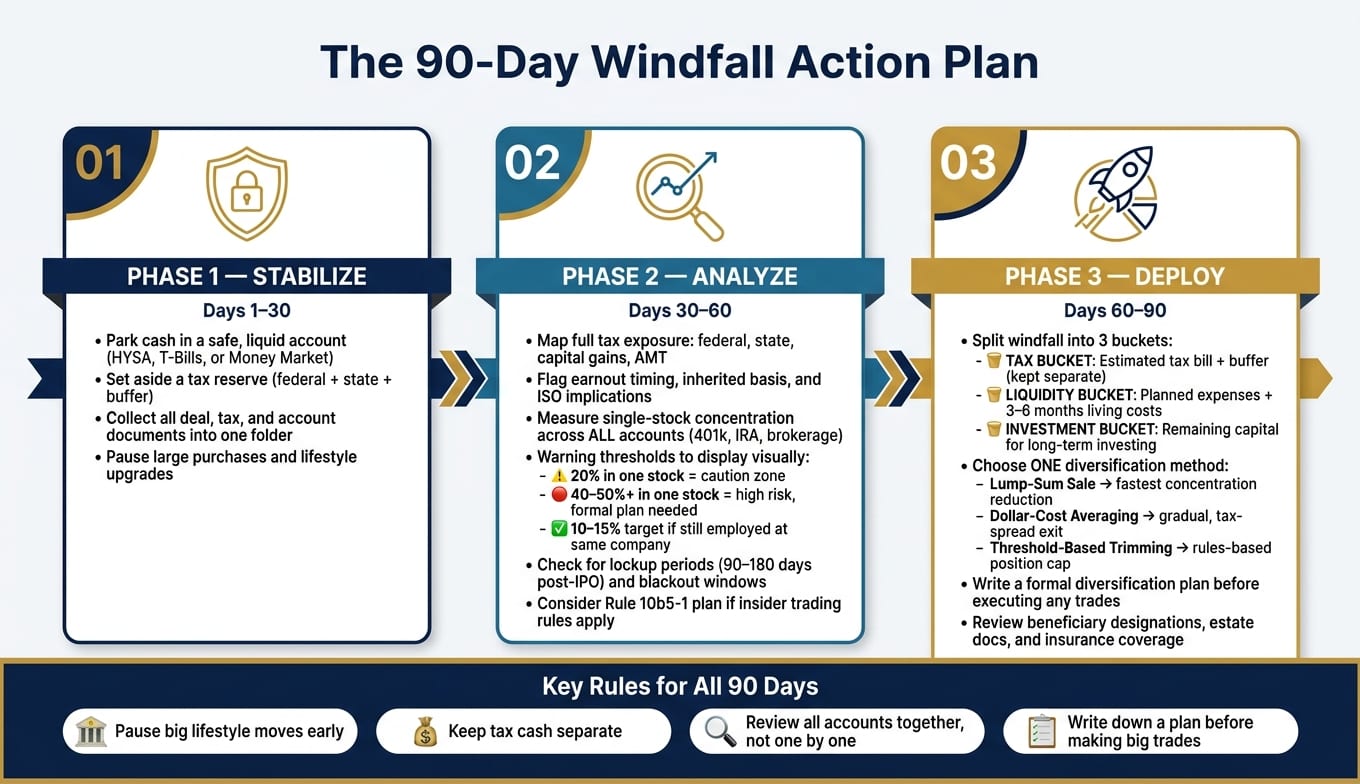
- In the first 30 days, some people may park cash in a safe, liquid account, set aside a tax reserve, and gather deal and tax documents.
- In days 30–60, they may map federal and state tax exposure, review items like AMT, inherited asset basis, or earnout timing, and measure single-stock exposure across all accounts.
- In days 60–90, they may split money into tax, liquidity, and investment buckets, then choose a rule for reducing concentration over time.
- After IPOs or acquisitions, one stock may make up 20%, 40%, or even more of net worth, and that may change the risk picture fast.
- If trading limits apply, some people may look at items such as lockups, blackout windows, or Rule 10b5-1 plans before selling.
A few themes run through the whole piece:
- Pause big lifestyle moves early
- Keep tax cash separate
- Check every account together, not one by one
- Write down a plan before making big trades
This article boils that process down into a simple sequence: stabilize cash, map taxes, measure concentration, then decide what to do next.
Days 1–30: Stabilize the Cash and Avoid Early Mistakes
Use the first 30 days to park the money, set aside cash for taxes, and avoid moves that may be hard to undo.
Where to park the money before you invest it
Move the cash into a safe, liquid account. Pick the safest liquid place that lines up with when you may need the money.
The main idea here is simple: choose based on timing, not return targets. If you may need the money soon, liquidity may matter more than chasing a slightly higher yield.
Set a tax reserve and track key deadlines
Before you spend or invest anything, move part of the money into a separate tax reserve. That reserve may need to cover expected federal, state, and investment taxes until a CPA confirms the final amount.
It also may help to track every form, filing date, and estimated-payment deadline tied to the event. A missed date may create extra cost, and those deadlines are easy to lose track of when a big cash event hits all at once.
Collect the documents you need before making any decisions
Pull the event records, tax forms, transaction statements, and recent account statements into one folder before making any allocation change. That may sound basic, but it may prevent a big move before you have a clear view of your assets, liabilities, and any vesting, lockup, or transfer limits.
That file set becomes the starting point for the account-wide review in days 30–60.
Once the cash is parked and the records are in one place, you may be in a better position to map tax exposure and concentration risk across every account.
Days 30–60: Organize Your Taxes, Concentration Risk, and Account Picture
With cash set aside and records in one place, this phase shifts from cleanup to analysis. Start with taxes. Then look at concentration risk.
Map your tax exposure before making large moves
A windfall may not come with one simple tax number attached to it. It may involve federal income tax, state and local income tax, capital gains, and sometimes Alternative Minimum Tax (AMT), especially if you exercised incentive stock options (ISOs) as part of an IPO or acquisition. Many people work with a CPA to build a one-page tax map that lays out taxable income by category, likely marginal rate, and payment deadlines.
Timing may matter more than people expect. A $1.5 million gain taxed as short-term income may cost far more than that same gain taxed at long-term rates. Because of that, some people use a phased approach instead of making one all-at-once move. That might mean selling part now and setting the rest for after the one-year mark.
If the windfall came from an M&A deal, earnouts, holdbacks, and milestone payments may affect when taxes apply, so those items need to be flagged. If the assets were inherited, it may make sense to confirm whether a step-up in basis applies and to review the 10-year distribution rules tied to many inherited IRAs under the SECURE Act.
Once that tax picture is on paper, the next step is seeing how much risk may still sit in one name.
Measure concentrated-stock risk across all accounts
A liquidity event may leave a big chunk of wealth tied to one stock, one sector, or one investing style. The first job is to measure that exposure honestly, not just in a brokerage account, but across your 401(k), IRA, and employer stock plans together.
Some investors treat single-stock exposure above 20% of net worth as a warning sign. Exposure above 40% to 50% may point to high risk and may call for a formal diversification plan. If someone is still tied to that same company for salary or bonus, a lower range of 10% to 15% of net worth in one stock is often cited as a more cautious target.
This is where hidden overlap tends to show up. A 401(k) index fund or a sector ETF inside an IRA may already hold a large position in the same company or sector you own directly. On paper, each account may look fine by itself. Put them together, and the picture may look very different.
If you are an insider and subject to lockup periods, often 90 to 180 days after an IPO, or blackout windows around earnings, your ability to sell may be limited no matter what the numbers show. In that case, a Rule 10b5-1 trading plan may become a practical tool. When adopted while you are not in possession of material nonpublic information, a 10b5-1 plan pre-schedules sales using a fixed formula, so trades may still go through during later blackout windows. Under the SEC's 2023 amendments, officers and directors must observe a cooling-off period of at least 90 days after plan adoption, or 2 business days after the next Form 10-Q or 10-K filing, whichever is later, up to 120 days, before the first trade under a new plan.
Some investors work toward cutting concentration to 10% to 20% of net worth over 12 to 24 months, timed around trading windows, vesting, and tax years.
Before making any move, it helps to confirm the full exposure across every account.
Use Mezzi to connect accounts and spot blind spots
Getting a full view of your finances after a windfall may be harder than it sounds. Accounts may sit at different firms. Retirement plans may use different custodians. Employer equity may live in a separate stock plan portal.
Mezzi connects brokerage, retirement, bank, and employer accounts through read-only access via Plaid and Finicity. Mezzi acts as an SEC-registered fiduciary. Because the access is read-only, you keep full control over when and where you trade. Mezzi surfaces the insights, and you decide what to do.
A few tools may help surface issues that are easy to miss:
- A unified dashboard
- X-Ray overlap analysis
- Wash-sale monitoring
The goal here may be a clear risk map, not a trade list. That diagnostic may then shape the 60–90 day transition plan.
Days 60–90: Build a Transition Plan Before Investing Long-Term
Once you have your tax map, cash reserve, and concentration picture, the next move may be to set rules before you invest.
Divide the windfall into tax, liquidity, and investment buckets
Split the windfall into three buckets: tax, liquidity, and investment.
The tax bucket comes first. Set aside your estimated federal and state tax bill, plus a buffer, and keep it separate from money you may invest.
The liquidity bucket covers near-term spending and your emergency reserve. A practical target may be enough cash for planned expenses plus 3 to 6 months of living costs in cash or short-term instruments. That may give you breathing room, so a market downturn does not force a sale of long-term investments at the wrong time.
Everything left over goes into the investment bucket - the capital available for high-net-worth investing strategies and long-term growth. Keep the buckets separate in your records and accounts.
That split may also shape what happens next: whether you sell now, stage sales over time, or hold some money back for liquidity.
Pick a diversification method you can follow through on
Use your concentration level and tax timing to choose one exit rule.
Pick one rule for reducing concentration before you act.
Set a maximum position size before you sell. If your position is above that level, a rules-based trimming plan may be easier to follow than trying to time the market on emotion.
Use Mezzi to test tax, retirement, and portfolio tradeoffs before acting
Use Mezzi to test those rules against your actual tax, cash, and portfolio data.
You may use Mezzi to test sell, hold, and rebalance scenarios across all connected accounts before moving money. You can ask situation-specific questions like, "If I sell part of my employer stock this year, how does that affect my tax picture and retirement plan?" or "How should I think about asset location across my taxable and tax-advantaged accounts?" Mezzi's AI may work through those tradeoffs using your connected account data rather than guesswork.
Mezzi's X-Ray tool may also flag hidden risks, including overexposure to a single stock or sector and idle cash sitting in accounts. And before you sell anything to rebalance or diversify, Mezzi may surface wash sale alerts across all connected accounts, so you may avoid creating a tax issue while trying to fix a concentration problem.
Conclusion: What to Do Now, What to Pause, and What to Review
Order matters here: cash, taxes, documents, concentration, then deployment. If you jump ahead, mistakes may get expensive and hard to unwind.
Treat the first 90 days as a stabilization window, not an investing window. After a windfall, impulsive spending and social pressure may turn into regret. A deliberate pause on lifestyle upgrades, large gifts, and long-term commitments may protect you from locking in decisions before you understand the full tax and risk picture.
This checklist separates what may make sense now from what may need to wait:
Use Mezzi to keep the plan, deadlines, and account picture in one place. By day 90, you may want a written plan, clear tax reserves, and a full account view.
FAQs
Who should build a tax reserve first?
Anyone with a liquidity event that creates substantial income or gains may want to set aside a tax reserve right away.
Why do this early? Because a reserve may give you cash for upcoming tax bills without forcing asset sales at a rough moment. It may also reduce the chance of quarterly estimated tax penalties, depending on your situation.
Some people use AI-powered tools or work with a tax professional to estimate what they may owe. From there, they set a reserve amount that fits their new financial picture.
How much company stock is too much?
A common benchmark some investors use is to keep company stock under 5% to 10% of a total portfolio. Going above that may add concentration risk, especially if income may also be tied to the same employer.
If private company equity makes up more than 50% of household net worth, that level may be viewed as highly concentrated and may warrant close monitoring.
When should I wait before making big money moves?
Pause on major financial moves until you have a clear plan for costs, risks, and tax implications. Moving too fast may lead to tax mistakes that might have been avoided, or leave you with more concentration risk than you intended.
In the first 90 days, it may make sense to avoid rushing into large investments or selling concentrated positions before modeling scenarios, checking deadlines like December 31, and seeing how each move may affect your overall portfolio.
Disclosures:
- This content is for informational purposes only and does not constitute investment advice or a recommendation to buy or sell any security.
- Past performance is not indicative of future results. No guarantee of future performance or outcomes is implied.
- Registration does not imply a certain level of skill or that the SEC has approved the company or its services.
- Savings and performance examples are hypothetical and for illustrative purposes only. Actual results will vary based on individual circumstances, portfolio composition, market conditions, and fees.
Related Blog Posts
- Managing a financial windfall: what to consider in the first 90 days
- Concentrated stock position: when and how to diversify
- How to manage wealth after a company acquisition or IPO exit
- Post-IPO Wealth Management: Lock-Up Periods, 10b5-1 Plans, Diversification
Anyone with a liquidity event that creates substantial income or gains may want to set aside a tax reserve right away.
Why do this early? Because a reserve may give you cash for upcoming tax bills without forcing asset sales at a rough moment. It may also reduce the chance of quarterly estimated tax penalties, depending on your situation.
Some people use AI-powered tools or work with a tax professional to estimate what they may owe. From there, they set a reserve amount that fits their new financial picture.
A common benchmark some investors use is to keep company stock under 5% to 10% of a total portfolio. Going above that may add concentration risk, especially if income may also be tied to the same employer.
If private company equity makes up more than 50% of household net worth, that level may be viewed as highly concentrated and may warrant close monitoring.
Pause on major financial moves until you have a clear plan for costs, risks, and tax implications. Moving too fast may lead to tax mistakes that might have been avoided, or leave you with more concentration risk than you intended.
In the first 90 days, it may make sense to avoid rushing into large investments or selling concentrated positions before modeling scenarios, checking deadlines like December 31, and seeing how each move may affect your overall portfolio.