The BoostMezzi’s Sunday email about one decision shaping your wealth.
Most of my portfolio is in a traditional IRA. I wish more were in a Roth.
In my 20s and 30s, I was too focused on the tax deduction. I didn’t think enough about what I’d owe when I took the money out.
The last Boost showed how a Roth conversion could help. But wanting more in a Roth doesn’t mean converting now is right.
This week: four checks before you make a move you can’t undo. Roth conversions cannot be recharacterized back to a traditional IRA.
You could pay a higher rate today
Moving untaxed money from a traditional IRA into a Roth IRA adds to the income you’re taxed on this year. The IRS taxes income in slices called brackets. Each slice has its own rate.
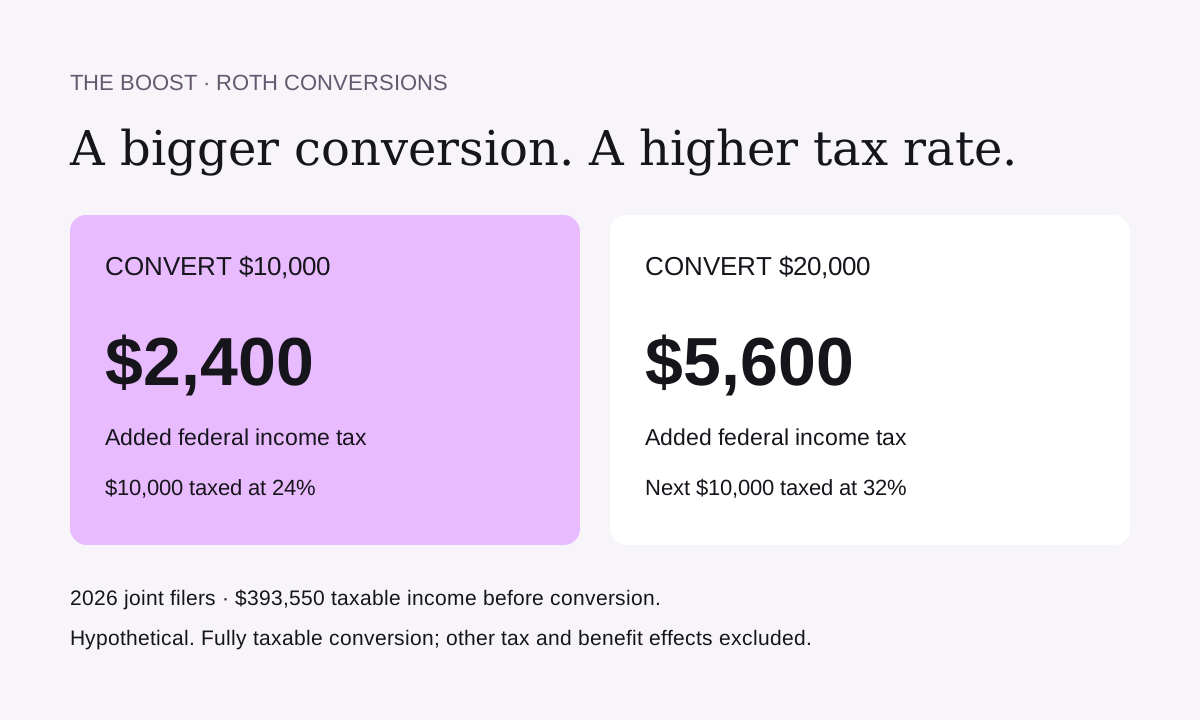
A couple filing jointly in 2026 has $393,550 of income after deductions, before any conversion. If they convert $20,000, the first $10,000 is taxed at 24% and the next $10,000 at 32%.
| Conversion | Added federal income tax in this example |
|---|---|
| No conversion | $0 |
| Convert $10,000 | $2,400 |
| Convert $20,000 | $5,600 |
This hypothetical example uses the 2026 federal tax brackets, assumes the conversion is fully taxable, and isolates the added federal income tax from those brackets. State taxes and effects on other taxes, deductions, credits and benefits are not included.
If you expect a lower-income year after you stop working, compare that year with this one. Paying 32% on those dollars today can be costly if you could pay a lower rate later. Planning a move? Compare what you’d owe in each state, too.
Your health coverage could cost more
A 2026 conversion can shrink the subsidy that helps pay for a Marketplace health plan this year. Marketplace savings depend on your household income for the coverage year.
If you’re on Medicare in 2028, it could raise your premiums then, because Medicare generally uses income from two years earlier. Extra income can also make more of your Social Security benefits taxable.
The tax bill can strain your cash
Pay the bill from savings and the full amount you planned to convert can go into the Roth. Selling investments to raise cash can create a second tax bill.
Use part of the IRA money to pay the tax and less reaches the Roth. That money can also face an extra 10% tax if you’re under 59½, unless an exception applies. See the IRS’s IRA distribution guidance.
Set aside the cash you need for your family first. Then compare a smaller conversion with waiting.
Check your accounts before converting
- Take required IRA withdrawals first. You can’t convert that money.
- Check what’s taxable. Track IRA contributions you couldn’t deduct so you don’t pay tax twice. The taxable share generally accounts for your traditional, SEP and SIMPLE IRAs together.
- Moving a 401(k) to an IRA? You could lose penalty-free access before age 59½. Some early-distribution exceptions for employer plans do not apply to IRAs.
- Need the Roth money soon? Check when you can withdraw without taxes or penalties. The rules for Roth earnings and the separate five-year clocks on conversions differ; see IRS Publication 590-B.
Want to convert this year? Start early so it’s completed by December 31.
See what a conversion could cost you
Ask Mezzi to compare converting a little, converting over several years, and waiting. Your connected accounts and financial profile give it the context to weigh the tax bill against your retirement plans and the cash you need to keep.
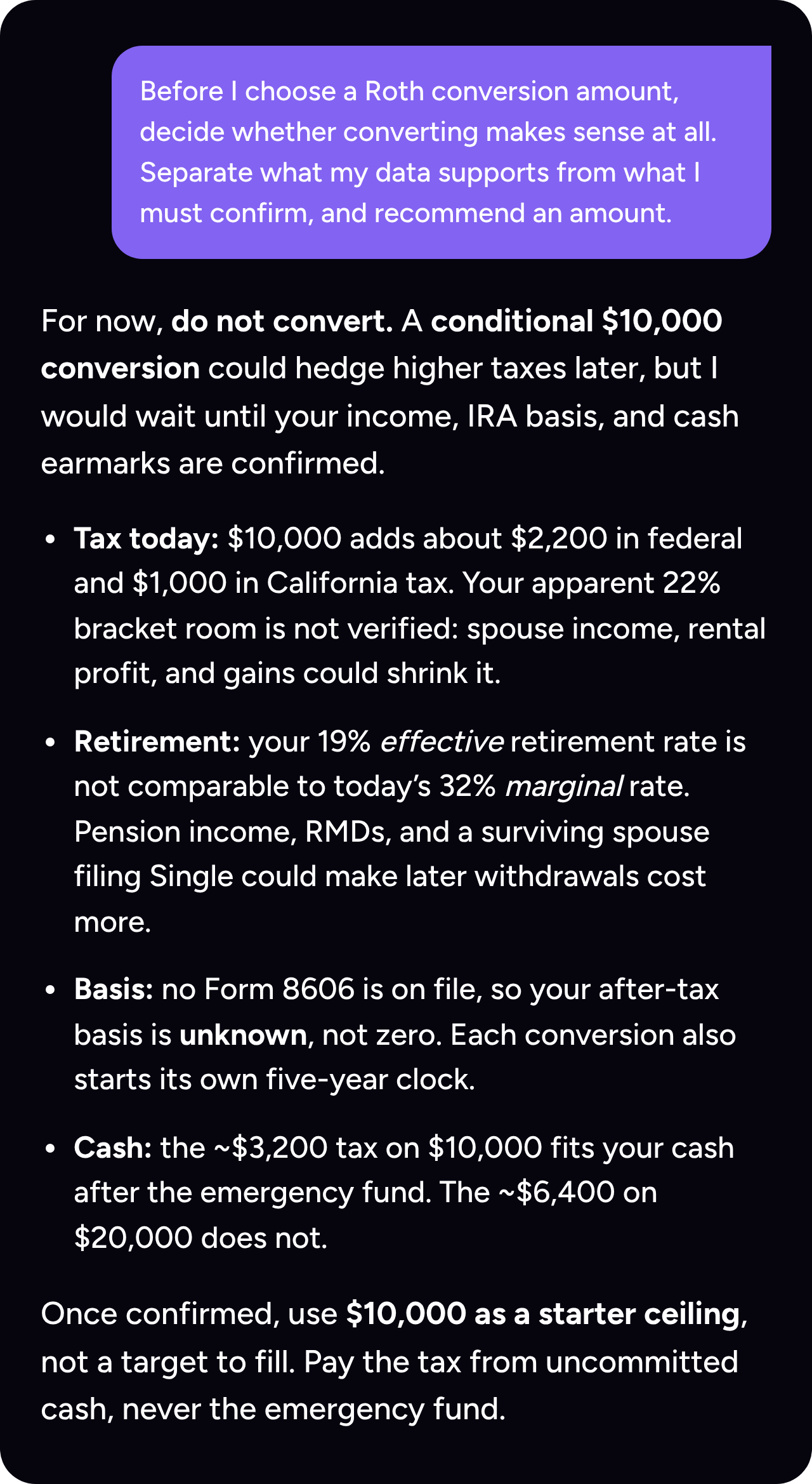
Here’s what Mezzi told me. It said not to convert yet, and showed exactly what it couldn’t verify.
Find out whether converting makes sense for you. Compare your options before choosing an amount.
Ask MezziSecurely upload your 2025 tax return and, if you’re working, a recent pay stub to the document vault on your Financial Profile page. Keeping relevant documents together helps Mezzi connect last year’s tax picture with this year’s income. Tell Mezzi about any bonus or other income the documents don’t capture.
Your year-end tax planning guide
- More to retire on. More to leave behind. — see how a lower tax rate and fewer required withdrawals can leave more for you and your family.
- Before you sell your biggest winner — compare giving cash with donating shares, and see when a charitable deduction could help.
- Don’t let the tax bill make the decision — check paycheck withholding, use investment losses, and weigh the tax cost of reducing a large holding.
- What your CPA may not be telling you — understand fund payouts, dividend taxes, tax brackets, and unused investment losses.
- Staying ahead of the costs you didn’t plan for — see how retirement withdrawals and Roth conversions can affect future Medicare premiums.